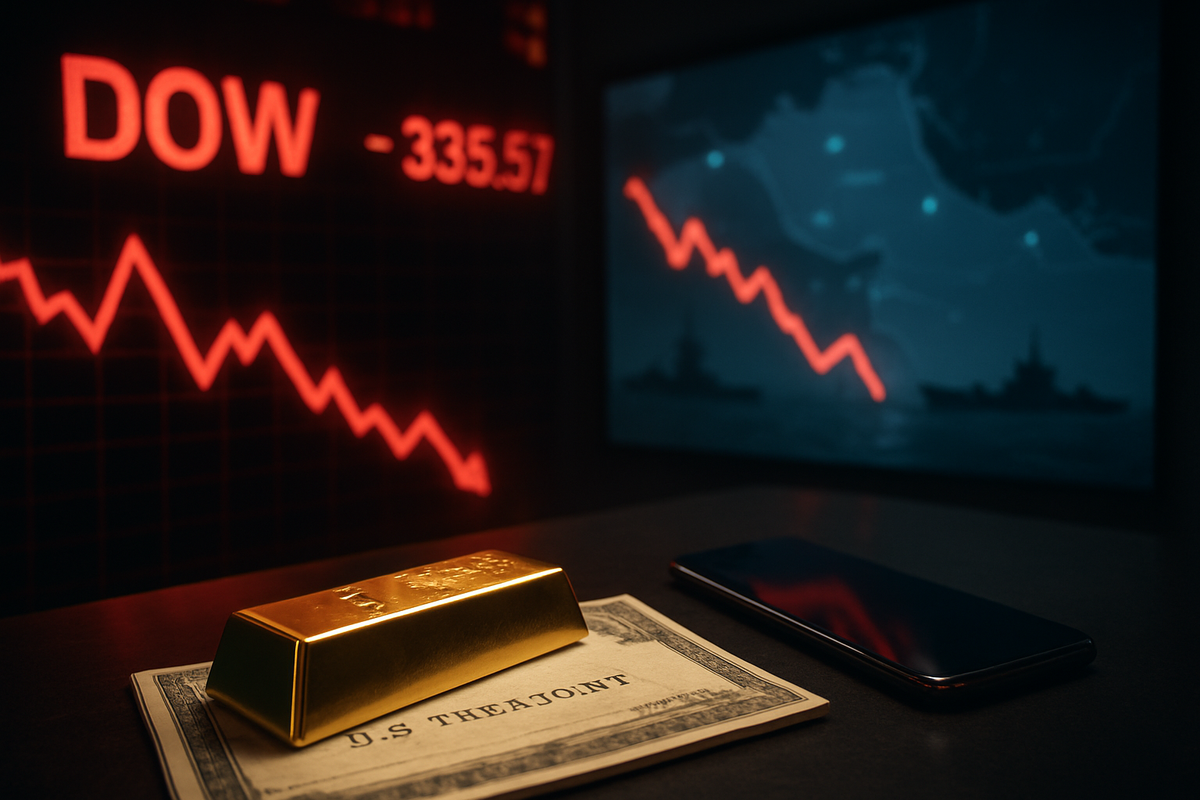
The global financial landscape fractured today, March 12, 2026, as the Dow Jones Industrial Average suffered a staggering 600-point collapse. The sell-off was ignited by the "Mojtaba Ultimatum," a defiant decree from Iran’s new leadership that officially rejected a G7-mediated ceasefire and declared the Strait of Hormuz—the world’s most vital oil artery—permanently mined. As news of the diplomatic collapse hit trading floors at 9:30 AM EST, the initial shock evolved into a broad-based liquidation, with investors grappling with the reality of a prolonged military conflict in the Persian Gulf.
The immediate implications are dire for the global economy. Brent crude oil prices, which had briefly stabilized on hopes of a diplomatic resolution, surged past $110 per barrel within hours of the announcement. This energy price spike has acted as a catalyst for panic selling across the consumer discretionary and transportation sectors, while simultaneously triggering a massive flight to safety. Investors are dumping equities in favor of traditional havens, pushing gold to record highs and causing significant volatility in the U.S. Treasury market as the specter of "war-induced inflation" looms over the Federal Reserve’s upcoming policy meeting.
A Dark Thursday: The Timeline of Escalation
The market carnage witnessed today is the culmination of a rapidly deteriorating security situation that began in late February 2026. Following "Operation Epic Fury"—a massive joint military offensive by U.S. and allied forces—Iran launched a retaliatory campaign dubbed "Operation Martyr Soleimani II." The conflict reached a fever pitch on March 2, when Tehran initiated a de facto blockade of the Strait of Hormuz, effectively trapping 20% of the world's daily oil supply. While diplomatic backchannels remained open for ten days, the hope for a peaceful exit evaporated this morning when Supreme Leader Mojtaba Khamenei issued his first public decree since assuming power.
The "Mojtaba Ultimatum" not only rejected the G7’s terms for a ceasefire but also escalated the rhetoric, labeling any commercial tanker attempting to transit the Gulf under U.S. naval escort as a "legitimate military target." The announcement was accompanied by intelligence reports suggesting that Iranian forces have deployed advanced sea mines throughout the shipping lanes. The immediate psychological impact on the U.S. investor base was profound; the realization that the U.S. is now embroiled in a "war of attrition" rather than a short-term skirmish has shattered the market's previous assumptions of a quick recovery.
By mid-day, the panic was visible on every ticker. The Dow Jones Industrial Average dropped 614 points by 2:00 PM EST, wiping out months of gains. The volatility was not confined to blue-chip stocks; the CBOE Volatility Index (VIX) spiked to its highest level since the early days of the 2020 pandemic, reflecting a deep-seated fear that the global supply chain, already fragile from years of post-pandemic restructuring, may be facing its greatest challenge yet.
Winners and Losers: A Divided Market
The market reaction has been sharply polarized, with specific sectors bearing the brunt of the geopolitical fallout while others find opportunity in the chaos. The travel and retail sectors have emerged as the primary losers in today's session. Major carriers like United Airlines (NASDAQ: UAL) and Delta Air Lines (NYSE: DAL) saw their stock prices plunge by more than 7% as the prospect of jet fuel costs doubling overnight became a reality. The closure of Middle Eastern airspace has further compounded their woes, forcing long-haul rerouting that increases operational costs and reduces efficiency.
In the retail space, giants such as Walmart (NYSE: WMT) and Target (NYSE: TGT) faced heavy selling pressure. High energy prices historically act as a "stealth tax" on consumers, and investors are already pricing in a significant drop in discretionary spending for the second quarter. As gasoline prices at the pump are projected to hit record highs by the weekend, the concern is that American households will prioritize essential heating and transport costs over the electronics and apparel that drive retail margins. Even Amazon (NASDAQ: AMZN) saw its shares retreat as rising logistics and shipping costs threatened to eat into its thin retail margins.
Conversely, the defense and energy sectors have seen a paradoxical boost. Defense contractors like Lockheed Martin (NYSE: LMT) and Northrop Grumman (NYSE: NOC) saw modest gains as the market anticipated a surge in government spending for military hardware and replenishment of munitions. Energy titans such as ExxonMobil (NYSE: XOM) and Chevron (NYSE: CVX) initially rose alongside crude prices, though their gains were capped by fears that a global recession could eventually destroy oil demand. Meanwhile, the flight to safety was most evident in SPDR Gold Shares (NYSEArca: GLD), which surged as gold prices hit a historic $5,417 per ounce, and the iShares 20+ Year Treasury Bond ETF (NASDAQ: TLT), which saw high volume as institutional investors sought the relative security of U.S. government debt, despite rising yields.
Broader Significance and Historical Precedents
Today’s 600-point drop is more than just a bad day on Wall Street; it represents a fundamental shift in the global risk assessment. The mining of the Strait of Hormuz draws uncomfortable parallels to the 1973 and 1979 oil shocks, where geopolitical instability in the Middle East led to years of stagflation in the West. Analysts are noting that this event fits into a broader trend of "de-globalization" and the fragmentation of the international order. Unlike the 2019 Abqaiq–Khurais attack, which the markets largely dismissed as a temporary supply shock, the 2026 escalation is being viewed as a systemic threat to the post-war maritime security architecture.
The ripple effects are expected to be felt far beyond the Persian Gulf. Competitors and partners in the Indo-Pacific and Europe are now bracing for an energy crisis that could force a rapid and potentially chaotic acceleration of energy transition policies. Furthermore, the Federal Reserve is now trapped in a policy nightmare. Traditionally, a market crash of this magnitude would warrant a "dovish" pivot or interest rate cuts; however, with oil-induced inflation expected to surge, the Fed may be forced to keep rates high to prevent a wage-price spiral, even as the economy slides toward a "war-time recession."
Regulatory implications are also looming. The U.S. government is expected to consider emergency measures, including further releases from the Strategic Petroleum Reserve (SPR) or even temporary export bans to prioritize domestic supply. Such moves would have massive implications for international trade agreements and the long-term profitability of U.S.-based multinational energy firms.
The Road Ahead: Strategic Pivots and Scenarios
In the short term, market participants should prepare for extreme volatility. The immediate question is whether the U.S. Navy will attempt a "clearing operation" of the Strait, which could lead to direct naval engagements and further escalations. A successful clearing could lead to a relief rally, but any prolonged failure to reopen the shipping lanes would likely trigger a bear market. Companies in the travel and retail sectors will need to initiate rapid strategic pivots, focusing on cost-containment and potentially passing higher costs onto consumers through "fuel surcharges" or price hikes.
Long-term, this crisis may serve as a permanent inflection point for the global economy. We could see a massive capital flight toward renewable energy infrastructure and nuclear power as nations prioritize "energy sovereignty" over cheap but unstable fossil fuel imports. For the U.S. investor base, the "peace dividend" that characterized much of the last few decades appears to be officially over. Market opportunities may emerge in the cybersecurity and domestic manufacturing sectors as "friend-shoring" becomes not just a buzzword, but a national security requirement.
Conclusion and Investor Outlook
The events of March 12, 2026, mark a watershed moment for the Dow Jones and the global economy. The 600-point drop is a visceral reaction to the collapse of diplomacy and the start of what could be a long and costly military confrontation with Iran. The key takeaway for investors is that the era of low-volatility energy costs is over, and the "geopolitical risk premium" is back with a vengeance.
Moving forward, the market will be hyper-sensitive to any military developments in the Gulf and any shifts in Federal Reserve rhetoric. While the immediate outlook is grim, history shows that markets eventually adapt to new realities. However, the path to stability will likely be paved with further volatility. Investors should watch for the impact of $110+ oil on upcoming quarterly earnings reports and keep a close eye on the performance of safe-haven assets. The resilience of the American consumer is about to be tested as never before in this new era of global instability.
This content is intended for informational purposes only and is not financial advice