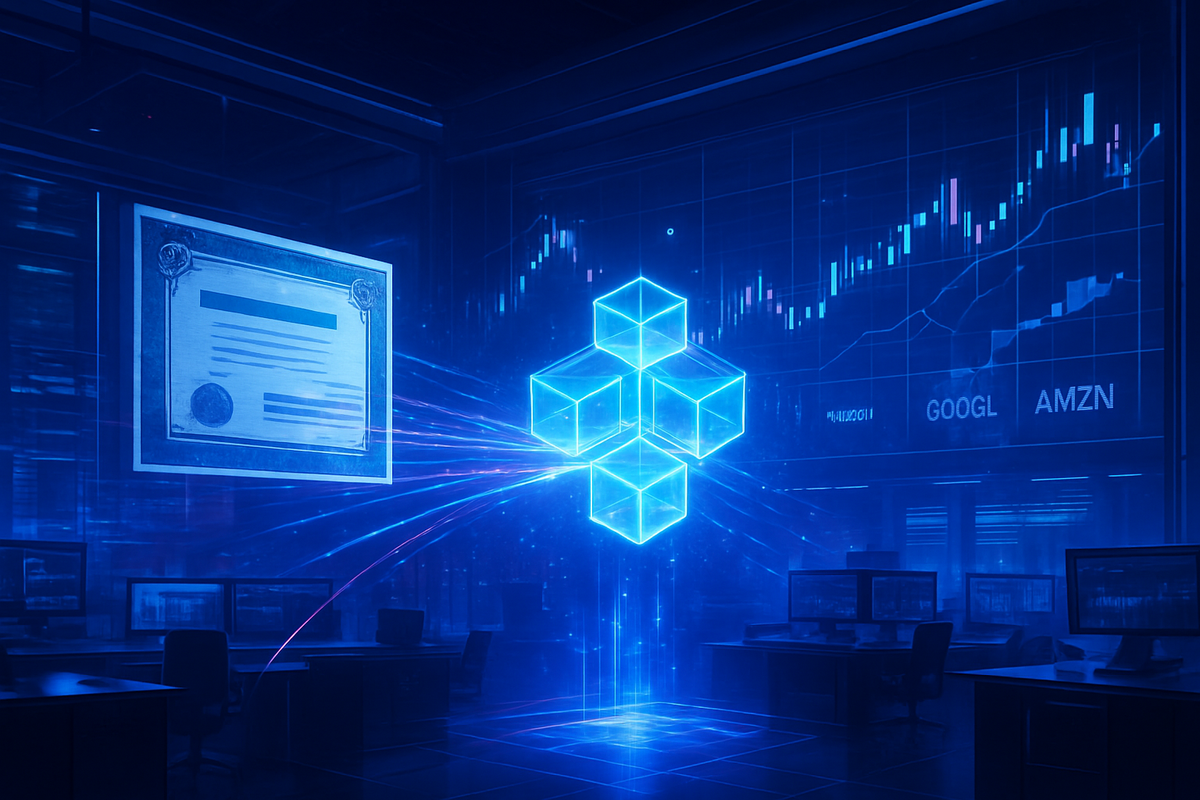
In a move that signals the most significant shift in market structure since the transition from floor trading to electronic matching, Nasdaq (Nasdaq: NDAQ) and Payward, the parent company of the cryptocurrency exchange Kraken, announced a sweeping partnership on March 9, 2026. The collaboration aims to launch the "Equities Transformation Gateway," a sophisticated infrastructure designed to enable the 24/7 trading and atomic settlement of tokenized blue-chip stocks. By merging the institutional rigor of a legacy exchange with the agility of decentralized finance (DeFi), the duo intends to bring the world’s most liquid equities into a blockchain-native ecosystem.
The immediate implications of this deal are profound. For the first time, institutional investors will have a regulated, seamless pipeline to trade tokenized versions of companies like Nvidia (Nasdaq: NVDA) and Tesla (Nasdaq: TSLA) with near-instant settlement. This removes the friction of the traditional T+1 settlement cycle and opens the door for programmable corporate actions, where dividends and voting rights are managed directly through smart contracts.
The Architecture of the Equities Transformation Gateway
The partnership is built upon the "xStocks" framework, a proprietary technology Kraken launched in mid-2025 that has already facilitated over $25 billion in private-label tokenized volume. Under the new agreement, Nasdaq will integrate xStocks into its core matching engine, creating a hybrid environment where traditional shares can be "wrapped" into digital tokens and traded on a regulated secondary market. This gateway isn't just a separate sandbox; it is designed to synchronize directly with an issuer’s official share registry. This ensures that a digital token held in a blockchain wallet carries the same legal weight as a share held in a traditional brokerage account.
The timeline leading to this announcement began in late 2025, following Nasdaq’s strategic acquisition of several distributed ledger technology (DLT) patents and a pilot program with Boerse Stuttgart in Europe. The momentum accelerated in December 2025 when Kraken’s parent company, Payward, acquired Backed Finance to bolster its real-world asset (RWA) tokenization capabilities. Market observers note that the collaboration solves the "liquidity silo" problem that has plagued previous tokenization attempts, as Nasdaq provides the massive existing pool of institutional liquidity while Kraken provides the on-chain connectivity.
Initial industry reactions have been overwhelmingly positive, though cautious. Major market makers have praised the shift toward atomic settlement, which reduces counterparty risk and frees up billions in collateral currently tied up in the settlement process. However, some traditional custodians have expressed concerns regarding the shift in their role as the primary "source of truth" for asset ownership moves toward the blockchain.
Winners, Losers, and the Shifting Exchange Landscape
The clear winners in this new paradigm are high-frequency trading firms and liquidity providers who stand to benefit from 24/7 market activity and the capital efficiency of T+0 settlement. By eliminating the waiting period for funds to clear, these firms can recycle capital much faster, potentially increasing market depth. Public companies themselves also gain a new level of direct engagement with their shareholders; with programmable equities, a company could theoretically distribute a dividend and have it arrive in thousands of global wallets in seconds, rather than days.
Conversely, traditional clearinghouses and legacy settlement intermediaries face an existential threat. If the Equities Transformation Gateway successfully demonstrates that blockchain can handle high-volume equity settlement without the need for centralized clearing intermediaries, the fee-based models of these legacy institutions will be under intense pressure. Furthermore, smaller regional exchanges that lack the capital to invest in similar DLT infrastructure may find themselves marginalized as volume migrates to "New Finance" hubs that offer more flexible, digital-native trading hours.
Retail brokerages are also in a precarious position. While they may benefit from offering tokenized assets to their clients, the rise of self-custody options enabled by Kraken’s infrastructure could lead more sophisticated retail traders to move their assets off-platform. This would force traditional brokers to radically innovate their value proposition beyond simple trade execution to stay relevant in an era of direct asset ownership.
The Regulatory Thaw and the Rise of "New Finance"
The Nasdaq-Kraken partnership did not emerge in a vacuum; it is the direct result of a tectonic shift in the U.S. regulatory landscape. The passage of the GENIUS Act in July 2025 provided a federal framework for payment stablecoins, which now serve as the "cash leg" for on-chain equity settlement. This was followed by the Digital Asset Market Clarity Act of 2026, which provided a "safe harbor" for exchanges to experiment with tokenized securities.
This event fits into the broader trend of "Real-World Asset" (RWA) tokenization, which has grown from a niche DeFi experiment into a multi-trillion-dollar industry. Historically, the gap between traditional finance and crypto was defined by mutual distrust. However, the 2026 SEC Staff Statement on Tokenized Securities effectively bridged this gap by clarifying that the technology used to record ownership is secondary to the legal rights conferred to the investor. This has created a "technology-neutral" regulatory environment that favors incumbents like Nasdaq who are willing to cannibalize their legacy systems to capture the future.
Comparisons are already being drawn to the "Big Bang" of 1986 in London, which deregulated the markets and paved the way for modern electronic trading. The Nasdaq-Kraken alliance is being viewed as the "Digital Big Bang," marking the moment when the distinction between "crypto" and "finance" finally began to disappear.
The Road to 2027 and Full Atomic Settlement
Looking ahead, the partnership outlines a roadmap that leads to full operational status by the first half of 2027. In the short term, the market can expect a series of "pilot tokens" featuring top-tier tech stocks to test the stability of the Equities Transformation Gateway. The primary challenge will be ensuring that the blockchain infrastructure can handle the massive message traffic generated by Nasdaq’s high-frequency trading environment without compromising on decentralization or security.
Strategic pivots are likely as other major players react. We may see rival exchanges like the NYSE announce similar partnerships with crypto-native firms or accelerate their own internal blockchain projects. There is also the potential for "cross-chain" equity trading, where a share tokenized on the Solana network could be seamlessly traded against a share on Ethereum via Nasdaq’s liquidity bridge. This would represent a level of market interoperability that was previously unthinkable.
In the long run, the success of this initiative could lead to the complete phase-out of traditional paper-based or legacy digital share registries. As more assets—from real estate to private credit—are brought onto the same infrastructure, we may see the emergence of a unified global liquidity pool where any asset can be traded against any other asset instantly.
A Watershed Moment for Global Capital Markets
The partnership between Nasdaq and Kraken is more than just a joint venture; it is a declaration that the future of capital markets is on-chain. By combining the trust and regulatory pedigree of Nasdaq with the technical innovation of Kraken, the two entities have set a new standard for what a modern financial exchange looks like. The move addresses the long-standing inefficiencies of the T+1 settlement cycle and promises a more democratic, accessible, and efficient market for investors worldwide.
As we move forward into 2026 and 2027, the market will transition from the "discovery phase" of tokenization to the "integration phase." Investors should keep a close eye on the adoption rates of the Equities Transformation Gateway and the launch of the first tokenized S&P 500 components. The performance of these digital assets during periods of high market volatility will be the ultimate test of the new infrastructure.
For the savvy investor, this represents a shift toward a world of 24/7 liquidity and programmable wealth. The "New Finance" landscape is no longer a distant vision—it is being built today, one block at a time, by the very institutions that once defined the old guard.
This content is intended for informational purposes only and is not financial advice.