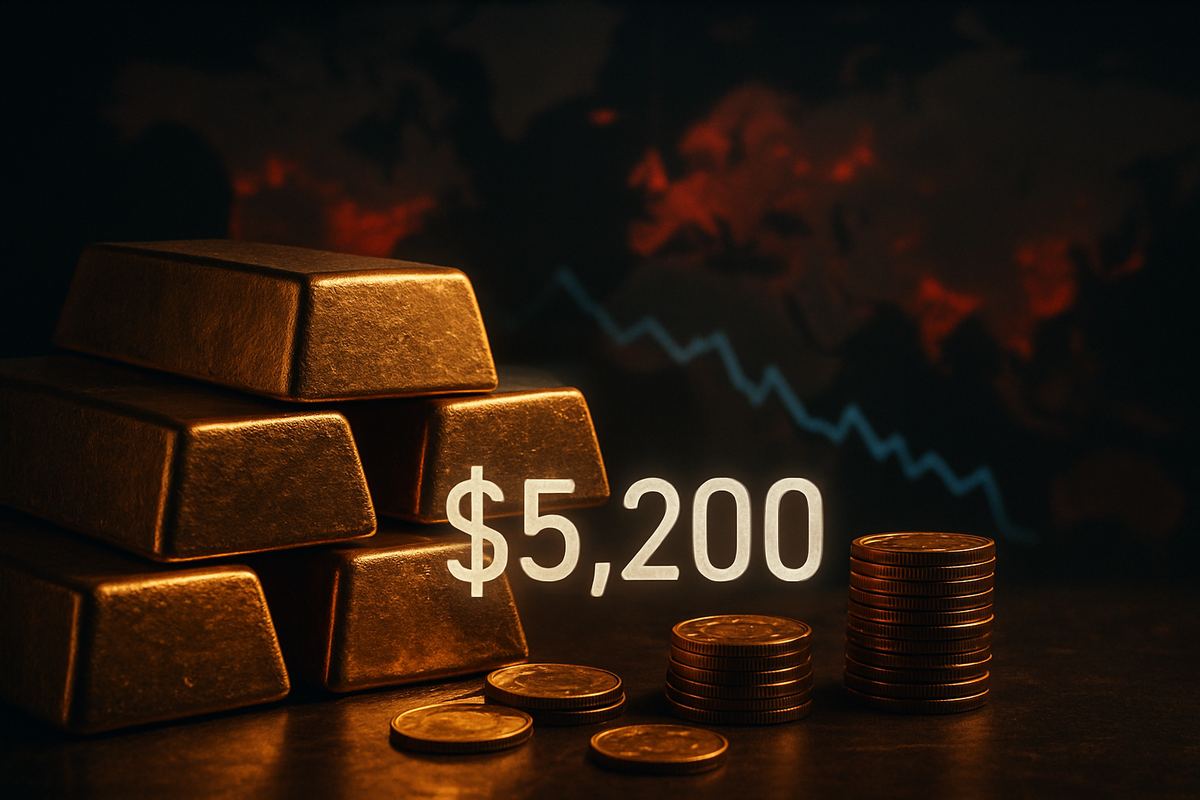
As of March 10, 2026, the global financial landscape is undergoing a seismic shift as gold prices shatter historical records, firmly establishing what analysts are calling the "2026 Gold Supercycle." Spot gold has climbed to an unprecedented nearly $5,200 per ounce, driven by a potent cocktail of geopolitical escalation in the Middle East and a breakdown in traditional global trade relations. This "safe-haven" bid has seen investors flee volatile risk assets in favor of the yellow metal’s millennia-old stability.
The immediate implications are profound: central banks are accelerating their diversification away from the U.S. dollar at the fastest pace in forty years, while institutional portfolios are being aggressively reweighted. With gold now acting as the primary anchor for global wealth, the traditional "60/40" portfolio is being reimagined, placing bullion at the forefront of capital preservation strategies in an era defined by "Permacrisis."
A Perfect Storm of Conflict and Protectionism
The ascent to $5,200 per ounce was not a gradual climb but a vertical breakout triggered by a series of high-stakes geopolitical events. The spark was ignited on February 28, 2026, following coordinated military strikes in the Middle East that threatened the stability of the Strait of Hormuz, sending Brent crude oil prices toward the $100 mark. As energy costs spiked, inflation fears—once thought to be a relic of the early 2020s—returned with a vengeance, forcing investors to seek shelter in hard assets.
Simultaneously, the global trade environment has descended into what economists are calling "The Great Tariff War of 2026." Following a series of legislative pivots, the U.S. administration invoked Section 122 of the Trade Act to impose a 15% blanket global tariff, effectively dismantling decades of globalization in a matter of weeks. This move sparked immediate retaliatory measures from the Eurozone and China, creating a fragmented "trade chaos" that has devalued fiat currencies and left gold as the only universally accepted medium of exchange.
Central banks have been the silent architects of this supercycle. Led by the People’s Bank of China and the Reserve Bank of India, monetary authorities have reported their 15th consecutive month of net gold purchases. Unlike the retail-driven rallies of the past, this surge is backed by institutional "deep pockets" who view gold not just as a hedge, but as a necessary structural component of a new, multi-polar financial system.
The Corporate Winners and the Crypto Retreat
The primary beneficiaries of this price surge are the major mining houses, which are now operating with "super-margins" last seen during the post-2008 recovery. Newmont Corporation (NYSE: NEM) has emerged as a titan in this environment, reporting a massive Q4 2025 revenue beat of $6.81 billion. Despite a projected "production trough" in 2026, the company’s massive scale and low price-to-earnings ratio have made it a favorite for value-seeking institutional investors. Similarly, Barrick Gold Corp (NYSE: GOLD) is seeing record free cash flow, recently reporting $3.9 billion for the prior fiscal year, even as it navigates complex joint venture negotiations in Nevada.
Beyond the miners, royalty and streaming companies like Franco-Nevada Corp (NYSE: FNV) are reaping the rewards of higher prices without the direct burden of escalating energy and labor costs. These "top-line" players are seeing their valuations swell as they capture the upside of $5,200 gold with a fixed-cost base. Conversely, the "Digital Gold" narrative has suffered a catastrophic blow. The Bloomberg Galaxy Crypto Index (BGCI) is down a staggering 24% year-to-date, as the volatility of digital assets proves unpalatable during times of kinetic warfare and trade blockades.
For the losers, the impact is felt most acutely in the consumer tech and automotive sectors, where rising input costs for gold—critical in high-end electronics and semiconductors—are squeezing margins. Companies like Apple Inc. (NASDAQ: AAPL) and Tesla (NASDAQ: TSLA) are facing the dual threat of trade tariffs on parts and the soaring cost of the precious metals required for their circuitry. For these giants, the gold supercycle represents a significant "inflationary tax" on production that may soon be passed on to the consumer.
Significance in a Multi-Polar World
This event fits into a broader industry trend of "de-dollarization" that has been simmering for nearly a decade. The 2026 supercycle represents the climax of this trend, where the U.S. dollar's role as the world's sole reserve currency is being actively challenged by a commodity-backed alternative. The ripple effects are reaching beyond the gold market, influencing the pricing of silver, platinum, and even copper, as the entire "hard asset" class re-rates in sympathy with gold’s move.
Historically, the only precedent for such a move was the 1970s stagflationary era. However, the 2026 environment is more complex due to the interconnectedness of modern supply chains. While the 1970s saw gold rise in response to domestic policy failures, the current rally is a reaction to a total breakdown in international cooperation. Regulatory implications are already emerging, with several G20 nations discussing "windfall taxes" on mining profits to fund social programs amidst the trade-induced economic slowdown.
Furthermore, the decoupling of gold from the cryptocurrency market marks a definitive end to the "Store of Value" debate for digital assets. During this crisis, the lack of physical tangibility and the dependence on a stable internet/energy infrastructure have sidelined Bitcoin in favor of bullion. This shift is likely to lead to stricter regulatory oversight of crypto-assets as they lose their status as "safe" alternatives and are re-classified as purely speculative "high-beta" risk assets.
The Road to $6,300 and Beyond
Looking forward, the short-term trajectory for gold appears biased to the upside. J.P. Morgan (NYSE: JPM) has recently revised its year-end price target to a staggering $6,300 per ounce. This forecast assumes that the Middle East conflict remains contained but unresolved and that trade tariffs remain a permanent fixture of the 2026-2027 fiscal years. If private investors continue to increase their gold allocations from the current average of 3% toward a more defensive 5%, some analysts suggest a "blow-off top" toward $8,000 is within the realm of possibility.
Market participants should prepare for a period of extreme volatility in the broader equities market as companies adapt to these new "hard money" realities. We may see a strategic pivot toward "resource nationalism," where nations restrict the export of gold and other strategic minerals to protect their own currency reserves. This would create a scarcity squeeze that could propel prices even higher, even if the underlying geopolitical tensions begin to cool.
The primary challenge emerging from this supercycle will be the "affordability crisis" for industrial users of gold. As the metal becomes too expensive for use in consumer goods, we expect to see a surge in R&D spending focused on finding synthetic alternatives for gold in industrial applications. For investors, the opportunity lies in the junior mining sector, which has lagged behind the majors but is now becoming ripe for acquisition as Newmont and Barrick look to replenish their reserves at any cost.
A New Era for Global Finance
The 2026 Gold Supercycle is more than just a price rally; it is a fundamental revaluation of what constitutes "safety" in the modern age. With gold holding steady near $5,200 and J.P. Morgan signaling even higher heights, the message to the market is clear: the era of "easy money" and frictionless trade is over. The metal of kings has returned to its throne, providing an anchor in a world adrift in geopolitical and economic uncertainty.
Moving forward, the market will likely see a continued divergence between "analog" safety (gold, land, commodities) and "digital" speculation. Investors should watch for the upcoming quarterly earnings of major miners to see how they manage the windfall profits and whether they begin a new cycle of aggressive M&A. The lasting impact of this supercycle will be a more fragmented, commodity-centric global economy where "hard assets" are once again the ultimate arbiter of value.
As we move toward the second half of 2026, the key watchwords will be "central bank reserves" and "tariff escalation." If the PBoC continues its buying spree and trade barriers remain high, the $6,300 target may not be the ceiling, but merely a stepping stone in a much longer ascent for the world's oldest currency.
This content is intended for informational purposes only and is not financial advice.