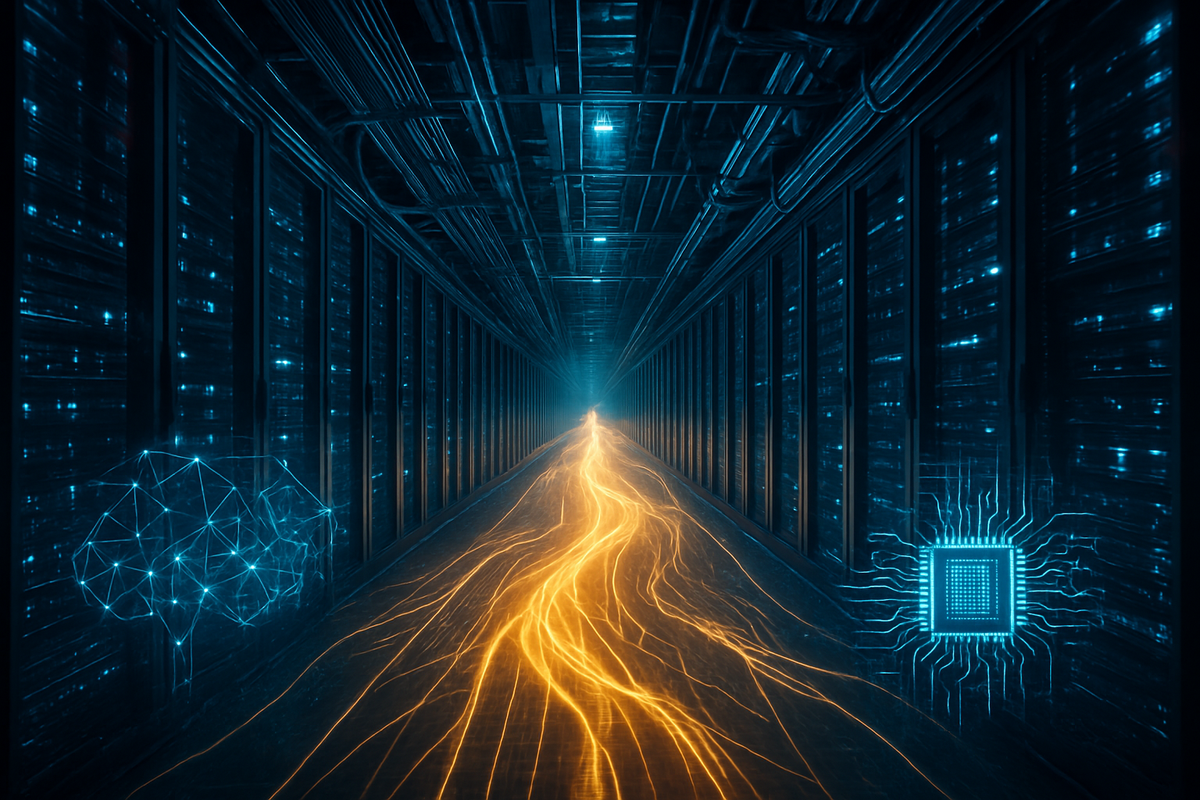
The global technology landscape is undergoing a tectonic shift as the world’s largest "hyperscalers" abandon their traditional reliance on cash reserves to embrace a historic wave of debt financing. As of late January 2026, industry giants like Amazon.com Inc. (NASDAQ: AMZN) and Alphabet Inc. (NASDAQ: GOOGL) are leading a capital expenditure (CAPEX) blitz that has reached unprecedented proportions, signaling that the "AI arms race" has moved from experimental software to a massive, physical infrastructure build-out.
This pivot toward debt represents a fundamental change in the fiscal strategies of Big Tech. For over a decade, these companies were the darlings of the "capital-lite" movement, generating enough cash to fund operations and buybacks simultaneously. However, the sheer scale of the artificial intelligence revolution—requiring massive data centers, custom silicon, and nuclear-grade power solutions—has forced even the wealthiest balance sheets to tap the credit markets. Projections for 2026 suggest that the combined CAPEX of the five largest hyperscalers will soar to a staggering $602 billion, with nearly three-quarters of that sum dedicated exclusively to AI infrastructure.
The Infrastructure Gold Rush: A Timeline of the Debt Wave
The current surge in financing began in earnest during the final quarter of 2025. In November, Amazon.com Inc. (NASDAQ: AMZN) returned to the USD bond market for the first time in three years, raising $15 billion in a deal that saw nearly $80 billion in investor demand. This was followed closely by Alphabet Inc. (NASDAQ: GOOGL), which issued $25 billion in bonds, including a significant Euro-denominated tranche, to bolster its technical infrastructure and the development of its latest TPU v7 "Ironwood" chips. Not to be outdone, Meta Platforms Inc. (NASDAQ: META) complemented a $30 billion bond sale with a unique $29 billion private credit facility, partnering with financial titans like KKR and Brookfield to keep debt off its primary balance sheet while scaling its global data center footprint.
This aggressive borrowing is driven by a timeline of necessity. Throughout 2025, it became clear that the demand for "agentic AI"—autonomous systems capable of performing complex tasks—was outpacing the available compute capacity. By January 2026, Microsoft Corp. (NASDAQ: MSFT) reported a record quarterly CAPEX of $37.5 billion, a figure that would have been unimaginable just two years prior. The market reaction has been a mix of awe and anxiety. While high demand for these bonds indicates strong institutional confidence, investors have begun to scrutinize the rising interest expenses and the massive depreciation hits that will inevitably follow this spending spree.
Winners and Losers in the CAPEX Supercycle
The primary beneficiaries of this $600 billion spending wave are the "arms dealers" of the AI era. NVIDIA Corp. (NASDAQ: NVDA) remains the undisputed leader, with its Blackwell and upcoming 2026 Rubin architectures serving as the cornerstone for almost every major data center project. Similarly, Taiwan Semiconductor Manufacturing Company (NYSE: TSM) and Broadcom Inc. (NASDAQ: AVGO) have seen their order books swell as hyperscalers move toward custom silicon to lower long-term operating costs. Infrastructure players like Corning Inc. (NYSE: GLW), which recently secured a $6 billion deal with Meta for AI-scale fiber optics, and Vertiv Holdings Co. (NYSE: VRT), a specialist in the liquid cooling systems required for high-density AI racks, are also riding the wave of record demand.
On the other side of the ledger, the losers are becoming increasingly visible. Intel Corp. (NASDAQ: INTC) continues to struggle, as it finds itself squeezed between the dominance of NVIDIA and the hyperscalers' own internal chip designs, despite a modest $5 billion custom chip agreement. Furthermore, legacy "air-cooled" data center operators are facing obsolescence; as rack densities exceed 100kW, older facilities are being sidelined in favor of "AI-ready" designs. Perhaps the most surprising "loser" has been the Metaverse. Meta Platforms Inc. (NASDAQ: META) reportedly slashed its Reality Labs budget by 30% in early 2026, effectively cannibalizing its VR dreams to feed the insatiable hunger of its generative AI projects.
A New Era of Corporate Finance and Regulatory Friction
The wider significance of this event cannot be overstated. We are witnessing a transition from the software-dominated era of the 2010s to a "hard asset" era reminiscent of the late 19th-century railroad boom or the early 2000s fiber optic build-out. However, unlike the dot-com bubble, this spending is backed by companies with massive existing revenues and a clear—if expensive—technological roadmap. The ripple effects are extending into the energy sector, where Constellation Energy Corp. (NASDAQ: CEG) and GE Vernova Inc. (NYSE: GEV) are signing 20-year power purchase agreements with tech firms to provide the carbon-free, constant energy required by AI clusters.
However, this transition is meeting significant regulatory and physical headwinds. In early 2026, regulators in both the U.S. and Europe began implementing strict Water Usage Effectiveness (WUE) metrics, effectively halting several data center projects in drought-prone regions. The "AI debt fatigue" is also a growing concern for credit rating agencies. Moody’s and S&P Global have issued warnings that if enterprise ROI on AI does not materialize by the end of 2026, the rapid accumulation of debt could lead to credit downgrades for some of the tech sector's formerly "bulletproof" names.
The Road Ahead: Scenarios for 2026 and 2027
In the short term, the market is bracing for "margin compression." As these massive infrastructure projects come online, the depreciation of hardware—which typically lasts only 3 to 5 years in the fast-moving AI space—will weigh heavily on net income. The strategic pivot for most hyperscalers over the next 12 months will be shifting from "capacity building" to "utility monetization." If the enterprise world adopts agentic AI at the expected rate, the productivity gains could justify the $600 billion price tag.
Longer-term possibilities include a potential consolidation of the AI sector. Companies like Oracle Corp. (NYSE: ORCL), which has aggressively sought $18 billion in debt to fund its compute deals with OpenAI, are betting their entire corporate future on this infrastructure. If the "AI bubble" were to burst, the debt burdens could lead to a wave of distressed asset sales, where the physical data centers and energy rights become more valuable than the software companies that built them.
Final Assessment: The Stakes of the AI Supercycle
The move by Amazon, Google, and Meta to seek massive debt financing marks the end of the "experimentation" phase of artificial intelligence and the beginning of its "industrialization." This is a high-stakes gamble that assumes AI will become the foundational utility of the 21st century. The key takeaway for investors is that while the revenue potential of AI is vast, the cost of entry has become so high that only a handful of global entities can afford to play the game.
Moving forward, the market will be characterized by extreme volatility tied to quarterly CAPEX reports. Investors should watch for three critical indicators in the coming months: the specific ROI metrics reported by enterprise AI customers, the stability of interest rates as these tech giants roll over their massive short-term debt, and the progress of energy-permitting reform. The AI revolution is no longer just about code; it is about steel, silicon, and billions of dollars in borrowed capital.
This content is intended for informational purposes only and is not financial advice