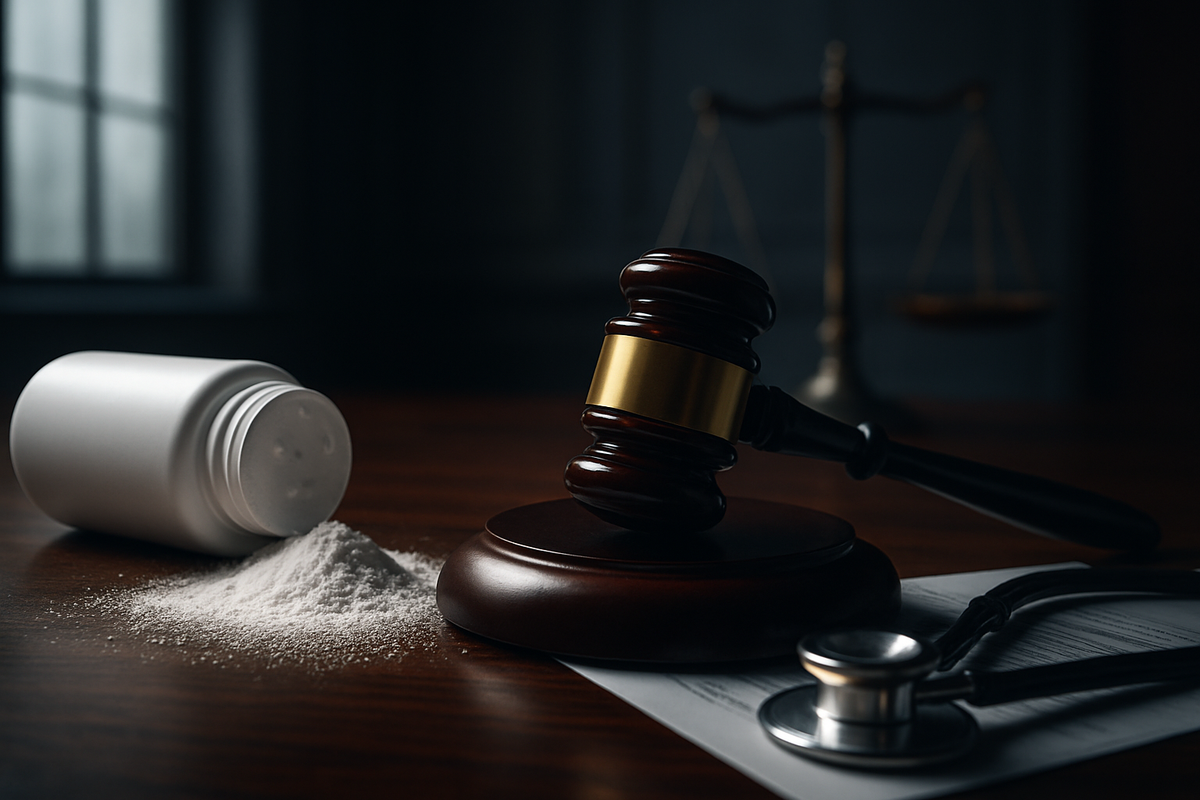
In a landmark ruling that has sent shockwaves through the corporate legal landscape, a Baltimore jury has ordered Johnson & Johnson (NYSE: JNJ) to pay a staggering $1.56 billion to a single plaintiff. The verdict, delivered in late December 2025, marks the largest individual award in the decades-long history of litigation surrounding the company’s talc-based baby powder. While the healthcare giant has weathered numerous legal storms, this record-breaking punitive award signals a perilous new chapter for the company as its long-preferred strategy of using bankruptcy courts to resolve these claims has effectively reached a dead end.
Despite the eye-watering headline figure, the immediate market reaction was unexpectedly muted. On the day the verdict was finalized, shares of Johnson & Johnson (NYSE: JNJ) actually edged higher, closing up 0.46% at $207.32. This counterintuitive movement suggests that institutional investors had already priced in significant litigation risk following the collapse of the company’s third attempt at a "Texas Two-Step" bankruptcy settlement earlier in the year. However, the sheer scale of the Baltimore award—which includes $1.5 billion in punitive damages alone—raises urgent questions about the ultimate cost of resolving the more than 67,000 remaining lawsuits currently pending in the U.S. court system.
The Baltimore Verdict: A New High-Water Mark for Liability
The case, heard in the Circuit Court for Baltimore City, centered on the claims of Cherie A. Craft, a 54-year-old nonprofit leader diagnosed with peritoneal mesothelioma in early 2024. Craft alleged that her terminal cancer was the direct result of inhaling asbestos fibers present in J&J’s baby powder, which she used daily for over 30 years. After weeks of testimony, the jury found that Johnson & Johnson and its subsidiary, Pecos River Talc LLC, were negligent in failing to warn consumers about the risks associated with their products. The final judgment awarded $60 million in compensatory damages to Craft and her family, bolstered by a massive $1.5 billion punitive damage penalty intended to punish the company for its conduct.
This verdict is the culmination of a disastrous year for J&J’s legal defense team. In April 2025, a U.S. bankruptcy judge rejected the company’s third attempt to utilize a Chapter 11 filing for a subsidiary to force a global $6.48 billion settlement. The court ruled that J&J, with its massive balance sheet and recent pharmaceutical successes, did not face the kind of "financial distress" required for bankruptcy protection. This ruling forced the company back into the traditional tort system, where it must now defend itself in individual "bellwether" trials across the country. The Baltimore result is the most severe of several recent losses, including a $966 million verdict in California and a $65.5 million award in Minnesota, both occurring in the final quarter of 2025.
Johnson & Johnson has remained defiant, calling the Baltimore verdict "egregious" and "unconstitutional." The company maintains that its talc products are safe, asbestos-free, and do not cause cancer, citing decades of independent scientific studies. J&J has already filed for an appeal, a process that could take years and often results in the reduction of large punitive awards. Historically, the company has been successful in getting massive verdicts overturned or slashed on appeal, a fact that likely contributed to the stock's stability following the announcement.
Winners and Losers in the Wake of the Award
The primary beneficiaries of this verdict are the plaintiffs' law firms specializing in mass tort litigation. Firms that have spent years building evidence against J&J now have a powerful precedent to use in settlement negotiations. For the thousands of plaintiffs suffering from mesothelioma and ovarian cancer, the Baltimore award provides a renewed sense of leverage, potentially forcing J&J to increase its global settlement offer far beyond the previously proposed $6.48 billion. Furthermore, the spinoff of J&J’s consumer health division into Kenvue (NYSE: KVUE) appears to have successfully insulated the new entity; Kenvue’s stock remained stable, as J&J retained the vast majority of the pre-spinoff talc liabilities.
Conversely, Johnson & Johnson (NYSE: JNJ) faces the prospect of a multi-billion dollar drain on its cash reserves. While the company holds a robust cash position, the cumulative effect of these massive verdicts could eventually threaten its credit rating or limit its ability to pursue aggressive mergers and acquisitions in the biotech space. Additionally, insurance providers like Chubb (NYSE: CB) and Travelers (NYSE: TRV) may face increased pressure as J&J seeks to tap into its excess liability policies to cover these mounting judgments, potentially leading to higher premiums for the entire healthcare sector.
Wider Significance and the End of the "Texas Two-Step"
The Baltimore verdict represents a significant turning point in American corporate law. For years, the "Texas Two-Step"—a legal maneuver where a company shifts its liabilities to a new subsidiary and then puts that subsidiary into bankruptcy—was seen as a viable escape hatch for wealthy corporations facing mass tort claims. The repeated rejection of J&J’s bankruptcy filings in 2025 by federal courts suggests that the judiciary is closing this loophole, emphasizing that bankruptcy is a tool for the insolvent, not a strategic shield for the profitable.
This shift has broader implications for other companies facing large-scale litigation. For instance, companies involved in PFAS ("forever chemicals") or opioid-related lawsuits are watching the J&J case closely. The inability of a blue-chip giant like J&J to secure a bankruptcy-led settlement signals to the entire market that mass torts must now be fought or settled in open court. This trend could lead to a more volatile environment for large-cap industrial and healthcare stocks, as a single jury’s decision can now result in a billion-dollar liability that cannot be easily restructured away.
The Road Ahead: Appeals and Strategic Pivots
In the short term, Johnson & Johnson (NYSE: JNJ) will focus on the appellate process, seeking to have the $1.5 billion punitive award vacated or significantly reduced. Legal experts suggest that the U.S. Supreme Court’s precedents on punitive-to-compensatory damage ratios—which typically favor a 1:1 or single-digit ratio—could work in J&J’s favor, potentially shrinking the $1.5 billion figure to under $500 million. However, even a reduced award remains a significant financial blow when multiplied by the thousands of cases still waiting for their day in court.
Long-term, J&J may be forced to return to the negotiating table with a significantly larger settlement fund. Analysts speculate that a global settlement could now cost the company between $10 billion and $15 billion to fully resolve all current and future talc claims. To fund such a move without hampering its R&D pipeline, J&J might consider further divestitures or a dedicated bond offering. The company’s strategic pivot toward high-growth pharmaceuticals and med-tech will be put to the test as it attempts to outpace its legal expenses with organic growth.
Conclusion: A Test of Corporate Resilience
The $1.5 billion Baltimore verdict is a sobering reminder of the unpredictability and potential scale of the U.S. jury system. For Johnson & Johnson (NYSE: JNJ), the event marks a definitive failure of its bankruptcy-centric legal strategy and a return to a more traditional, and potentially more expensive, litigation battle. While the company’s strong 2025 performance and $200+ stock price show that it remains a titan of the healthcare industry, the "talc overhang" continues to be the primary cloud over its valuation.
Investors should closely monitor the outcome of the Baltimore appeal and the results of the next several bellwether trials scheduled for early 2026. The key takeaway is that the era of the "Texas Two-Step" is effectively over for large, solvent corporations. Moving forward, the market will be looking for a definitive global settlement that can finally put these decades-old claims to rest, allowing J&J to focus entirely on its future as a pure-play healthcare innovator. Until then, every jury verdict will remain a high-stakes gamble for one of the world's most prominent companies.
This content is intended for informational purposes only and is not financial advice.