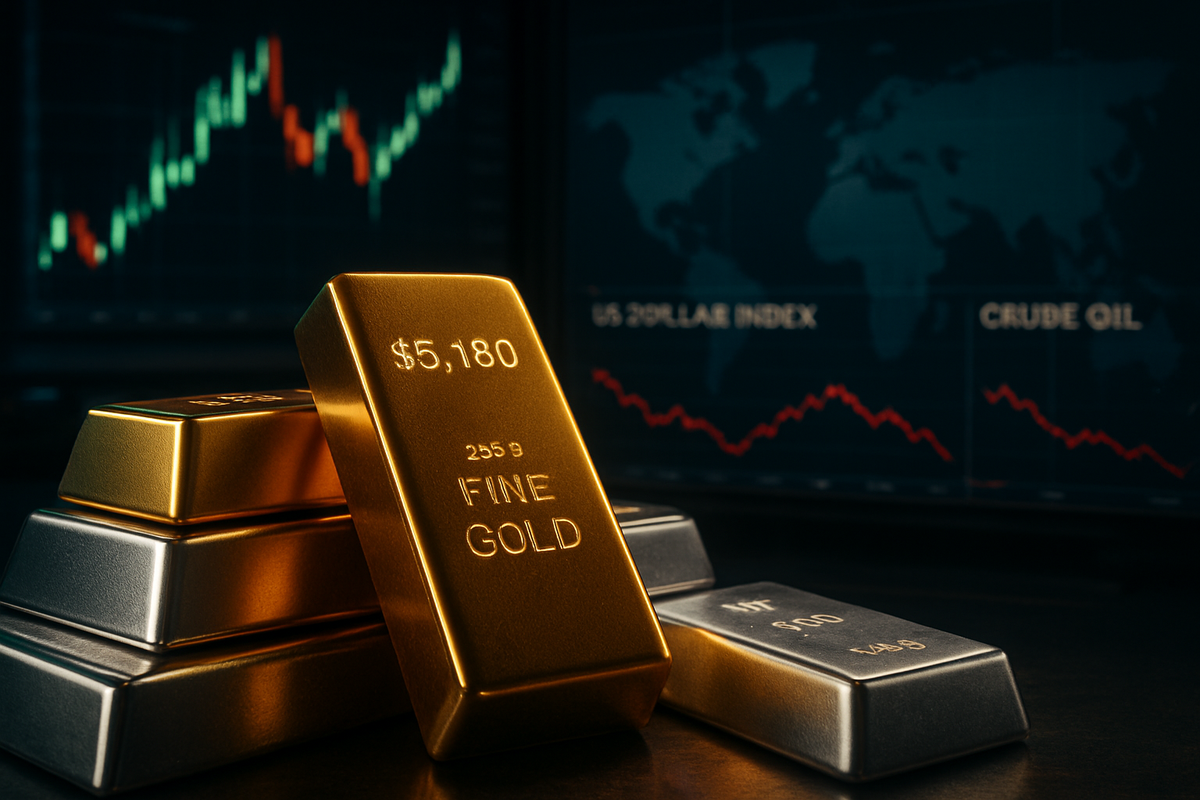
In a trading session that will likely be remembered as a watershed moment for 2026 financial markets, precious metals surged to unprecedented heights on March 10 following unexpected diplomatic signals from the White House. Spot gold prices shattered previous resistance levels to hit $5,180 per ounce, while silver staged a parabolic run to nearly $89 per ounce. The rally was ignited by President Donald Trump’s assertion that the ongoing military conflict between the United States and Iran is nearing an end, a comment that triggered a simultaneous retreat in the US dollar and a dramatic collapse in global energy prices.
The sudden shift in sentiment has created a unique market environment where "de-escalation hope" is paradoxically driving precious metal gains. While gold typically thrives on fear, the weakening of the US Dollar Index (DXY) to the 98.57 level provided enough tailwinds to push bullion prices into a new atmospheric layer. Investors are now recalibrating their portfolios as the prospect of a "very complete" military campaign suggests a transition from wartime volatility to a period of complex economic realignment.
De-escalation Talk Triggers Precious Metal Fireworks
The catalyst for Tuesday's market frenzy was an exclusive interview given by President Trump to CBS News, during which he characterized the US-Israeli strikes on Iranian strategic assets as "very complete, pretty much." Trump’s suggestion that the conflict, which had earlier threatened to engulf the entire Middle East, could be over "very soon" caught institutional traders by surprise. This rhetoric stands in sharp contrast to the aggressive posturing seen just a week ago when Brent Crude was flirting with $120 per barrel following the closure of the Strait of Hormuz.
The immediate reaction was a massive unwinding of "war premium" trades in the energy and currency sectors. Brent Crude plummeted over 10%, settling near $92 per barrel, while West Texas Intermediate (WTI) fell toward $88. However, instead of dragging gold down with it, the resulting slide in the US dollar index acted as a springboard for metals. Analysts noted that the "buy on dips" mentality in gold has become so entrenched in 2026 that even signs of peace are viewed as a green light for more aggressive positioning, especially as inflationary pressures from the previous energy spike continue to ripple through the global economy.
In India, the Multi Commodity Exchange (MCX) reflected this global mania. Gold futures for April delivery surged past ₹1,61,000 per 10 grams. Market participants and retail investors in Asia have been particularly active, with silver prices on the MCX jumping by over ₹11,000 per kilogram in a single session to trade near record levels of ₹2,78,000.
Corporate Winners and Losers in the Post-Conflict Pivot
The extreme volatility in the $5,180 gold environment has created a clear divide between winners and losers in the equities space. Major bullion producers like Newmont Corporation (NYSE: NEM) and Barrick Gold Corporation (NYSE: GOLD) have seen their valuations swell as their margins expand. With gold at these levels, the cost of production for these mining giants remains relatively stable compared to the exponential rise in realized sale prices, leading to record-breaking free cash flow projections for the fiscal year.
Streaming and royalty companies are also benefiting from the silver surge. Wheaton Precious Metals Corp. (NYSE: WPM) has seen its stock price track the nearly 5% daily gain in spot silver, as its high-leverage business model thrives on the $89-per-ounce price point. Conversely, the sudden crash in oil prices has put immediate pressure on the "Big Oil" sector. Exxon Mobil Corporation (NYSE: XOM) and Chevron Corporation (NYSE: CVX) saw their shares retreat as the prospect of $120 oil evaporated, though the lower energy costs may eventually provide relief to their downstream and chemical operations.
Aerospace and defense contractors, such as Lockheed Martin Corporation (NYSE: LMT) and RTX Corporation (NYSE: RTX), are also under scrutiny. The "very complete" nature of the conflict suggests that the massive replenishment orders for munitions and interceptor systems may be less urgent than previously feared, leading to a cooling of the "war trade" that had dominated the first quarter of 2026.
A New Paradigm for Geopolitical Risk and the Dollar
The March 10 rally highlights a significant shift in how the market processes geopolitical risk in the mid-2020s. Historically, gold would sell off on news of a "peace deal" as safe-haven demand dries up. However, the 2026 landscape is defined by a fragile US dollar and a global trend toward de-dollarization. When President Trump signaled an end to the Iran conflict, the market didn't just see "peace"; it saw a potential pivot in US Treasury yields and a likely end to the dollar’s "war-time strength."
This event fits into a broader trend where precious metals are increasingly viewed as the primary alternative to fiat currency rather than just a hedge against chaos. The historical precedent of the early 1970s and 2011 are often cited by historians, but the current scale is vastly different. With gold at $5,180, the metal is effectively pricing in a permanent devaluation of global currencies regardless of whether a specific hot war is active or cooling.
Furthermore, the "very complete" comments suggest a swift tactical success that may leave a power vacuum in the region. Analysts are concerned that while the kinetic phase of the conflict might be ending, the resulting diplomatic and economic "reconstruction" phase could be just as inflationary, further supporting the long-term case for silver and gold.
The Road to $5,300: What Lies Ahead for Investors
As the dust settles on this historic session, technical analysts are eyeing the next major milestones. For gold, the $5,200 spot level remains the immediate psychological and technical resistance. A sustained break above this could open the door for a run toward $5,350 by the end of the second quarter. In the Indian market, Jateen Trivedi, VP Research Analyst at LKP Securities, has highlighted a specific trading range for MCX gold between ₹158,000 and ₹164,000. Investors are advised to watch these boundaries closely, as a move outside this range could signal a secondary wave of momentum.
In the short term, the market will be looking for confirmation of Trump's claims. If the de-escalation proves to be a lasting reality rather than just a tactical pause, the Federal Reserve may find itself with more room to adjust interest rates, which could further weaken the dollar and provide a "floor" for silver at the $85–$88 level. Strategic pivots are already underway at major hedge funds, many of which are rotating out of energy-heavy portfolios and into "precious metal and infrastructure" themes for the remainder of 2026.
The challenges for the market remain significant. A sudden return to hostilities or a failed diplomatic transition in Tehran could send oil back above $100 and create a "double-spike" scenario that would be highly detrimental to global equity valuations.
Conclusion: A Market Redefining Its Safe Havens
The events of March 10, 2026, have underscored the decoupling of precious metals from traditional "fear" cycles. Gold’s climb to $5,180 and silver’s proximity to $90 in the face of cooling geopolitical tensions suggest that the market is prioritizing the decline of the US dollar and the exhaustion of oil-driven inflation over the immediate headlines of war. President Trump’s characterization of the Iran conflict as "very complete" has removed the immediate threat of a regional firestorm but has replaced it with a complex economic outlook where bullion remains king.
Moving forward, investors should keep a sharp eye on the US Dollar Index and the stability of the $88–$92 oil corridor. These factors will be the primary drivers of whether gold can sustain its current altitude or if it will consolidate within the MCX-predicted ₹158,000–₹164,000 range. The lasting impact of this session is the realization that in 2026, peace may be just as bullish for gold as war—provided the dollar continues to lose its grip as the world’s singular reserve asset.
This content is intended for informational purposes only and is not financial advice.