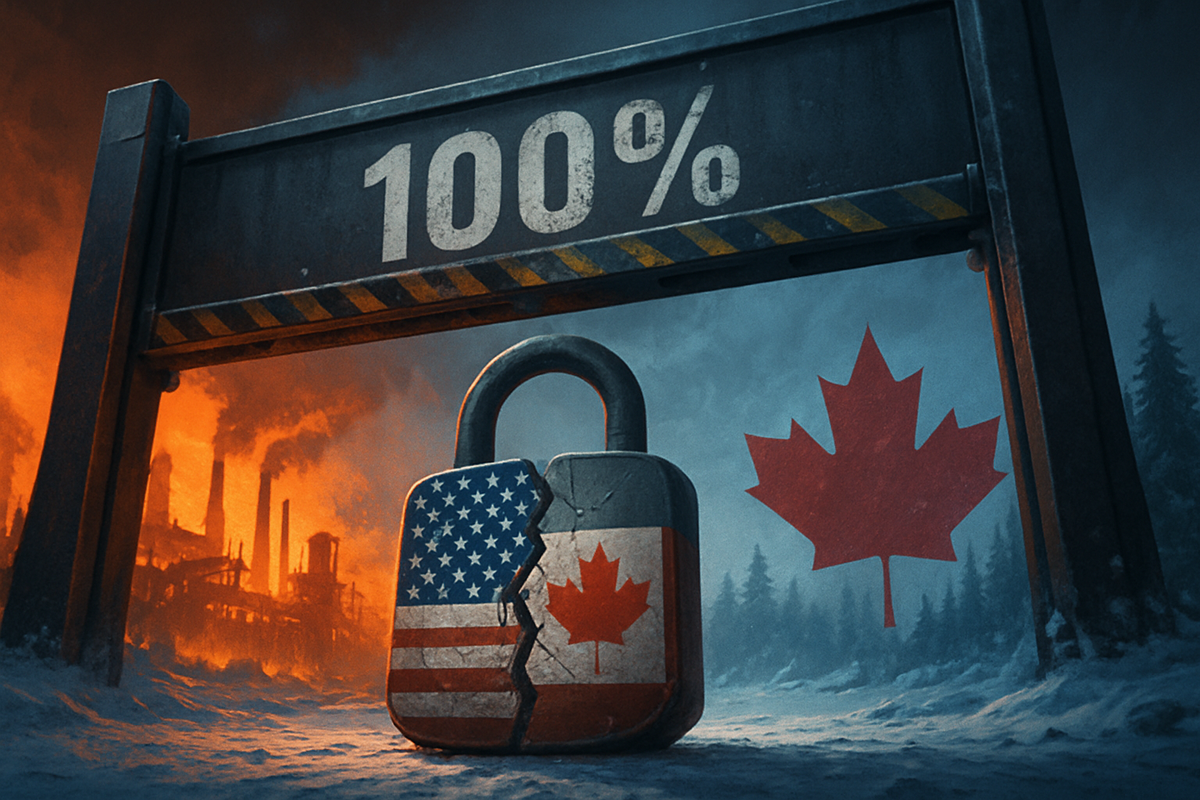
The long-standing economic alliance between the United States and Canada reached a perilous breaking point this week. As of January 30, 2026, the North American trading block—once the most integrated and prosperous in the world—is staring down a "nuclear" economic option. President Donald Trump, entering the second year of his second term, has issued a formal ultimatum to the Canadian government: terminate a newly proposed "Strategic Partnership" with China or face a 100% blanket tariff on all exports entering the United States.
The immediate implications are staggering. For a nation that sends over 75% of its exports to its southern neighbor, a 100% tariff is not merely a trade barrier; it is an economic blockade. Cross-border commerce has already begun to stutter as logistics providers and manufacturers scramble to assess the damage. With the 2026 review of the United States-Mexico-Canada Agreement (USMCA) looming in July, the threat has effectively paralyzed long-term investment and sent the Canadian dollar to decade-lows against the greenback.
The Escalation: From Border Security to a Total Trade War
The path to this moment began shortly after President Trump’s inauguration in January 2025. Invoking the International Emergency Economic Powers Act (IEEPA), the administration initially imposed a 25% "baseline" tariff on Canadian and Mexican goods, citing a failure to curb the flow of illegal migration and fentanyl. While Canadian Prime Minister Mark Carney—who assumed office in 2025—attempted to negotiate through enhanced border security measures, the rhetoric from Washington only sharpened throughout the year.
The flashpoint arrived on January 24, 2026, when reports surfaced that Ottawa was finalizing a massive trade and infrastructure deal with Beijing. President Trump characterized the move as a "betrayal" and a "backdoor for Chinese dominance" in North America. By January 29, the tension spilled over into the aerospace sector, with the administration threatening a 50% tariff on Canadian-made aircraft and the potential "decertification" of Bombardier (TSX: BBD.B) jets in U.S. airspace. This move was a direct retaliation for Canada’s refusal to certify Georgia-based Gulfstream Aerospace, a subsidiary of General Dynamics (NYSE: GD), under new Canadian safety standards.
The key players in this geopolitical drama are now locked in a high-stakes game of chicken. Prime Minister Carney has defended the "China Deal" as a necessary diversification strategy to protect Canada from U.S. protectionism. Conversely, U.S. Trade Representative Robert Lighthizer has signaled that the administration is prepared to let the USMCA expire during the July 2026 review process unless Canada offers "total alignment" with U.S. economic and security interests. Market reaction has been swift: the S&P/TSX Composite Index saw its worst three-day rout in five years, while U.S. Treasury yields fluctuated on fears of renewed inflation.
Identifying the Winners and Losers in a Decoupled Economy
In the zero-sum logic of 100% tariffs, certain U.S. domestic sectors are positioned to reap significant, albeit potentially short-lived, gains. U.S. steel and aluminum producers are the most obvious beneficiaries, as the exclusion of Canadian supply creates a domestic vacuum. Nucor (NYSE: NUE) and Steel Dynamics (NASDAQ: STLD) have seen their stock prices surge as they prepare to capture market share previously held by Canadian rivals like Stelco (TSX: STLC). Similarly, in the timber industry, Weyerhaeuser (NYSE: WY) and Rayonier (NYSE: RYN) are poised to win as Canadian softwood lumber, which historically supplies 25-30% of the U.S. market, faces prohibitive duties.
However, the "loser" column is significantly more crowded, populated by companies that rely on deeply integrated supply chains. Magna International (NYSE: MGA), a titan in the auto-parts industry, faces a catastrophic scenario where parts that cross the border multiple times during assembly could be taxed at every juncture. This has already forced Ford (NYSE: F) and General Motors (NYSE: GM) to pause production at several Midwestern plants that rely on specialized Canadian components. The energy sector is also reeling; while U.S. natural gas producers like EQT (NYSE: EQT) may benefit from higher prices, U.S. refiners such as Valero (NYSE: VLO) and Phillips 66 (NYSE: PSX) are "technologically locked" into processing heavy Canadian crude. A 100% tariff on oil imports from Enbridge (NYSE: ENB) pipelines would likely lead to a "paralysis" in refining margins and a spike in gas prices for U.S. consumers.
In the retail and tech space, the impact is equally severe. Lululemon (NASDAQ: LULU) is already projecting a $320 million hit to its 2026 operating margins due to the removal of duty-free exemptions. E-commerce giant Shopify (NYSE: SHOP) has reported that its cross-border merchants are cutting inventory by up to 40% to mitigate risk. Perhaps most tellingly, the luxury retail conglomerate Saks Global—the newly formed entity encompassing Saks Fifth Avenue and Neiman Marcus—filed for Chapter 11 bankruptcy in late January 2026, citing the crushing weight of tariff-induced costs and declining consumer sentiment.
The End of Continentalism: A Shift in Global Trade Trends
This event signifies more than just a bilateral spat; it represents a fundamental shift away from the "Continentalism" that has defined North American policy for forty years. The USMCA was intended to modernize the legacy of NAFTA, but the 2026 tensions suggest the agreement may have been a temporary bridge to an era of "Fortress America" protectionism. Historically, this level of tension has not been seen since the "Nixon Shock" of 1971, when a 10% import surcharge stunned Canadian officials. However, a 100% tariff threat is an order of magnitude more severe, reflecting a world where trade is used primarily as a weapon of national security.
The ripple effects extend far beyond the border. Global supply chains are watching the "death of the North American Auto Pact" with alarm, as it suggests that no trade agreement is truly permanent. Regulatory implications are also profound; the U.S. is increasingly demanding that its partners adopt its own regulatory standards on everything from digital services to environmental policy, or face total market exclusion. If the USMCA review in July results in a formal termination, the "rules-based order" in North America will be replaced by a series of volatile, transactional bilateral deals.
Furthermore, the "China factor" has fundamentally changed the calculus. In previous decades, the U.S. and Canada were largely aligned on the threat of foreign competition. Today, Canada’s attempt to "hedge" against U.S. volatility by engaging with China has become a primary driver of conflict. This suggests that the U.S. now views the North American trade block not just as an economic zone, but as a strategic perimeter that must be cleared of "adversarial" influence at any cost.
What Comes Next: The July Review and Strategic Pivots
As we move toward the second half of 2026, the market will be hyper-focused on the "Sunset Clause" negotiations scheduled for July. There are two primary scenarios: a "Grand Bargain" or a "Hard Break." In a Grand Bargain, Canada would likely be forced to abandon its China partnership, eliminate its supply management system for dairy (a long-time U.S. grievance), and harmonize its border policies with Washington in exchange for the removal of the 100% threat.
In the event of a Hard Break, we can expect a massive strategic pivot toward "onshoring" within the United States. Companies that currently manufacture in Ontario or Quebec will be forced to relocate to the U.S. to maintain access to the American consumer. This would create a short-term construction boom in the U.S. but would likely trigger a deep recession in Canada and significant inflationary pressure in the U.S. logistics and retail sectors. For investors, the "carry trade" involving the Canadian dollar will remain highly risky, while U.S. domestic-centric stocks in the industrial and energy sectors may provide a safe harbor.
Summary: A New Paradigm for North American Investors
The threat of 100% tariffs on Canadian goods marks the final transition into an era of "Maximum Pressure" trade policy. For the market, the key takeaway is that the "integrated North American economy" is no longer a guaranteed baseline for financial modeling. The volatility of the past week has shown that geopolitical leverage now takes precedence over economic efficiency, a reality that will weigh heavily on cross-border giants like Canadian Pacific Kansas City (NYSE: CP) as they see freight volumes decline.
Moving forward, investors should watch for the rhetoric surrounding the July 2026 USMCA review. Any sign of a climb-down from Ottawa regarding the China partnership could trigger a massive relief rally in Canadian equities. Conversely, if the Trump administration formalizes the 100% tariffs via executive order, the decoupling of the North American economy will become the defining market theme of the decade. The "special relationship" is officially on life support; what replaces it will be far more transactional, far more expensive, and significantly less predictable.
This content is intended for informational purposes only and is not financial advice.