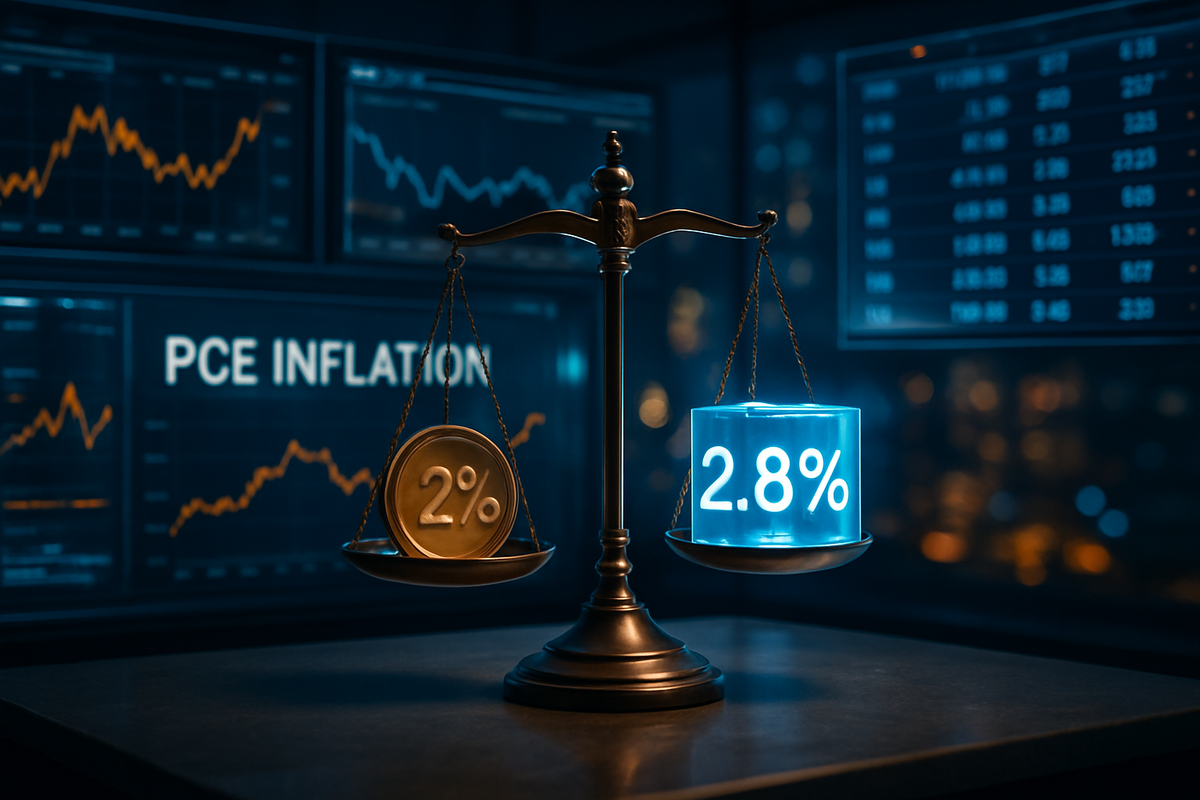
NEW YORK — As the sun rose over Wall Street on January 22, 2026, investors were greeted by one of the most anticipated and unusual economic reports in recent memory. The Bureau of Economic Analysis (BEA) released a combined Personal Consumption Expenditures (PCE) report covering both October and November 2025—a "catch-up" data dump necessitated by a 43-day federal government shutdown that had previously blinded the markets. The results confirmed a growing fear among economists: the "last mile" of the inflation fight has turned into a marathon, with price growth stalling well above the Federal Reserve’s 2% target.
The new data shows Core PCE, the Fed’s preferred metric that strips out volatile food and energy costs, ticking up to 2.8% year-over-year in November, a slight increase from October’s 2.7%. While the broader markets initially staged a relief rally—cheered by the fact that the numbers weren't worse—the implications for the Federal Open Market Committee (FOMC) meeting on January 27–28 are now crystal clear. The era of rapid interest rate cuts appears to be on an indefinite hiatus, as the Fed prepares to hold its benchmark rate steady in the 3.50%–3.75% range.
Sticky Data and Shutdown Delays
The timeline leading to today’s release has been anything but standard. Following a tumultuous end to 2025 marked by a prolonged federal government shutdown, the flow of official economic data was completely severed for over six weeks. This left the Federal Reserve and private institutions like JPMorgan Chase & Co. (NYSE: JPM) flying blind during the crucial holiday shopping season. Today’s dual-month report was the first official confirmation that while the economy remains robust, the disinflationary trend that defined early 2025 has hit a significant snag.
Federal Reserve Chair Jerome Powell has repeatedly signaled a "data-dependent" approach, but the "data" has been both delayed and distorted. The November Core PCE reading of 2.8% marks the third consecutive month that inflation has failed to move closer to the 2% goal. With the labor market still showing resilience—adding 210,000 jobs in December with a 4.4% unemployment rate—there is little political or economic pressure on the Fed to provide further stimulus. The consensus among market watchers, including analysts at S&P Global Inc. (NYSE: SPGI), is that the Fed will opt for a "hawkish hold" next week, waiting for the December 2025 PCE data, now rescheduled for late February, before even considering another move.
Retail Reshuffle: Winners and Losers in the 2.8% Economy
The market reaction to today's data has highlighted a stark divide between sectors. Large-cap technology stocks have largely shrugged off the "higher-for-longer" interest rate fears, driven by a feverish cycle of capital expenditure. NVIDIA Corp. (NASDAQ: NVDA) saw its shares climb 1.45% to $185.98 today, as investors looked past inflation to the impending launch of its Vera Rubin AI platform. Similarly, Microsoft Corp. (NASDAQ: MSFT) rose 1.1% to $449.27, as the market bets that AI-driven productivity gains will eventually prove more influential than marginal interest rate fluctuations.
However, the retail sector is telling a more somber story. A "K-shaped" consumption pattern has emerged where high-end consumers continue to spend, but middle- and lower-income households are retreating. Walmart Inc. (NYSE: WMT) saw its stock plummet 8% earlier this week after issuing cautious 2026 guidance, suggesting that even its "trade-down" appeal has limits. Conversely, Costco Wholesale Corp. (NASDAQ: COST) has emerged as a winner, reporting an 8.2% rise in net sales as its membership model provides a buffer against price volatility. Meanwhile, Target Corp. (NYSE: TGT) continues to struggle, as its discretionary-heavy product mix feels the squeeze of persistent inflation and high borrowing costs.
The 'Last Mile' and New Economic Headwinds
This current inflationary stall fits into a broader trend of structural "stickiness" that some economists are calling the "2.8% plateau." Historically, the final move from 3% inflation down to 2% has been the most difficult for central banks to achieve without inducing a recession. Unlike previous cycles, the Fed is now contending with new variables: the massive expansion of AI infrastructure spending and a radical shift in consumer behavior driven by GLP-1 obesity drugs.
Data suggests that the widespread adoption of these medications has resulted in an estimated $6.5 billion loss in grocery sales, particularly in the snacking and processed food categories. This has put immense pressure on companies like The Kraft Heinz Co. (NASDAQ: KHC), which is already reeling from rumors of a massive divestment by Berkshire Hathaway Inc. (NYSE: BRK.B). Furthermore, the rise of "Agentic AI"—where automated agents perform nearly 47% of routine shopping tasks—is fundamentally altering the way Amazon.com Inc. (NASDAQ: AMZN) and Alibaba Group Holding Ltd. (NYSE: BABA) compete for the "digital wallet," creating a deflationary force in goods that is being offset by persistent service-sector inflation.
Looking Ahead: The February Pivot Point
The immediate focus now shifts to the February 20 release of the December 2025 PCE data. This will be the first "clean" report post-shutdown and will include the full impact of the holiday spending season. If that report shows a further acceleration in prices, the market may have to price in the possibility of an interest rate hike in the second quarter of 2026—a scenario that was unthinkable just six months ago.
Strategically, companies are already pivoting. Many firms are moving away from broad price increases and toward "precision pricing" powered by the very AI they are investing in. Investors should expect a volatile spring as the market reconciles the disconnect between high-flying AI valuations and the reality of a Federal Reserve that is no longer in a hurry to provide a liquidity safety net.
Summary: A Market in Transition
The importance of the PCE data cannot be overstated; it is the North Star for the Federal Reserve’s policy. Today’s consolidated report has confirmed that while the U.S. economy avoided a hard landing in 2025, it has also failed to reach the "inflationary destination" of 2%. The stall at 2.8% suggests that interest rates will remain a headwind for the foreseeable future, rewarding companies with strong balance sheets and "moats"—like Costco—while punishing those reliant on discretionary spending or high leverage.
Moving forward, investors should keep a close eye on the February PCE release and the Fed's commentary following next week's meeting. The primary risk remains a "re-acceleration" of inflation, which would force the Fed to abandon its current neutral stance. For now, the market is in a state of watchful waiting, balancing the promise of a technological revolution against the stubborn reality of a higher-cost economy.
This content is intended for informational purposes only and is not financial advice.