As the final grain elevators of the 2025 autumn harvest are sealed across the North China Plain, the global agricultural market is grappling with a new reality: China has fundamentally altered its relationship with the world’s food supply. Under the direct mandate of President Xi Jinping, the People’s Republic has achieved a record-breaking production year, harvesting an estimated 715 million metric tons of grain in 2025. This surge is not merely a seasonal fluke but the cornerstone of a multi-year strategic "decoupling" from Western agricultural reliance, transforming food security into a primary pillar of national defense.
The immediate implications are reverberating through the trading floors of Chicago and the boardrooms of the world’s largest agribusinesses. By prioritizing "absolute self-sufficiency" in staples like wheat and rice, and aggressively narrowing the gap in corn and soybean production, Beijing has successfully suppressed global commodity prices. For the first time in decades, the world’s largest importer of agricultural goods is signaling that its "rice bowl" is no longer filled by the surplus of the West, but by a high-tech, state-driven domestic revolution.
The 100 Billion Jin Mandate: A Timeline of Autonomy
The current state of Chinese agriculture is the result of a meticulously executed timeline that accelerated sharply in late 2024. During the Central Rural Work Conference in December of that year, President Xi Jinping introduced the "New Round of Actions to Increase Grain Production Capacity by 100 Billion Jin." The goal was ambitious: to raise annual production capacity by 50 million metric tons (100 billion jin) by 2030. Throughout 2025, this policy manifested in the construction of "high-standard farmland" across 71.75 million hectares, utilizing advanced irrigation and satellite-guided precision planting to maximize every square inch of the nation’s 120-million-hectare "red line" of arable land.
The technological tipping point arrived in February 2025, with the release of the "No. 1 Central Document." This policy pivot officially embraced "new quality productive forces" in the countryside, moving beyond traditional farming to a focus on biotechnology and AI-driven yields. By mid-2025, the Ministry of Agriculture and Rural Affairs had approved 17 new varieties of genetically modified (GM) and gene-edited crops, including the first-ever disease-resistant gene-edited wheat. This move ended decades of official hesitation regarding GMOs, effectively greenlighting a commercial revolution that analysts estimate could boost domestic corn yields by up to 12% within the next three harvest cycles.
Key stakeholders in this transition include the state-owned giant COFCO Group and the Syngenta Group, which have spearheaded the distribution of these high-yield seeds. The reaction from the global market was swift; as China’s corn import projections for the 2025/26 cycle were slashed from 23 million metric tons to just 7 million, Chicago Board of Trade (CBOT) corn futures plummeted to a three-year low of $4.15 per bushel in late summer. While a late-year trade truce between Washington and Beijing provided a temporary floor for prices, the underlying trend remains clear: China is no longer a desperate buyer.
The Corporate Fallout: Giants in the Crosshairs
The shift toward Chinese self-sufficiency has created a bifurcated landscape for public companies. The traditional "ABCD" grain majors—Archer Daniels Midland (NYSE: ADM) and Bunge Global SA (NYSE: BG)—have faced significant headwinds. ADM, in particular, was forced to slash its 2025 adjusted EPS guidance to a range of $3.25–$3.50, down from previous estimates of $4.00, as "crush margins" collapsed. The company’s reliance on the U.S.-to-China soybean pipeline has become a liability as China increasingly sources from Brazil or its own expanding domestic stocks. Bunge has similarly felt the pressure, with its stock price weighed down by the geopolitical "overhang" of China’s ability to delay or block major mergers, such as the Viterra acquisition, as a point of leverage.
In the machinery sector, Deere & Co (NYSE: DE) has emerged as a primary victim of China’s "Trade War 2.0" and its domestic substitution policy. Deere projected a 15% to 20% decline in large agricultural equipment sales for 2025, citing both retaliatory tariffs and a concerted effort by Beijing to favor domestic brands like First Tractor. The "Buy China" mandate in high-end machinery has effectively frozen Western manufacturers out of the world’s fastest-growing precision-ag market, forcing these companies to pivot their growth strategies toward South America and India.
Conversely, Corteva (NYSE: CTVA) has shown remarkable resilience. While it faces the same trade hurdles as its peers, Corteva’s focus on high-yield seed technology and crop protection has kept it relevant in a world obsessed with yield. The company raised its 2025 EBITDA guidance to $3.8B–$3.9B, benefiting from the global "non-discretionary" demand for seeds that can withstand the increasingly volatile climates of both the U.S. and China. As China adopts its own GM traits, Corteva has strategically positioned itself as a technology partner rather than just a commodity seller, navigating the narrow path between competition and collaboration.
Geopolitical Decoupling and the "Busan Truce"
China’s grain push is a textbook example of "geoeconomic hedging." By insulating its food supply, Beijing has effectively neutralized one of the West's most potent diplomatic levers. Historically, China’s dependence on U.S. soybeans was seen as a "ballast" in the bilateral relationship—a mutual dependency that prevented total economic rupture. However, the 2025 harvest suggests that this ballast is being cut. The "Soy China" initiative, launched with Brazil in July 2025, has institutionalized a supply chain that bypasses North America entirely, aligning Brazilian production with Chinese traceability and sustainability standards.
This decoupling reached a fever pitch in early 2025 when China imposed retaliatory tariffs of up to 45% on U.S. agricultural exports. The tension only eased on October 30, 2025, with the "Busan Truce," a landmark framework agreement where China pledged to purchase 12 million metric tons of U.S. soybeans to stabilize the market. However, industry veterans view this as a tactical pause rather than a strategic reversal. The precedent set by the 2025 record harvest proves that China can, if necessary, survive with minimal U.S. imports, a realization that has permanently altered the risk premium for agricultural commodities.
Furthermore, this event fits into a broader global trend of "food nationalism." Similar to India’s restrictions on rice exports and Russia’s use of wheat as a diplomatic tool, China’s drive for self-sufficiency signals the end of the era of "just-in-time" global food logistics. The regulatory environment in Beijing is now focused on "seed sovereignty," with new laws enacted in 2025 that provide massive subsidies for domestic gene-editing firms while tightening the "security reviews" required for foreign agricultural investments.
The Road to 2030: Challenges and Strategic Pivots
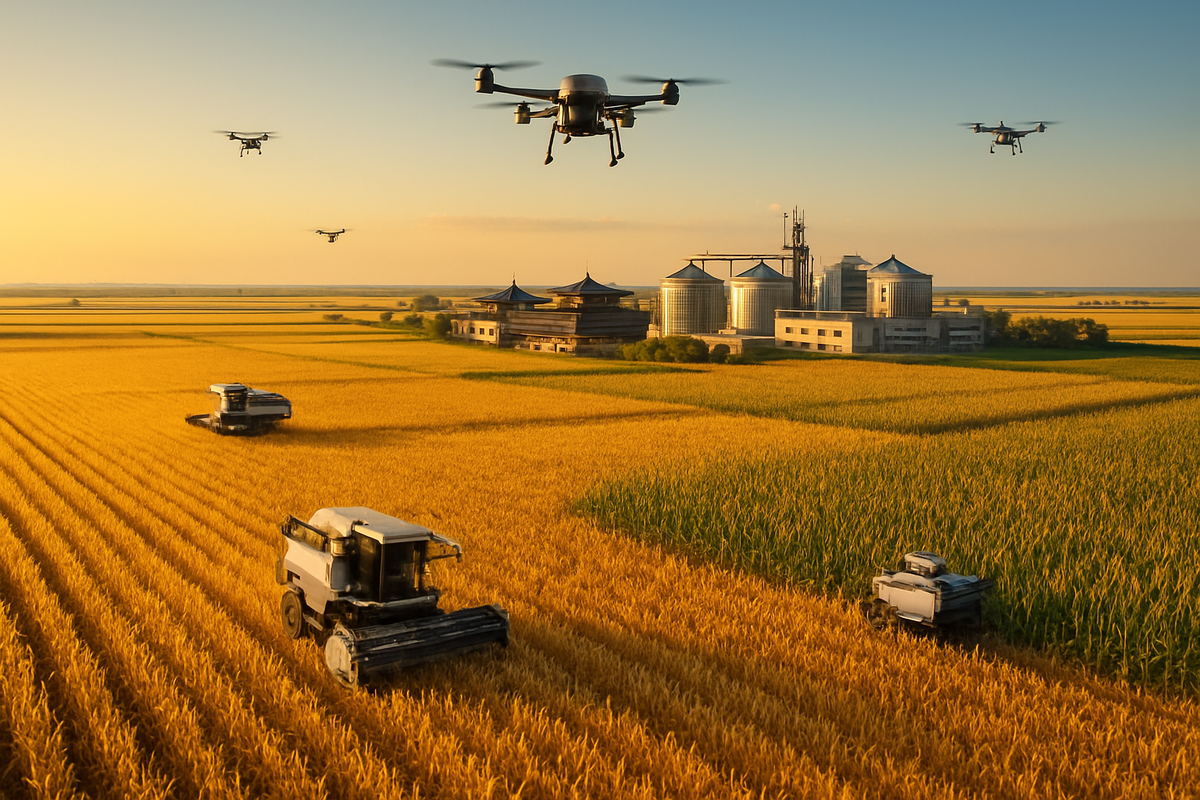
Looking ahead, the primary challenge to China’s "absolute security" remains the environment. Despite the 2025 success, the nation faces chronic water scarcity in its northern grain belts and an aging rural workforce. To counter this, the next five years will likely see a massive investment in "autonomous farming" and "indoor agriculture." We should expect a strategic pivot where China moves from being a net importer of calories to a net exporter of agricultural technology. The "Digital Silk Road" is already beginning to export Chinese-made drones and AI crop-monitoring systems to Southeast Asia and Africa, creating a new sphere of agricultural influence.
In the short term, global markets should prepare for continued volatility. While the Busan Truce provides a temporary reprieve for U.S. farmers, the long-term trend of declining Chinese demand for foreign corn and wheat is likely irreversible. Companies like ADM and Bunge will need to accelerate their diversification into biofuels and alternative proteins to replace the lost margins from the China trade. For investors, the "China story" is no longer about how much the country will buy, but how much it will produce and how that production will cap global price rallies.
A New Era for Global Agribusiness
The 2025 harvest marks the definitive end of the post-Cold War agricultural order. China’s successful push for grain self-sufficiency has demonstrated that a determined state can use biotechnology and centralized planning to overcome geographic and demographic limitations. The takeaway for the market is clear: the era of "China-driven" commodity super-cycles is over. In its place is a more fragmented, politically charged market where domestic production targets in Beijing matter more than the weather in Iowa.
Moving forward, the market will be defined by how the U.S. and Brazil respond to China’s shrinking import needs. Investors should watch for three key indicators in the coming months: the actual adoption rate of GM corn in China’s spring 2026 planting season, the stability of the Busan Truce, and any further sanitary-related trade barriers China may place on South American meat exports. China has successfully "held its rice bowl firmly," and the rest of the world must now learn to eat from a much smaller table.
This content is intended for informational purposes only and is not financial advice.