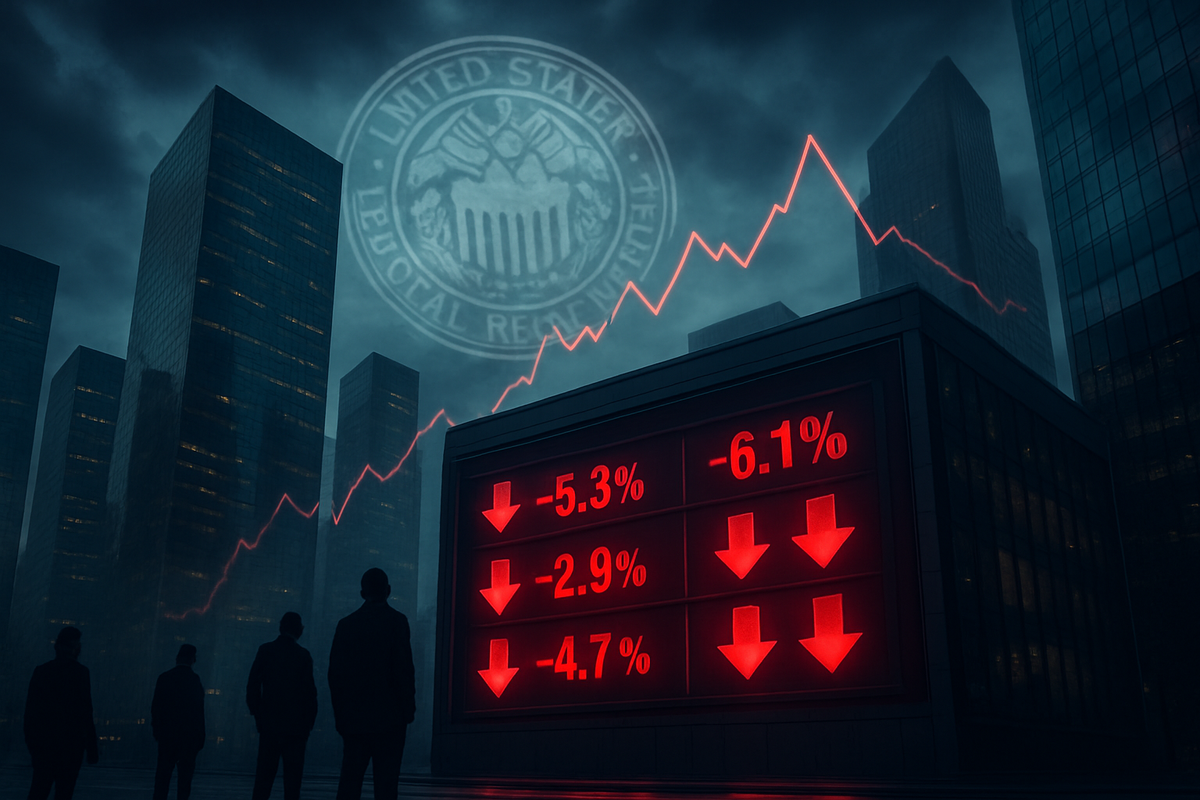
The final weeks of 2025 have proven to be a sobering period for the U.S. financial sector, as a confluence of interest rate uncertainty and emerging credit risks sparked a broad sell-off across banking stocks and major exchange-traded funds. While the broader markets flirted with record highs earlier in the month, the financial sector has been weighed down by a "hawkish" pivot from the Federal Reserve and a series of localized credit shocks that have investors questioning the resilience of bank balance sheets heading into 2026.
The immediate implications are stark: the Financial Select Sector SPDR Fund (NYSE: XLF) and the SPDR S&P Bank ETF (NYSE: KBE) have seen significant outflows as institutional investors rotate into more defensive sectors. This retreat marks a sharp reversal from the bullish sentiment seen in the third quarter, highlighting a growing consensus that the "easy money" phase of the post-inflationary recovery is over, replaced by a complex landscape of narrowing margins and rising defaults.
A Perfect Storm: From Fraud Scandals to Fed Frustration
The seeds of the current sell-off were sown in mid-October 2025, when the regional banking sector was rocked by a sudden crisis of confidence. Zions Bancorporation (NASDAQ: ZION) and Western Alliance Bancorporation (NYSE: WAL) both disclosed significant losses tied to sophisticated borrower fraud schemes. The news triggered a 6.3% single-day crash in regional bank indices, erasing over $100 billion in market value. This "October Surprise" reminded the market of the structural vulnerabilities still lingering in mid-tier banks, leading to a flight toward the perceived safety of "fortress" balance sheets.
However, the safety of the mega-banks was soon challenged by the "Cockroach Effect." In late October and November, the high-profile bankruptcies of auto-parts giant First Brands and subprime lender Tricolor sent shockwaves through the industry. JPMorgan Chase & Co. (NYSE: JPM) reported a $170 million loss related to the Tricolor collapse, prompting CEO Jamie Dimon to warn that these failures might be the first of many hidden credit risks emerging as the economy slows.
The situation reached a boiling point following the Federal Reserve's policy meeting on December 10, 2025. While the Fed delivered a widely expected 25-basis-point rate cut, bringing the benchmark rate to 3.50%–3.75%, the accompanying "dot plot" was far more hawkish than anticipated. The central bank projected only one additional cut for 2026, shattering market hopes for a rapid easing cycle. This "hawkish cut" effectively capped the potential for Net Interest Income (NII) growth, as banks find themselves trapped between falling yields on assets and stubbornly high costs for deposits.
Winners and Losers in a Fragmented Market
The primary losers in this environment have been the regional and mid-sized lenders. Zions Bancorporation (NASDAQ: ZION) remains under intense pressure, with its stock down nearly 15% since its October disclosure. Similarly, Western Alliance Bancorporation (NYSE: WAL) has struggled to regain investor trust, facing both a depressed stock price and mounting legal scrutiny over its risk management protocols. These banks are finding it increasingly difficult to compete for deposits without further eroding their already thin margins.
Even the industry titans have not been immune to the downturn. Bank of America Corp. (NYSE: BAC) saw its stock downgraded to a "Sell" by several prominent analysts in late December. Despite beating third-quarter earnings expectations, the bank’s proprietary "Bull & Bear Indicator" hit an extreme reading of 8.5—a historical signal for institutional profit-taking. Investors are increasingly concerned about Bank of America’s rising non-interest expenses and its exposure to a softening consumer credit market, particularly as unemployment nudges up to 4.4%.
On the other side of the ledger, a few "winners" have emerged, albeit in a relative sense. Large-cap diversified financials with strong investment banking arms, such as Goldman Sachs Group Inc. (NYSE: GS) and Morgan Stanley (NYSE: MS), have managed to offset some lending weakness with a surge in deal-making and advisory fees. These firms are less reliant on the traditional "spread" business that is currently being squeezed by the Fed's policy path, allowing them to outperform their more traditional commercial banking peers.
Wider Significance: The Deposit Paradox and Private Credit Shadows
This year-end sell-off is not merely a seasonal correction; it reflects a fundamental shift in the banking industry’s operating environment. The "Deposit Paradox" has become a central theme: even as the Fed cuts rates, banks are finding it impossible to lower the interest they pay to depositors, who have become accustomed to high-yield environments. This has led to a persistent Net Interest Margin (NIM) compression that is expected to continue well into 2026, challenging the traditional profitability model of the U.S. banking system.
Furthermore, the event highlights the growing "shadow" cast by the private credit market. As companies like First Brands and Tricolor falter, the interconnectedness between traditional banks and opaque private lending vehicles is coming under regulatory scrutiny. The current sell-off mirrors historical precedents where localized credit issues in niche markets eventually bled into the broader financial system, drawing comparisons to the early stages of the 2008 financial crisis, though with significantly higher capital buffers in place today.
Regulators are already signaling a response. The Federal Reserve and the FDIC are expected to increase oversight of regional banks' internal fraud controls and tighten capital requirements for banks with heavy exposure to subprime and commercial real estate sectors. This regulatory tightening, while necessary for long-term stability, is likely to act as a further headwind for bank stock valuations in the short term.
What Comes Next: A Year of Consolidation and Caution
Looking ahead to 2026, the banking sector faces a period of strategic pivots. With organic growth capped by interest rate uncertainty and margin compression, many analysts expect a wave of consolidation. Mid-tier banks may seek mergers to achieve the scale necessary to absorb rising regulatory and technology costs. For investors, the "higher for longer" deposit costs mean that stock selection will be paramount; banks with the most loyal, low-cost deposit bases will likely be the only ones capable of maintaining earnings growth.
In the short term, the market will be hyper-focused on the fourth-quarter earnings season in January. Investors will be looking for clarity on 2026 expense guidance and updated projections for credit loss provisions. If more "cockroaches" emerge in the form of corporate defaults or fraud disclosures, the current sell-off could deepen into a more systemic re-rating of the entire financial sector.
Closing Thoughts for the 2025 Market
The year 2025 is ending on a cautionary note for the financial sector. The transition from an era of rising rates to an era of uncertain, slow-walking cuts has created a "no-man's land" for bank profitability. The recent sell-off serves as a reminder that while the "fortress" banks may be stable, they are not invincible to the broader pressures of a cooling economy and shifting monetary policy.
Moving forward, the market will remain sensitive to every word from the Federal Reserve and every data point on credit quality. Investors should watch for signs of stabilizing margins and any further fallout from the private credit space. While the current weakness offers a potential entry point for long-term value seekers, the immediate path for the banking sector remains fraught with volatility and structural challenges.
This content is intended for informational purposes only and is not financial advice.