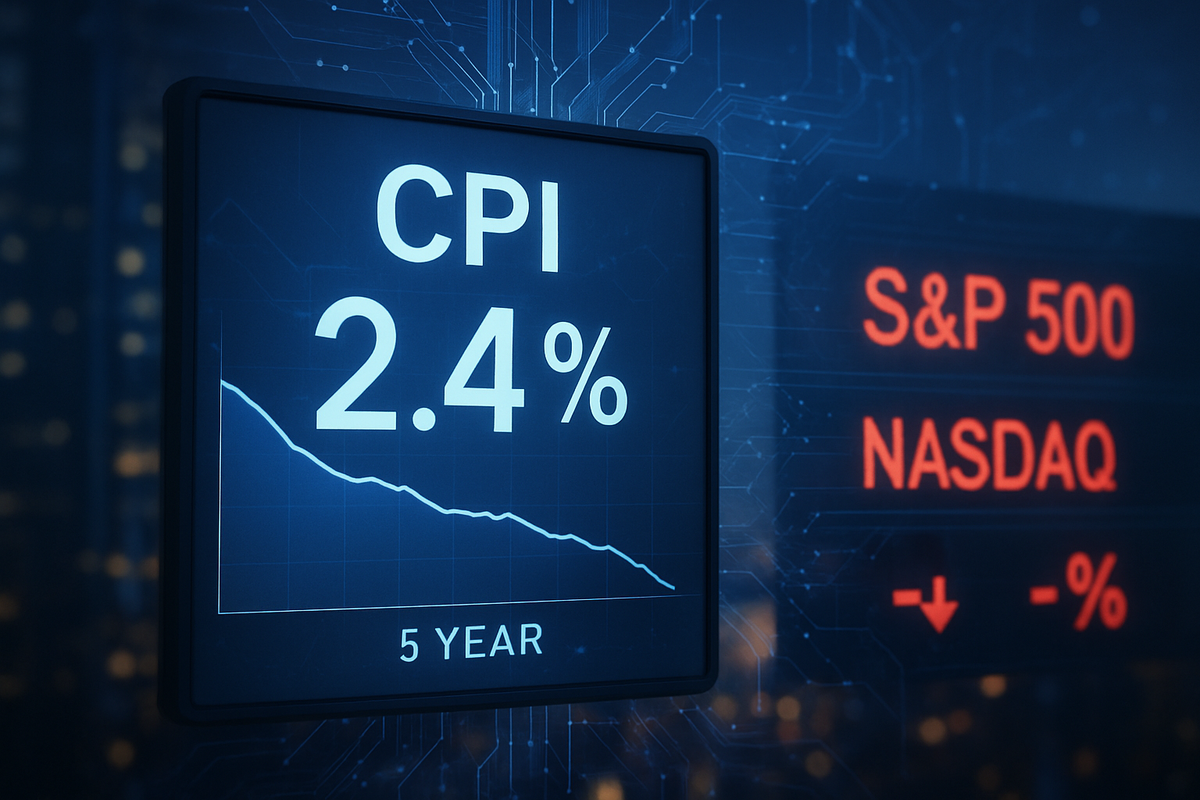
On February 13, 2026, the Bureau of Labor Statistics delivered a report many investors had long awaited: headline inflation in the United States plummeted to a nearly five-year low. The January Consumer Price Index (CPI) showed a year-over-year increase of just 2.4%, a level not seen since the early spring of 2021. This milestone suggested that the Federal Reserve's long-standing battle against post-pandemic price surges might finally be entering its endgame, as cooling gasoline and shelter costs provided much-needed relief to American households.
However, the celebratory mood on Wall Street was short-lived. Despite an initial surge in early morning trading, the broader markets reversed course as a new wave of "AI anxiety" gripped the tech sector. The S&P 500 (INDEXSP:.INX) closed down 26.54 points, or 0.39%, at 6,806.22, while the Nasdaq Composite (INDEXNASDAQ: .IXIC) fell 159.11 points, or 0.70%, to finish at 22,438.04. The disconnect between a favorable inflation print and a declining stock market signaled a fundamental shift in investor focus from macro-inflationary risks to the micro-disruptions posed by artificial intelligence.
The Path to 2.4%: A Look at the Cooling Numbers
The January CPI report was a definitive sign of disinflationary momentum. The 2.4% headline figure was down from 2.7% in December 2025 and beat the consensus analyst forecast of 2.5%. Perhaps more importantly for policymakers, the Core CPI—which strips out the volatile food and energy sectors—dipped to 2.5% year-over-year. This represented a significant cooling from the stubborn 3% ranges seen throughout much of 2024 and 2025. On a month-over-month basis, both headline and core figures rose by a modest 0.2% and 0.3%, respectively, aligning with the Federal Reserve's long-term targets.
The primary drivers of this decline were energy and housing. Gasoline prices saw a sharp retreat in January, while shelter costs—which had remained frustratingly high for years—finally showed a meaningful deceleration, rising just 0.2% for the month. These gains were partially offset by price hikes in electronics and appliances, which analysts attributed to the lingering effects of trade tariffs. The timeline leading up to this moment has been one of cautious optimism; the Fed had held the federal funds rate steady at 3.50%–3.75% during its January meeting, waiting for exactly this type of "clear and convincing" evidence that inflation was returning to the 2% goal.
Winners and Losers in a Volatile Session
In the wake of the report, defensive sectors emerged as the primary beneficiaries of the lower-than-expected inflation. Utilities and Consumer Staples gained 1.5% and 0.9% respectively, as investors moved capital into "safety" plays that benefit from a lower-interest-rate environment. One of the day's biggest individual winners was Rivian Automotive, Inc. (NASDAQ: RIVN), which saw its stock price jump 14% following a robust earnings report that coincided with the CPI release. Similarly, Applied Materials, Inc. (NASDAQ: AMAT) climbed 11% after providing upbeat guidance, proving that high-quality semiconductor firms could still find favor even amidst broader tech volatility.
Conversely, the tech heavyweights faced a difficult session. Apple Inc. (NASDAQ: AAPL) remained under significant pressure, falling to its lowest level since mid-2025 following reports of development delays for its next-generation AI-integrated Siri upgrades. The broader "AI Disruption" narrative weighed heavily on software and logistics companies. Investors expressed concerns that while inflation is cooling, the rapid integration of AI across the economy could lead to margin compression for traditional software providers and service-based firms. This fear led to a notable rotation out of growth-oriented stocks, specifically those that have seen massive valuation expansions over the last 18 months.
A Changing Guard and Shifting Industry Trends
The January CPI report arrives at a critical juncture for the Federal Reserve. Following the January 30 nomination of Kevin Warsh to succeed Jerome Powell as Fed Chair in May, the market is closely watching for any shift in monetary philosophy. Warsh, known historically as a hawk, has recently adopted a more pragmatic tone, suggesting that the central bank should "look through" temporary price spikes caused by tariffs. This CPI print gives the incoming leadership a comfortable "cushion," likely cementing expectations for a rate cut in June 2026.
Historically, reaching a five-year low in inflation would have triggered a massive rally in the Nasdaq. However, the current trend suggests that the market has moved past "inflation peak" and is now grappling with "technological displacement." The ripple effects are being felt across the competitive landscape; as companies like Rivian capitalize on lower borrowing costs to scale production, legacy tech firms are being forced to prove their AI utility to justify their multiples. The regulatory environment also looms large, as the cooling inflation may give the government more room to pursue infrastructure and energy projects without the immediate fear of overheating the economy.
The Road Ahead: June Cuts and Strategic Pivots
As we look toward the remainder of the first half of 2026, the market is increasingly pricing in a June rate cut. The Federal Reserve's "data-dependent" mantra will be tested by subsequent labor market reports. If the economy continues to add jobs while inflation remains near 2.4%, a "soft landing" may transition into a period of stable growth. However, for the technology sector, the path is more complex. Companies will likely need to undergo strategic pivots, shifting from growth-at-all-costs to demonstrating how AI can drive operational efficiency rather than just acting as a buzzword.
Short-term volatility is expected to persist as the market reconciles lower interest rates with the disruptive potential of AI. Opportunities may emerge in the small-cap and mid-cap spaces, where companies have been battered by high interest rates over the past few years. These firms, often more sensitive to borrowing costs than the "Magnificent Seven," could see a resurgence if the Fed initiates an easing cycle this summer. Conversely, the challenge for investors will be identifying which "AI losers" are genuinely at risk and which are simply victims of temporary market sentiment.
Summary of a Landmark Day
The February 13, 2026, CPI report will be remembered as a milestone in the post-pandemic economic recovery. Reaching a headline inflation rate of 2.4% marks the end of an era of aggressive price hikes and sets the stage for a new chapter in Federal Reserve policy. While the S&P 500 and Nasdaq did not celebrate with a rally, the underlying data suggests a healthier, more balanced economy. The market's pivot toward AI-related fears is a sign that the "inflation trade" is officially over, replaced by a more nuanced assessment of how technology will reshape corporate earnings in the years to come.
Moving forward, investors should watch for the Fed’s messaging regarding the June meeting and keep a close eye on the transition from the Powell era to the Warsh era. The resilience of the labor market alongside cooling prices remains the key indicator of economic health. While the "AI anxiety" of mid-February may cause short-term turbulence, the fundamental easing of price pressures remains a massive tailwind for the global economy.
This content is intended for informational purposes only and is not financial advice