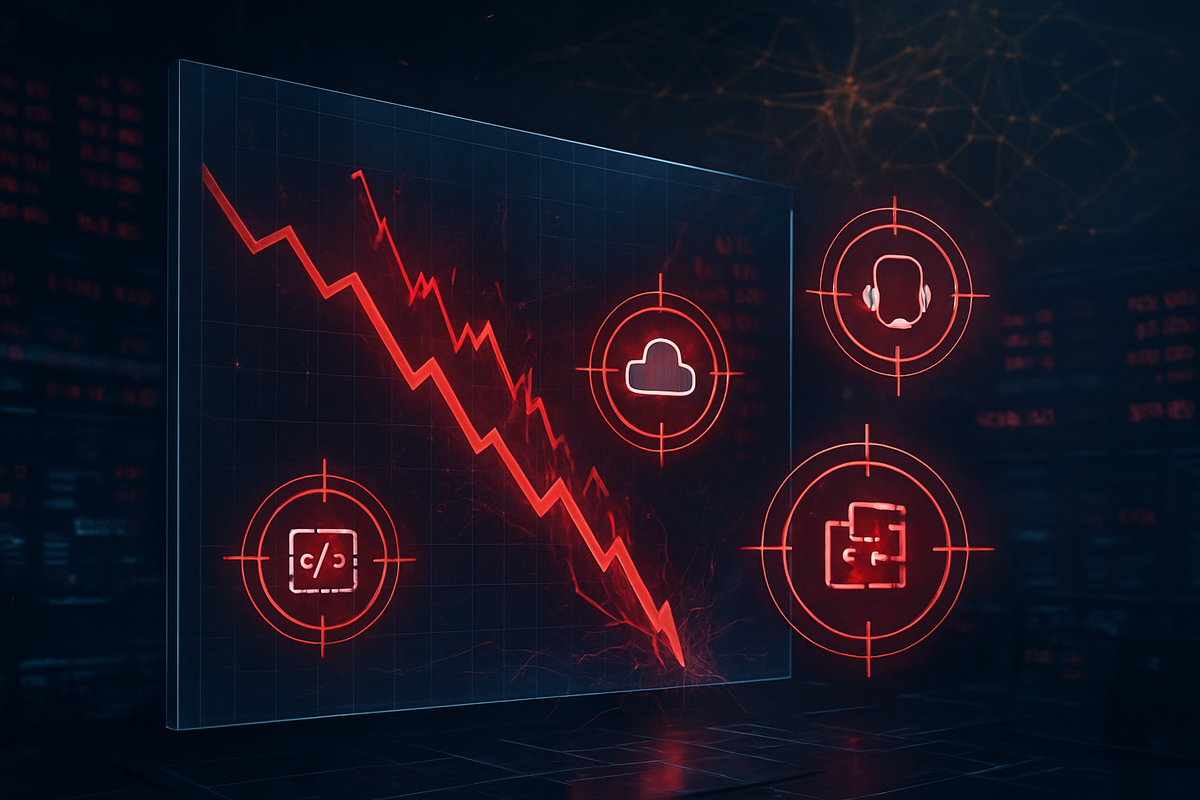
The second week of February 2026 has sent a chilling reminder through global equity markets that the "AI Gold Rush" has a darker, more destructive twin: the "AI Crosshairs." In what analysts are now calling "Software-mageddon," a massive rotation out of traditional application software and service-oriented sectors has erased more than $1.2 trillion in market value in just five trading sessions. This aggressive "sell-the-disrupted" strategy has moved beyond speculative fear and into a fundamental repricing of companies whose business models—once thought to have wide moats—are being systematically dismantled by autonomous AI agents.
The immediate implications are stark. For investors, the focus has shifted from identifying the next chip giant to identifying the "terminal value" of established players. As generative AI shifts from a tool used by humans to a replacement for human-centric processes, the market is ruthlessly discounting firms that rely on per-seat licensing or labor-intensive service delivery. This has led to a bifurcated market where "AI-native" firms soar while legacy giants find themselves fighting for relevance in a landscape that no longer values their traditional core competencies.
The Path to the 2026 Sell-Off: A Timeline of Disruption
The "AI Crosshairs" phenomenon did not emerge in a vacuum. It began as a series of isolated shocks, most notably with the May 2023 "Chegg Moment," when Chegg Inc. (NYSE: CHGG) admitted that the free availability of ChatGPT was cannibalizing its subscriber growth. This served as the "canary in the coal mine," signaling that any company whose value proposition was purely "information retrieval" or "content generation" was at extreme risk. Throughout 2024 and 2025, this trend metastasized. Initially, the market focused on education and language learning, but as AI agents became more sophisticated in 2025, the radius of disruption expanded to include customer service, coding platforms, and professional advisory services.
The catalyst for the current February 2026 market rout was the simultaneous release of three "agentic" AI frameworks from major tech players that demonstrated a nearly 90% reduction in the need for human oversight in middle-office financial tasks. This sparked an immediate exit from diversified financial service providers. In a single day of trading this week, Charles Schwab Corp. (NYSE: SCHW) and Raymond James Financial Inc. (NYSE: RJF) saw their stocks tumble by 8% and 9%, respectively, as investors feared that automated AI-driven wealth management tools would render traditional advisory models obsolete.
Market reactions have been characterized by a "sell first, ask questions later" mentality. The iShares Expanded Tech-Software Sector ETF (BATS: IGV) has become the primary theater for this battle, experiencing record outflows as institutional managers reallocate capital toward "AI-hardened" infrastructure. Unlike previous tech corrections, this sell-off is not driven by interest rates or macro headwinds, but by a fundamental reassessment of "moats" in an era where AI can replicate a software company’s entire feature set with minimal human intervention.
Winners, Losers, and the Battle for Survival
The "AI Crosshairs" have created a clear dividing line between those who are being consumed by the technology and those who have successfully weaponized it. In the "loser" category, companies like Teleperformance SE (OTC: TLPFY) and Concentrix Corp. (NASDAQ: CNXC) continue to struggle. These Business Process Outsourcing (BPO) firms, which once provided the human backbone for global customer support, are seeing their margins decimated as enterprises replace thousands of human agents with a single, high-fidelity AI support instance. Similarly, in the EdTech space, Coursera Inc. (NYSE: COUR) has faced a difficult 2025 and 2026, as the market questions the long-term value of structured online courses when personalized AI tutors can provide bespoke learning paths for free.
Conversely, the winners are those who provide the "proprietary data" that AI cannot hallucinate or replicate. NVIDIA Corp. (NASDAQ: NVDA) and Microsoft Corp. (NASDAQ: MSFT) remain the primary beneficiaries, providing the chips and the foundational models that power the disruption. However, a new class of "pivot winners" is emerging. Wix.com Ltd. (NASDAQ: WIX) and HubSpot Inc. (NYSE: HUBS) have managed to evade the crosshairs by aggressively integrating AI as a core feature rather than a defensive add-on. By transforming from "tools people use" into "platforms that do work for people," they have managed to maintain their valuations while their peers faltered.
The software development sector remains one of the most volatile areas of this conflict. GitLab Inc. (NASDAQ: GTLB) saw a significant decline this month as investors worried that AI-native coding assistants like GitHub Copilot and Cursor are not just assisting developers, but are on the verge of automating the entire DevOps lifecycle. The fear is that the "value of the seat" is dropping toward zero, forcing these companies to completely rethink their monetization strategies from per-user to per-outcome.
Wider Significance: The End of the "Software Moat"
The significance of the "AI Crosshairs" trend lies in the death of the traditional software moat. For two decades, the "Software as a Service" (SaaS) model was the gold standard of investing, prized for its recurring revenue and high switching costs. However, as the 2026 "Software-mageddon" proves, those switching costs are evaporating. When an AI agent can migrate an entire company’s database and rebuild its custom workflows on a different platform over a weekend, the "stickiness" of legacy software disappears. This event marks a shift toward "Data-as-a-Service" and "Outcome-as-a-Service."
This trend also has massive regulatory and policy implications. As AI begins to hollow out middle-class professional roles in wealth management, law, and coding, governments are facing renewed pressure to address "technological unemployment." We are seeing historical parallels to the Industrial Revolution, but at a velocity that is 10 to 100 times faster. In the same way the internal combustion engine rendered the horse-and-carriage industry obsolete, AI is doing the same to the "digital carriage" industry of basic SaaS and entry-level professional services.
Furthermore, the "AI Crosshairs" strategy is forcing a massive ripple effect onto competitors. Companies that were not previously considered tech companies are now being forced to adopt "AI-first" postures just to defend their stock prices. The premium for "safety" has moved away from established brands and toward companies that control the most unique, non-replicable datasets—a trend that is likely to trigger a wave of aggressive M&A as legacy players attempt to buy their way out of the crosshairs.
What Comes Next: The M&A Wave and AI-Native Evolution
In the short term, the market should prepare for a "consolidation winter." Many mid-cap software companies currently in the AI crosshairs will likely become acquisition targets for larger tech titans or private equity firms looking to strip them for their data. We expect a 15-20% uptick in "fire sale" acquisitions through the remainder of 2026 as companies realize their terminal value is declining faster than they can innovate. The challenge for these firms will be proving that they possess "unique data" that provides a "reason to exist" in an AI-commoditized world.
Long-term, we will see the emergence of "AI-native" public companies—firms built from the ground up with zero human labor in their core service delivery loop. These companies will have margin profiles that make current SaaS companies look inefficient. For the "disrupted" incumbents, the strategic pivot required is existential. They must move away from "per-seat" pricing—which penalizes customers for using AI to reduce headcount—and move toward "value-based" or "compute-based" pricing models. Those who fail to make this transition by the end of 2026 will likely face delisting or bankruptcy.
Market opportunities will emerge in the "AI Defense" sector—firms that help companies identify where they are vulnerable to AI and help them "harden" their business models. Investors will also likely move toward "Physical-world" assets that AI cannot disrupt, leading to a potential renaissance in manufacturing, energy, and infrastructure stocks as a hedge against digital disruption.
Wrapping Up: Navigating the Great Disruption
The rise of the "AI Crosshairs" trend represents a fundamental shift in market psychology. We have moved past the era of "AI excitement" and into the era of "AI Darwinism." The February 2026 sell-off has shown that the market is no longer willing to give legacy companies the benefit of the doubt. If a business model can be replicated by a sophisticated large language model or an autonomous agent, the market will treat its terminal value as zero until proven otherwise.
Moving forward, investors must be surgically precise. The broad "tech" umbrella is no longer a safe haven. Instead, the focus must be on "data sovereignty" and "agentic readiness." The key takeaway from this month's volatility is that "defensive" investing now requires an offensive understanding of AI capabilities. Watching the quarterly earnings calls of companies like Chegg Inc. (NYSE: CHGG) and Teleperformance SE (OTC: TLPFY) will provide early signals on whether the "disrupted" can successfully pivot or if they are simply managing a slow decline.
In the coming months, the most important metric for any investor will not be revenue growth or P/E ratios, but "AI-displacement risk." As the crosshairs continue to move across the S&P 500, the only real protection is owning the companies that are building the future—or those that hold the data the future is built upon.
This content is intended for informational purposes only and is not financial advice