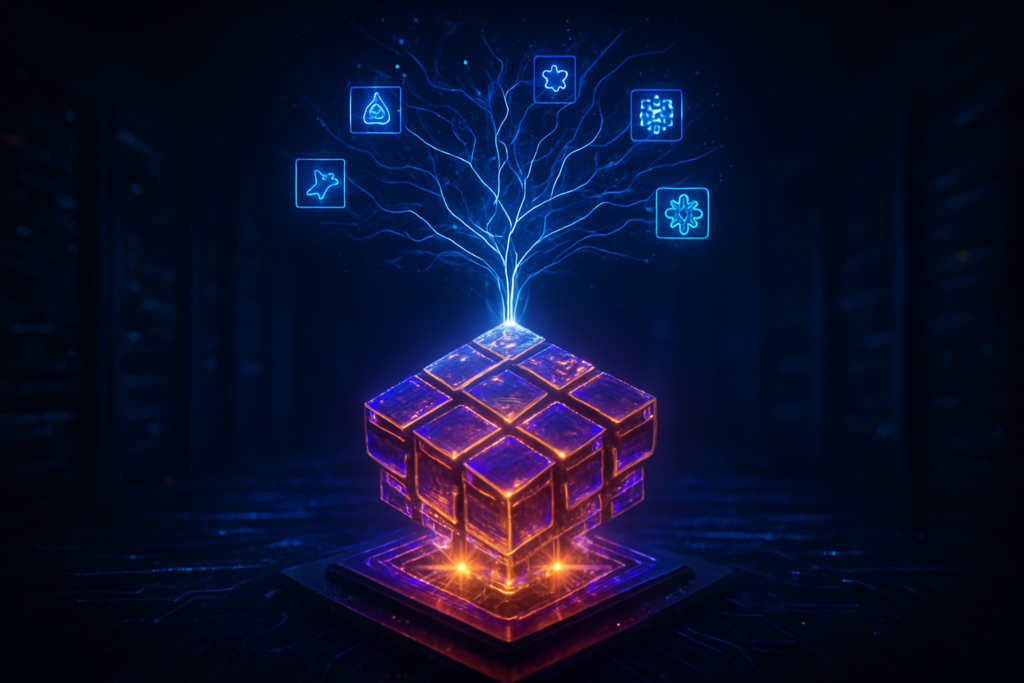
The landscape of artificial intelligence underwent a tectonic shift at CES 2026 as NVIDIA (NASDAQ: NVDA) officially debuted its next-generation "Vera Rubin" platform. Moving beyond the text-generation capabilities of the previous Blackwell era, the Rubin architecture is designed from the ground up to support "Agentic AI"—systems capable of autonomous reasoning, long-term planning, and independent execution of complex workflows. CEO Jensen Huang described the launch as the beginning of the "Reasoning Revolution," where AI transitions from a passive co-pilot to an active, autonomous digital employee.
The announcement represents more than just a hardware refresh; it is a fundamental redesign of the AI factory. By integrating the new Vera CPU and the R100 GPU with industry-first 6th-gen HBM4 memory, NVIDIA aims to eliminate the "memory wall" that has hindered the development of truly autonomous agents. As global enterprises look to deploy agents that can manage entire supply chains or conduct scientific research with minimal human oversight, the Rubin platform arrives as the essential infrastructure for the next decade of silicon-based intelligence.
Technical Prowess: The Vera CPU and R100 GPU Deep Dive
At the heart of the Rubin platform lies a sophisticated "extreme-codesigned" system consisting of the Vera CPU and the R100 GPU. The Vera CPU, succeeding the Grace architecture, features 88 custom "Olympus" cores built on the Arm v9.2 architecture. Utilizing spatial multi-threading, Vera supports 176 concurrent threads, delivering a twofold performance increase over its predecessor. This CPU is specifically tuned to act as the "orchestrator" for agentic tasks, managing the complex logic and tool-use protocols required when an AI agent interacts with external software or hardware.
The R100 GPU is the platform's powerhouse, manufactured on TSMC’s (NYSE: TSM) advanced 3nm process. It boasts a staggering 336 billion transistors and introduces the 3rd-generation Transformer Engine. Most notably, the R100 features redesigned Streaming Multiprocessors (SMs) optimized for "Tree-of-Thought" processing. This allows the GPU to explore multiple logical paths simultaneously and discard unproductive reasoning branches in real-time, a capability crucial for models like OpenAI’s o1 or Google’s (NASDAQ: GOOGL) latest reasoning-heavy architectures.
The most significant bottleneck in AI—memory bandwidth—has been addressed through the integration of 6th-generation HBM4 memory. Each R100 GPU is equipped with 288GB of HBM4, providing an aggregate bandwidth of 22 TB/s. This represents a nearly threefold increase over the Blackwell generation. Through NVLink-C2C, the Vera CPU and Rubin GPUs share a unified memory pool, allowing for the seamless data movement necessary to handle trillion-parameter models that require massive "test-time scaling," where the system "thinks" longer to produce more accurate results.
Reshaping the AI Market: The End of the "Inference Tax"
The introduction of the Rubin architecture sends a clear signal to the rest of the tech industry: the cost of intelligence is about to plummet. NVIDIA claims the platform reduces the cost per token by 10x while delivering 5x faster inference performance compared to Blackwell. This reduction is critical for cloud service providers like Amazon (NASDAQ: AMZN) AWS, Microsoft (NASDAQ: MSFT) Azure, and Oracle (NYSE: ORCL), who are all slated to receive the first Rubin-powered systems in the second half of 2026. By lowering the "inference tax," NVIDIA is making it economically viable for startups to deploy persistent, always-on AI agents that were previously too expensive to maintain.
For competitors like AMD (NASDAQ: AMD) and Intel (NASDAQ: INTC), the Rubin platform raises the bar for what constitutes an "AI chip." NVIDIA is no longer just selling silicon; it is selling a rack-scale computer—the NVL72—which acts as a single, massive GPU. The inclusion of the BlueField-4 DPU for context memory management and Spectrum-X silicon photonics networking ensures that NVIDIA maintains its "moat" by providing a vertically integrated stack that is difficult for rivals to replicate piece-meal.
A Wider Significance: From Pattern Matching to Autonomous Reasoning
The Vera Rubin platform marks the transition of the industry from the "Generative Era" to the "Reasoning Era." For the past three years, AI has been largely characterized by high-speed pattern matching. The Rubin architecture is the first hardware platform specifically built for "Closed-Loop Science" and autonomous reasoning. During the CES demonstration, NVIDIA showcased agents hypothesized new chemical compounds, simulated their properties, and then directed robotic lab equipment to synthesize them—all running locally on a Rubin cluster.
This shift has profound implications for the broader AI landscape. By enabling "test-time scaling," Rubin allows AI models to spend more compute cycles on reasoning rather than just outputting the next likely word. This addresses a major concern in the research community: the plateauing of model performance based on data scaling alone. If models can "think" their way through problems using Rubin’s specialized SMs, the path to Artificial General Intelligence (AGI) may no longer depend solely on scraping more internet data, but on more efficient, autonomous logical exploration.
The Horizon: Future Developments and Agentic Workflows
Looking ahead, the rollout of the Rubin platform in late 2026 is expected to trigger a wave of "Agentic Workflows" across various sectors. In the near term, we expect to see the rise of "Digital Employees" in software engineering, legal discovery, and financial modeling—agents that can work for hours or days on a single prompt. The long-term challenge will be the massive power requirements of these reasoning-heavy tasks. While Rubin is more efficient per-token, the sheer volume of autonomous agents could strain global energy grids, prompting further innovation in liquid cooling and sustainable data center design.
Experts predict that the next phase of development will focus on "Inter-Agent Collaboration." With the Rubin platform's high-speed NVLink 6 interconnect, thousands of specialized agents could potentially work together in a single rack, functioning like a synthetic department within a company. The primary hurdle will be creating the software frameworks to manage these fleets of agents, a task NVIDIA hopes to solve with its expanded CUDA-X libraries and NIM microservices.
Conclusion: A Landmark in AI History
NVIDIA’s unveiling of the Vera Rubin platform at CES 2026 is a defining moment in the history of computing. By providing the specialized hardware necessary for autonomous reasoning and agentic behavior, NVIDIA has effectively set the stage for the next phase of the digital revolution. The combination of Vera CPUs, R100 GPUs, and HBM4 memory breaks the traditional barriers of memory and logic that have constrained AI until now.
As the industry prepares for the delivery of these systems in H2 2026, the focus will shift from what AI can say to what AI can do. The Rubin architecture isn't just a faster processor; it is the foundation for a world where autonomous digital entities become an integral part of the workforce. For investors, developers, and society at large, the message from CES 2026 is clear: the era of the reasoning agent has officially arrived.
This content is intended for informational purposes only and represents analysis of current AI developments.
TokenRing AI delivers enterprise-grade solutions for multi-agent AI workflow orchestration, AI-powered development tools, and seamless remote collaboration platforms.
For more information, visit https://www.tokenring.ai/.