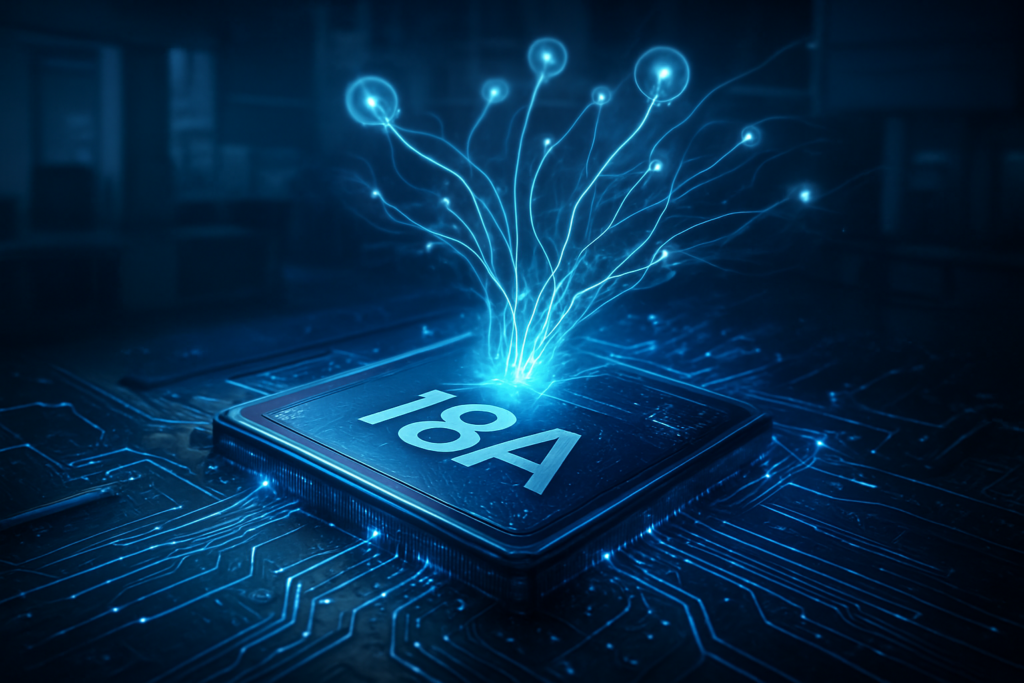
In a landmark moment for the semiconductor industry, Intel Corporation (NASDAQ: INTC) has officially begun shipping its highly anticipated Panther Lake processors, branded as Core Ultra Series 3. The launch, which took place in late January 2026, marks the successful high-volume manufacturing of the Intel 18A process node at the company’s Ocotillo campus in Arizona. For Intel, this is more than just a product release; it is the final validation of CEO Pat Gelsinger’s ambitious "5-nodes-in-4-years" turnaround strategy, positioning the company at the bleeding edge of logic manufacturing once again.
Early third-party benchmarks and internal validation data indicate that Panther Lake has achieved a stunning 33% multi-core performance lead over the Apple Inc. (NASDAQ: AAPL) M5 processor, which launched late last year. This performance delta signals a massive shift in the mobile computing landscape, where Apple’s silicon has held the crown for efficiency and multi-threaded throughput for over half a decade. By successfully delivering 18A on schedule, Intel has not only regained parity with Taiwan Semiconductor Manufacturing Company (NYSE: TSM) but has arguably moved ahead in the integration of next-generation transistor technologies.
Technical Mastery: RibbonFET, PowerVia, and the Xe3 Leap
At the heart of Panther Lake’s dominance is the Intel 18A process, which introduces two revolutionary technologies to high-volume manufacturing: RibbonFET and PowerVia. RibbonFET, Intel's implementation of gate-all-around (GAA) transistors, provides superior control over the transistor channel, significantly reducing power leakage while increasing drive current. Complementing this is PowerVia, the industry's first commercial implementation of backside power delivery. By moving power routing to the rear of the silicon wafer, Intel has eliminated the "wiring congestion" that has plagued chip designers for years, allowing for higher clock speeds and improved thermal management.
The architecture of Panther Lake itself is a hybrid marvel. It features the new "Cougar Cove" Performance-cores (P-cores) and "Darkmont" Efficient-cores (E-cores). The Darkmont cores are particularly notable; they provide such a massive leap in IPC (Instructions Per Cycle) that they reportedly rival the performance of previous-generation performance cores while consuming a fraction of the power. This architectural synergy, combined with the 18A process's density, is what allows the flagship 16-core mobile SKUs to handily outperform the Apple M5 in multi-threaded workloads like 8K video rendering and large-scale code compilation.
On the graphics and AI front, Panther Lake debuts the Xe3 "Celestial" architecture. Early testing shows a nearly 70% gaming performance jump over the previous Lunar Lake generation, effectively making entry-level discrete GPUs obsolete for many users. More importantly for the modern era, the integrated NPU 5.0 delivers 50 dedicated TOPS (Trillion Operations Per Second), bringing the total platform AI throughput—combining the CPU, GPU, and NPU—to a staggering 180 TOPS. This puts Panther Lake at the forefront of the "Agentic AI" era, capable of running complex, autonomous AI agents locally without relying on cloud-based processing.
Shifting the Competitive Landscape: Intel’s Foundry Gambit
The success of Panther Lake has immediate and profound implications for the competitive dynamics of the tech industry. For years, Apple has enjoyed a "silicon moat," utilizing TSMC’s latest nodes to deliver hardware that its rivals simply couldn't match. With Panther Lake’s 33% lead, that moat has effectively been breached. Intel is now in a position to offer Windows-based OEMs, such as Dell and HP, silicon that is not only competitive but superior in raw multi-core performance, potentially leading to a market share reclamation in the premium ultra-portable segment.
Furthermore, the validation of the 18A node is a massive win for Intel Foundry. Microsoft Corporation (NASDAQ: MSFT) has already signed on as a primary customer for 18A, and the successful ramp-up in the Arizona fabs will likely lure other major chip designers who are looking to diversify their supply chains away from a total reliance on TSMC. As Qualcomm Incorporated (NASDAQ: QCOM) and AMD (NASDAQ: AMD) navigate their own 2026 roadmaps, they find themselves facing a resurgent Intel that is vertically integrated and producing the world's most advanced transistors on American soil.
This development also puts pressure on NVIDIA Corporation (NASDAQ: NVDA). While NVIDIA remains the king of the data center, Intel’s massive jump in integrated graphics and AI TOPS means that for many edge AI and consumer applications, a discrete NVIDIA GPU may no longer be necessary. The "AI PC" is no longer a marketing buzzword; with Panther Lake, it is a high-performance reality that shifts the value proposition of the entire personal computing market.
The AI PC Era and the Return of "Moore’s Law"
The arrival of Panther Lake fits into a broader trend of "decentralized AI." While the last two years were defined by massive LLMs running in the cloud, 2026 is becoming the year of local execution. With 180 platform TOPS, Panther Lake enables "Always-on AI," where digital assistants can manage schedules, draft emails, and even perform complex data analysis across different apps in real-time, all while maintaining user privacy by keeping data on the device.
This milestone is also a psychological turning point for the industry. For much of the 2010s, there was a growing sentiment that Moore’s Law was dead and that Intel had lost its way. The "5-nodes-in-4-years" campaign was viewed by many skeptics as an impossible marketing stunt. By shipping 18A and Panther Lake on time and exceeding performance targets, Intel has demonstrated that traditional silicon scaling is still very much alive, albeit through radical new innovations like backside power delivery.
However, challenges remain. The aggressive shift to 18A has required billions of dollars in capital expenditure, and Intel must now maintain high yields at scale to ensure profitability. While the Arizona fabs are currently the "beating heart" of 18A production, the company’s long-term success will depend on its ability to replicate this success across its global manufacturing network and continue the momentum into the upcoming 14A node.
The Road Ahead: 14A and Beyond
Looking toward the late 2020s, Intel’s roadmap shows no signs of slowing down. The company is already pivoting its research teams toward the 14A node, which is expected to utilize High-Numerical Aperture (High-NA) EUV lithography. Experts predict that the lessons learned from the 18A ramp—specifically regarding the RibbonFET architecture—will give Intel a significant head start in the sub-1.4nm era.
In the near term, expect to see Panther Lake-based laptops hitting retail shelves in February and March 2026. These devices will likely be the flagship "Copilot+ PCs" for 2026, featuring deeper Windows integration than ever before. The software ecosystem is also catching up, with developers increasingly optimizing for Intel’s OpenVINO toolkit to take advantage of the 180 TOPS available on the new platform.
A Historic Comeback for Team Blue
The launch of Panther Lake and the 18A process represents one of the most significant comebacks in the history of the technology industry. After years of manufacturing delays and losing ground to both Apple and TSMC, Intel has reclaimed a seat at the head of the table. By delivering a 33% multi-core lead over the Apple M5, Intel has proved that its manufacturing prowess is once again a strategic asset rather than a liability.
Key takeaways from this launch include the successful debut of backside power delivery (PowerVia), the resurgence of x86 efficiency through the Darkmont E-cores, and the establishment of the United States as a hub for leading-edge semiconductor manufacturing. As we move further into 2026, the focus will shift from whether Intel can build these chips to how many they can produce and how quickly they can convert their foundry customers into market-dominating forces. The AI PC era has officially entered its high-performance phase, and for the first time in years, Intel is the one setting the pace.
This content is intended for informational purposes only and represents analysis of current AI developments.
TokenRing AI delivers enterprise-grade solutions for multi-agent AI workflow orchestration, AI-powered development tools, and seamless remote collaboration platforms.
For more information, visit https://www.tokenring.ai/.