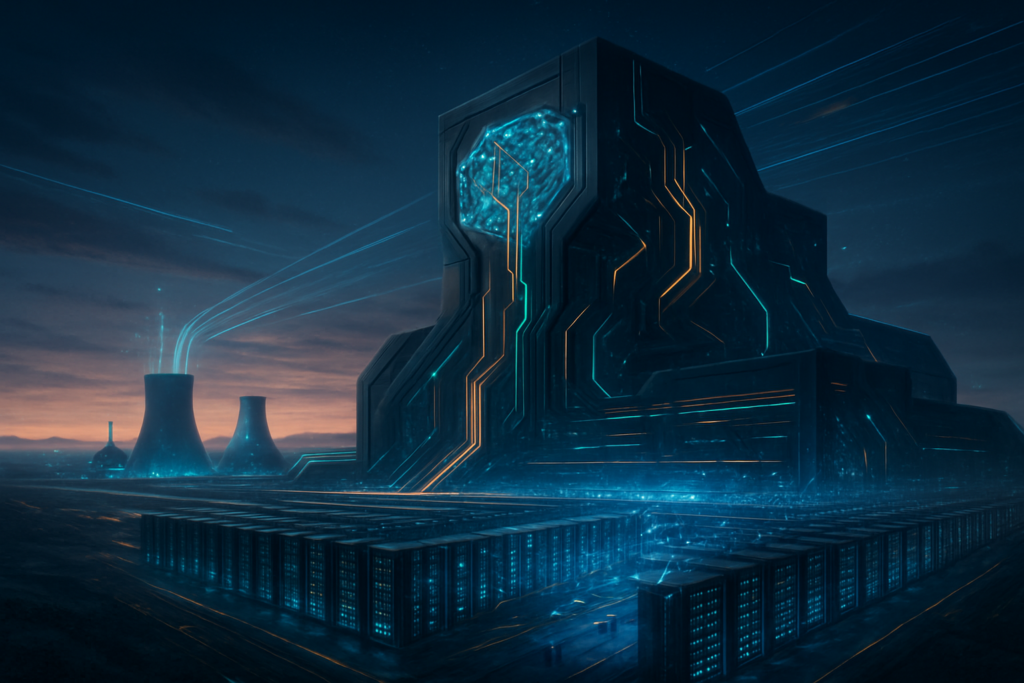
As of January 15, 2026, the landscape of artificial intelligence has moved beyond the era of mere software iteration and into a period of massive physical infrastructure. At the heart of this transformation is "Project Stargate," the legendary $100 billion supercomputer initiative spearheaded by Microsoft (NASDAQ: MSFT) and OpenAI. What began as a roadmap to house millions of specialized AI chips has now materialized into a series of "AI Superfactories" across the United States, marking the largest capital investment in a single computing project in human history.
This monumental collaboration represents more than just a data center expansion; it is an architectural bet on the arrival of Artificial General Intelligence (AGI). By integrating advanced liquid cooling, dedicated nuclear power sources, and a proprietary networking fabric, Microsoft and OpenAI are attempting to create a monolithic computing entity capable of training next-generation frontier models that are orders of magnitude more powerful than the GPT-4 and GPT-5 architectures that preceded them.
The Architecture of a Giant: 10 Gigawatts and Millions of Chips
Technically, Project Stargate has moved into Phase 5 of its multi-year development cycle. While Phase 4 saw the activation of the "Fairwater" campus in Wisconsin and the "Stargate I" facility in Abilene, Texas, the current phase involves the construction of the primary Stargate core. Unlike traditional data centers that serve thousands of different applications, Stargate is designed as a "monolithic" entity where the entire facility functions as one cohesive computer. To achieve this, the project is moving away from the industry-standard InfiniBand networking—which struggled to scale beyond hundreds of thousands of chips—in favor of an ultra-high-speed, custom Ethernet fabric designed to interconnect millions of specialized accelerators simultaneously.
The chip distribution for the 2026 roadmap reflects a diversified approach to silicon. While NVIDIA (NASDAQ: NVDA) remains the primary provider with its Blackwell (GB200 and GB300) and the newly shipping "Vera Rubin" architectures, Microsoft has successfully integrated its own custom silicon, the Maia 100 and the recently mass-produced "Braga" (Maia 2) accelerators. These chips are specifically tuned for OpenAI’s workloads, reducing the "compute tax" associated with general-purpose hardware. To keep these millions of processors from melting, the facilities utilize advanced closed-loop liquid cooling systems, which have become a regulatory necessity to eliminate the massive water consumption typically associated with such high-density heat loads.
This approach differs significantly from previous supercomputing clusters, which were often modular and geographically dispersed. Stargate’s primary innovation is its energy density and interconnectivity. The roadmap targets a staggering 10-gigawatt power capacity by 2030—roughly the energy consumption of New York City. Industry experts have noted that the sheer scale of the project has forced a shift in AI research from "algorithm-first" to "infrastructure-first," where the physical constraints of power and heat now dictate the boundaries of intelligence.
Market Shifting: The Era of the AI Super-Consortium
The implications for the technology sector are profound, as Project Stargate has triggered a "trillion-dollar arms race" among tech giants. Microsoft’s early $100 billion commitment has solidified its position as the dominant cloud provider for frontier AI, but the partnership has evolved. As of late 2025, OpenAI transitioned into a for-profit Public Benefit Corporation (PBC), allowing it to seek additional capital from a wider pool of investors. This led to the involvement of Oracle (NYSE: ORCL), which is now providing physical data center construction expertise, and SoftBank (OTC:SFTBY), which has contributed to a broader $500 billion "national AI fabric" initiative that grew out of the original Stargate roadmap.
Competitors have been forced to respond with equally audacious infrastructure plays. Google (NASDAQ: GOOGL) has accelerated its TPU v7 roadmap to match the Blackwell-Rubin scale, while Meta (NASDAQ: META) continues to build out its own massive clusters to support open-source research. However, the Microsoft-OpenAI alliance maintains a strategic advantage through its deep integration of custom hardware and software. By controlling the stack from the specialized "Braga" chips up to the model architecture, they can achieve efficiencies that startups and smaller labs simply cannot afford, potentially creating a "compute moat" that defines the next decade of the industry.
The Wider Significance: AI as National Infrastructure
Project Stargate is frequently compared to the Manhattan Project or the Apollo program, reflecting its status as a milestone of national importance. In the broader AI landscape, the project signals that the "scaling laws"—the observation that more compute and data consistently lead to better performance—have not yet hit a ceiling. However, this progress has brought significant concerns regarding energy consumption and environmental impact. The shift toward a 10-gigawatt requirement has turned Microsoft into a major energy player, exemplified by its 20-year deal with Constellation Energy (NASDAQ: CEG) to revive the Three Mile Island nuclear facility to provide clean baseload power.
Furthermore, the project has sparked intense debate over the centralization of power. With a $100 billion-plus facility under the control of two private entities, critics argue that the path to AGI is being privatized. This has led to increased regulatory scrutiny and a push for "sovereign AI" initiatives in Europe and Asia, as nations realize that computing power has become the 21st century's most critical strategic resource. The success or failure of Stargate will likely determine whether the future of AI is a decentralized ecosystem or a handful of "super-facilities" that serve as the world's primary cognitive engines.
The Horizon: SMRs and the Pursuit of AGI
Looking ahead, the next two to three years will focus on solving the "power bottleneck." While solar and battery storage are being deployed at the Texas sites, the long-term viability of Stargate Phase 5 depends on the successful deployment of Small Modular Reactors (SMRs). OpenAI’s involvement with Helion Energy is a key part of this strategy, with the goal of providing on-site fusion or advanced fission power to keep the clusters running without straining the public grid. If these energy breakthroughs coincide with the next leap in chip efficiency, the cost of "intelligence" could drop to a level where real-time, high-reasoning AI is available for every human activity.
Experts predict that by 2028, the Stargate core will be fully operational, facilitating the training of models that can perform complex scientific discovery, autonomous engineering, and advanced strategic planning. The primary challenge remains the physical supply chain: the sheer volume of copper, high-bandwidth memory, and specialized optical cables required for a "million-chip cluster" is currently stretching global manufacturing to its limits. How Microsoft and OpenAI manage these logistical hurdles will be as critical to their success as the code they write.
Conclusion: A Monument to the Intelligence Age
Project Stargate is more than a supercomputer; it is a monument to the belief that human-level intelligence can be engineered through massive scale. As we stand in early 2026, the project has already reshaped the global energy market, the semiconductor industry, and the geopolitical balance of technology. The key takeaway is that the era of "small-scale" AI experimentation is over; we have entered the age of industrial-scale intelligence, where success is measured in gigawatts and hundreds of billions of dollars.
In the coming months, the industry will be watching for the first training runs on the Phase 4 clusters and the progress of the Three Mile Island restoration. If Stargate delivers on its promise, it will be remembered as the infrastructure that birthed a new era of human capability. If it falters under the weight of its own complexity or energy demands, it will serve as a cautionary tale of the limits of silicon. Regardless of the outcome, the gate has been opened, and the race toward the frontier of intelligence has never been more intense.
This content is intended for informational purposes only and represents analysis of current AI developments.
TokenRing AI delivers enterprise-grade solutions for multi-agent AI workflow orchestration, AI-powered development tools, and seamless remote collaboration platforms. For more information, visit https://www.tokenring.ai/.