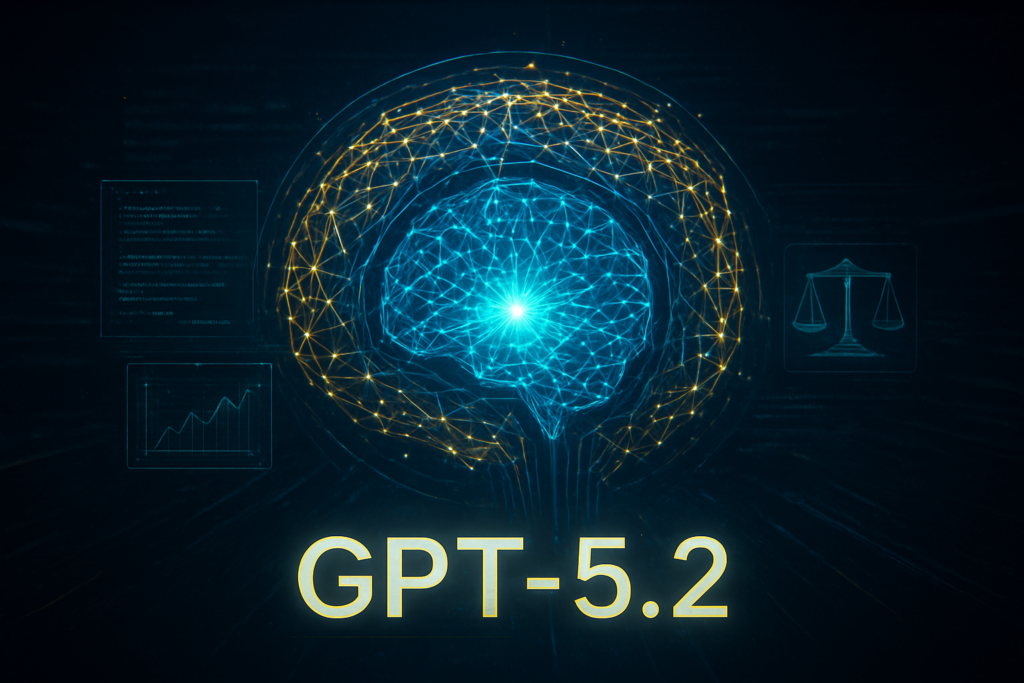
The artificial intelligence landscape underwent a seismic shift on December 11, 2025, with the release of OpenAI’s GPT-5.2. Positioned as a "professional agentic" tool rather than a mere conversationalist, GPT-5.2 represents the most significant leap in machine reasoning since the original debut of GPT-4. This latest iteration is designed to move beyond simple text generation, functioning instead as a high-fidelity reasoning engine capable of managing complex, multi-step workflows with a level of autonomy that was previously the stuff of science fiction.
The immediate significance of this release cannot be overstated. By introducing a tiered architecture—Instant, Thinking, and Pro—OpenAI has effectively created a "gearbox" for intelligence, allowing users to modulate the model's cognitive load based on the task at hand. Early industry feedback suggests that GPT-5.2 is not just an incremental update; it is a foundational change in how businesses approach cognitive labor. With a 30% reduction in factual errors and a performance profile that frequently matches or exceeds human professionals, the model has set a new standard for reliability and expert-level output in the enterprise sector.
Technically, GPT-5.2 is a marvel of efficiency and depth. At the heart of the release is the Thinking version, which utilizes a dynamic "Reasoning Effort" parameter. This allows the model to "deliberate" internally before providing an answer, providing a transparent summary of its internal logic via a Chain of Thought output. In the realm of software engineering, GPT-5.2 Thinking achieved a record-breaking score of 55.6% on the SWE-Bench Pro benchmark—a rigorous, multi-language evaluation designed to resist data contamination. A specialized variant, GPT-5.2-Codex, pushed this even further to 56.4%, demonstrating an uncanny ability to resolve complex GitHub issues and system-level bugs that previously required senior-level human intervention.
Perhaps more vital for enterprise adoption is the dramatic 30% reduction in factual errors compared to its predecessor, GPT-5.1. This was achieved through a combination of enhanced retrieval-augmented generation (RAG) and a new "verification layer" that cross-references internal outputs against high-authority knowledge bases in real-time. The flagship Pro version takes this a step further, offering a massive 400,000-token context window and an exclusive "xhigh" reasoning level. This mode allows the model to spend several minutes on a single prompt, effectively "thinking through" high-stakes problems in fields like legal discovery, medical diagnostics, and system architecture.
The Instant version rounds out the family, optimized for ultra-low latency. While it lacks the deep reasoning of its siblings, it boasts a 40% reduction in hallucinations for routine tasks, making it the ideal "reflexive" brain for real-time applications like live translation and scheduling. Initial reactions from the AI research community have been overwhelmingly positive, with many experts noting that the "Thinking" model's ability to show its work provides a much-needed layer of interpretability that has been missing from previous frontier models.
The market implications of GPT-5.2 were felt immediately across the tech sector. Microsoft (NASDAQ: MSFT), OpenAI’s primary partner, integrated the model into its Microsoft 365 Copilot suite within hours of the announcement. By late December, Microsoft began rebranding Windows 11 as an "agentic OS," leveraging GPT-5.2 to allow users to control system settings and execute complex file management tasks via natural language. This move has placed immense pressure on Alphabet Inc. (NASDAQ: GOOGL), which responded by accelerating the rollout of Gemini 3’s "Deep Think Mode" across 800 million Samsung (KRX: 005930) Galaxy devices.
The competitive landscape is also forcing defensive maneuvers from other tech giants. Meta Platforms, Inc. (NASDAQ: META), seeking to bridge the gap in autonomous agent capabilities, reportedly acquired the Singapore-based agentic startup Manus AI for $2 billion following the GPT-5.2 release. Meanwhile, Anthropic remains a fierce competitor; its Claude 4.5 model continues to hold a slight edge in certain coding leaderboards, maintaining its position as the preferred choice for safety-conscious enterprises. However, the sheer breadth of OpenAI’s "gearbox" approach—offering high-speed, high-reasoning, and deep-work tiers—gives them a strategic advantage in capturing diverse market segments from developers to C-suite executives.
Beyond the technical and corporate rivalry, the wider significance of GPT-5.2 lies in its economic potential, as highlighted by the new GDPval benchmark. Designed by OpenAI to measure performance on economically valuable tasks, GPT-5.2 Thinking outperformed industry professionals in 70.9% of comparisons across 44 occupations, including accounting, law, and manufacturing. The model completed these tasks roughly 11 times faster than human experts at less than 1% of the cost. This represents a pivotal moment in the "AI for work" trend, suggesting that AI is no longer just assisting professionals but is now capable of performing core professional duties at an expert level.
This breakthrough does not come without concerns. The ability of GPT-5.2 to outperform professionals across nearly four dozen occupations has reignited debates over labor displacement and the necessity of universal basic income (UBI) frameworks. On abstract reasoning tests like ARC-AGI-2, the model scored 54.2%, nearly triple the performance of previous generations, signaling that AI is rapidly closing the gap on general intelligence. This milestone compares to the historical significance of Deep Blue defeating Garry Kasparov, but with the added complexity that this "intelligence" is now being deployed across every sector of the global economy simultaneously.
Looking ahead, the near-term focus will be on the "agentic" deployment of these models. Experts predict that the next 12 months will see a proliferation of autonomous AI workers capable of managing entire departments, from customer support to software QA, with minimal human oversight. The challenge for 2026 will be addressing the "alignment gap"—ensuring that as these models spend more time "thinking" and acting independently, they remain strictly within the bounds of human intent and safety protocols.
We also expect to see a shift in hardware requirements. As GPT-5.2 Pro utilizes minutes of compute for a single query, the demand for specialized AI inference chips will likely skyrocket, further benefiting companies like NVIDIA (NASDAQ: NVDA). In the long term, the success of GPT-5.2 serves as a precursor to GPT-6, which is rumored to incorporate even more advanced "world models" that allow the AI to simulate outcomes in physical environments, potentially revolutionizing robotics and automated manufacturing.
OpenAI’s GPT-5.2 release marks the definitive end of the "chatbot era" and the beginning of the "agentic era." By delivering a model that can think, reason, and act with professional-grade precision, OpenAI has fundamentally altered the trajectory of human-computer interaction. The key takeaways are clear: the reduction in factual errors and the massive jump in coding and reasoning benchmarks make AI a reliable partner for high-stakes professional work.
As we move deeper into 2026, the industry will be watching how competitors like Google and Anthropic respond to this "gearbox" approach to intelligence. The significance of GPT-5.2 in AI history will likely be measured by how quickly society can adapt to its presence. For now, one thing is certain: the bar for what constitutes "artificial intelligence" has once again been raised, and the world is only beginning to understand the implications.
This content is intended for informational purposes only and represents analysis of current AI developments.
TokenRing AI delivers enterprise-grade solutions for multi-agent AI workflow orchestration, AI-powered development tools, and seamless remote collaboration platforms.
For more information, visit https://www.tokenring.ai/.