Looking back from the vantage point of January 2026, the trajectory of artificial intelligence has shifted dramatically from the digital screens of chatbots to the physical world of autonomous motion. This transformation can be traced back to a pivotal moment in late 2024, when Physical Intelligence (Pi), a San Francisco-based startup, secured a staggering $400 million in Series A funding. At a valuation of $2.4 billion, the round signaled more than just investor confidence; it marked the birth of the "Universal Foundation Model" for robotics, a breakthrough that promised to do for physical movement what GPT did for human language.
The funding round, which drew high-profile backing from Amazon.com, Inc. (NASDAQ: AMZN) founder Jeff Bezos, OpenAI, Thrive Capital, and Lux Capital, positioned Pi as the primary architect of a general-purpose robotic brain. By moving away from the "one-robot, one-task" paradigm that had defined the industry for decades, Physical Intelligence set out to create a single software system capable of controlling any robot, from industrial arms to advanced humanoids, across an infinite variety of tasks.
The Architecture of Action: Inside the $\pi_0$ Foundation Model
At the heart of Physical Intelligence’s success is $\pi_0$ (Pi-zero), a Vision-Language-Action (VLA) model that represents a fundamental departure from previous robotic control systems. Unlike traditional approaches that relied on rigid, hand-coded logic or narrow reinforcement learning for specific tasks, $\pi_0$ is a generalist. It was built upon a 3-billion parameter vision-language model, PaliGemma, developed by Alphabet Inc. (NASDAQ: GOOGL), which Pi augmented with a specialized 300-million parameter "action expert" module. This hybrid architecture allows the model to understand visual scenes and natural language instructions while simultaneously generating high-frequency motor commands.
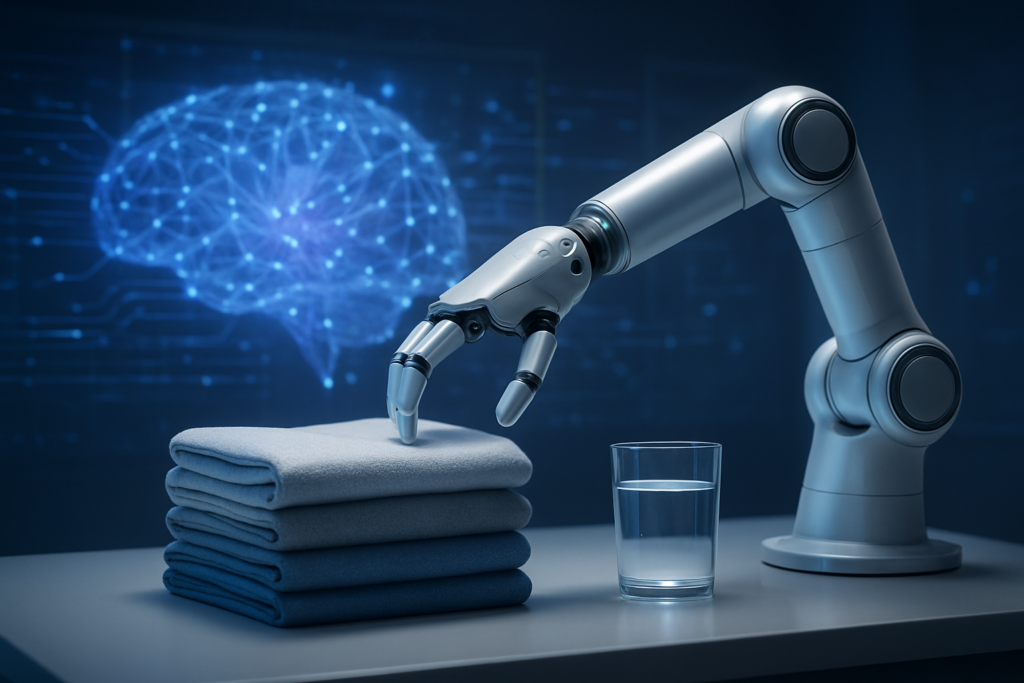
Technically, $\pi_0$ distinguishes itself through a method known as flow matching. This generative modeling technique allows the AI to produce smooth, continuous trajectories for robot limbs at a frequency of 50Hz, enabling the fluid, life-like movements seen in Pi’s demonstrations. During its initial unveiling, the model showcased remarkable versatility, autonomously folding laundry, bagging groceries, and clearing tables. Most impressively, the model exhibited "emergent behaviors"—unprogrammed actions like shaking a plate to clear crumbs into a bin before stacking it—demonstrating a level of physical reasoning previously unseen in the field.
This "cross-embodiment" capability is perhaps Pi’s greatest technical achievement. By training on over 10,000 hours of diverse data across seven different robot types, $\pi_0$ proved it could control hardware it had never seen before. This effectively decoupled the intelligence of the robot from its mechanical body, allowing a single "brain" to be downloaded into a variety of machines to perform complex, multi-stage tasks without the need for specialized retraining.
A New Power Dynamic: The Strategic Shift in the AI Arms Race
The $400 million investment into Physical Intelligence sent shockwaves through the tech industry, forcing major players to reconsider their robotics strategies. For companies like Tesla, Inc. (NASDAQ: TSLA), which has long championed a vertically integrated approach with its Optimus humanoid, Pi’s hardware-agnostic software represents a formidable challenge. While Tesla builds the entire stack from the motors to the neural nets, Pi’s strategy allows any hardware manufacturer to "plug in" a world-class brain, potentially commoditizing the hardware market and shifting the value toward the software layer.
The involvement of OpenAI and Jeff Bezos highlights a strategic hedge against the limitations of pure LLMs. As digital AI markets became increasingly crowded, the physical world emerged as the next great frontier for data and monetization. By backing Pi, OpenAI—supported by Microsoft Corp. (NASDAQ: MSFT)—ensured it remained at the center of the robotics revolution, even as it focused its internal resources on reasoning and agentic workflows. Meanwhile, for Bezos and Amazon, the technology offers a clear path toward the fully autonomous warehouse, where robots can handle the "long tail" of irregular items and unpredictable tasks that currently require human intervention.
For the broader startup ecosystem, Pi’s rise established a new "gold standard" for robotics software. It forced competitors like Sanctuary AI and Figure to accelerate their software development, leading to a "software-first" era in robotics. The release of OpenPi in early 2025 further cemented this dominance, as the open-source community adopted Pi’s framework as the standard operating system for robotic research, much like the Linux of the physical world.
The "GPT-3 Moment" for the Physical World
The emergence of Physical Intelligence is frequently compared to the "GPT-3 moment" for robotics. Just as GPT-3 proved that scaling language models could lead to unexpected capabilities in reasoning and creativity, $\pi_0$ proved that large-scale VLA models could master the nuances of the physical environment. This shift has profound implications for the global labor market and industrial productivity. For the first time, the "Moravec’s Paradox"—the discovery that high-level reasoning requires little computation but low-level sensorimotor skills require enormous resources—began to crumble.
However, this breakthrough also brought new concerns to the forefront. The ability for robots to perform diverse tasks like clearing tables or folding laundry raises immediate questions about the future of service-sector employment. Unlike the industrial robots of the 20th century, which were confined to safety cages in car factories, Pi-powered robots are designed to operate alongside humans in homes, hospitals, and restaurants. This proximity necessitates a new framework for safety and ethics in AI, as the consequences of a "hallucination" in the physical world are far more dangerous than a factual error in a text response.
Furthermore, the data requirements for these models are immense. While LLMs can scrape the internet for text, Physical Intelligence had to pioneer "robot data collection" at scale. This led to the creation of massive "data farms" where hundreds of robots perform repetitive tasks to feed the model's hunger for experience. As of 2026, the race for "physical data" has become as competitive as the race for high-quality text data was in 2023.
The Horizon: From Task-Specific to Fully Agentic Robots
As we move into 2026, the industry is eagerly awaiting the release of $\pi_1$, Physical Intelligence’s next-generation model. While $\pi_0$ mastered individual tasks, $\pi_1$ is expected to introduce "long-horizon reasoning." This would allow a robot to receive a single, vague command like "Clean the kitchen" and autonomously sequence dozens of sub-tasks—from loading the dishwasher to wiping the counters and taking out the trash—without human guidance.
The near-term future also holds the promise of "edge deployment," where these massive models are compressed to run locally on robot hardware, reducing latency and increasing privacy. Experts predict that by the end of 2026, we will see the first widespread commercial pilots of Pi-powered robots in elderly care facilities and hospitality, where the ability to handle soft, delicate objects and navigate cluttered environments is essential.
The primary challenge remaining is "generalization to the unknown." While Pi’s models have shown incredible adaptability, the sheer variety of the physical world remains a hurdle. A robot that can fold a shirt in a lab must also be able to fold a rain jacket in a dimly lit mudroom. Solving these "edge cases" of reality will be the focus of the next decade of AI development.
A New Chapter in Human-Robot Interaction
The $400 million funding round of 2024 was the catalyst that turned the dream of general-purpose robotics into a multi-billion dollar reality. Physical Intelligence has successfully demonstrated that the key to the future of robotics lies not in the metal and motors, but in the neural networks that govern them. By creating a "Universal Foundation Model," they have provided the industry with a common language for movement and interaction.
As we look toward the coming months, the focus will shift from what these robots can do to how they are integrated into society. With the expected launch of $\pi_1$ and the continued expansion of the OpenPi ecosystem, the barrier to entry for advanced robotics has never been lower. We are witnessing the transition of AI from a digital assistant to a physical partner, a shift that will redefine our relationship with technology for generations to come.
This content is intended for informational purposes only and represents analysis of current AI developments.
TokenRing AI delivers enterprise-grade solutions for multi-agent AI workflow orchestration, AI-powered development tools, and seamless remote collaboration platforms.
For more information, visit https://www.tokenring.ai/.