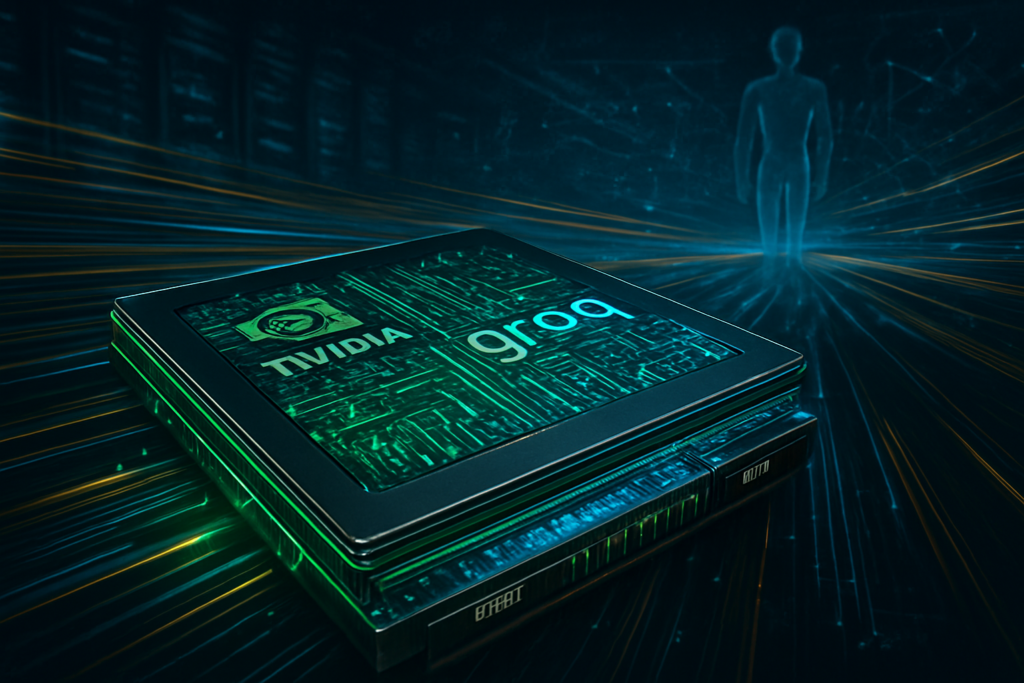
In a move that has sent shockwaves through the semiconductor industry, Nvidia (NASDAQ: NVDA) announced on December 24, 2025, that it has entered into a definitive $20 billion agreement to acquire the core assets and intellectual property of Groq, the pioneer of the Language Processing Unit (LPU). The deal, structured as a massive asset purchase and licensing agreement to navigate an increasingly complex global regulatory environment, effectively integrates the world’s fastest AI inference technology into the Nvidia ecosystem. As part of the transaction, Groq founder and former Google TPU architect Jonathan Ross will join Nvidia to lead a new "Ultra-Low Latency" division, bringing the majority of Groq’s elite engineering team with him.
The acquisition marks a pivotal shift in Nvidia's strategy as the AI market transitions from a focus on model training to a focus on real-time inference. By securing Groq’s deterministic architecture, Nvidia aims to eliminate the "memory wall" that has long plagued traditional GPU designs. This $20 billion bet is not merely about adding another chip to the catalog; it is a fundamental architectural evolution intended to consolidate Nvidia’s lead as the "AI Factory" for the world, ensuring that the next generation of generative AI applications—from humanoid robots to real-time translation—runs exclusively on Nvidia-powered silicon.
The Death of Latency: Groq’s Deterministic Edge
At the heart of this acquisition is Groq’s revolutionary LPU technology, which departs fundamentally from the probabilistic nature of traditional GPUs. While Nvidia’s current Blackwell architecture relies on complex scheduling, caches, and High Bandwidth Memory (HBM) to manage data, Groq’s LPU is entirely deterministic. The hardware is designed so that the compiler knows exactly where every piece of data is and what every transistor will be doing at every clock cycle. This eliminates the "jitter" and processing stalls common in multi-tenant GPU environments, allowing for the consistent, "speed-of-light" token generation that has made Groq a favorite among developers of real-time agents.
Technically, the LPU’s greatest advantage lies in its use of massive on-chip SRAM (Static Random Access Memory) rather than the external HBM3e used by competitors. This configuration allows for internal memory bandwidth of up to 80 TB/s—roughly ten times faster than the top-tier chips from Advanced Micro Devices (NASDAQ: AMD) or Intel (NASDAQ: INTC). In benchmarks released earlier this year, Groq’s hardware achieved inference speeds of over 500 tokens per second for Llama 3 70B, a feat that typically requires a massive cluster of GPUs to replicate. By bringing this IP in-house, Nvidia can now solve the "Batch Size 1" problem, delivering near-instantaneous responses for individual user queries without the latency penalties inherent in traditional parallel processing.
The initial reaction from the AI research community has been a mix of awe and apprehension. Experts note that while the integration of LPU technology will lead to unprecedented performance gains, it also signals the end of the "inference wars" that had briefly allowed smaller players to challenge Nvidia’s supremacy. "Nvidia just bought the one thing they didn't already have: the fastest short-burst inference engine on the planet," noted one lead analyst at a top Silicon Valley research firm. The move is seen as a direct response to the rising demand for "agentic AI," where models must think and respond in milliseconds to be useful in real-world interactions.
Neutralizing the Competition: A Masterstroke in Market Positioning
The competitive implications of this deal are devastating for Nvidia’s rivals. For years, AMD and Intel have attempted to carve out a niche in the inference market by offering high-memory GPUs as a more cost-effective alternative to Nvidia’s training-focused H100s and B200s. With the acquisition of Groq’s LPU technology, Nvidia has effectively closed that window. By integrating LPU logic into its upcoming Rubin architecture, Nvidia will be able to offer a hybrid "Superchip" that handles both massive-scale training and ultra-fast inference, leaving competitors with general-purpose architectures in a difficult position.
The deal also complicates the "make-vs-buy" calculus for hyperscalers like Amazon (NASDAQ: AMZN), Microsoft (NASDAQ: MSFT), and Alphabet (NASDAQ: GOOGL). These tech giants have invested billions into custom silicon like AWS Inferentia and Google’s TPU to reduce their reliance on Nvidia. However, Groq was the only independent provider whose performance could consistently beat these internal chips. By absorbing Groq’s talent and tech, Nvidia has ensured that the "merchant" silicon available on the market remains superior to the proprietary chips developed by the cloud providers, potentially stalling further investment in custom internal hardware.
For AI hardware startups like Cerebras and SambaNova, the $20 billion price tag sets an intimidating benchmark. These companies, which once positioned themselves as "Nvidia killers," now face a consolidated giant that possesses both the manufacturing scale of a trillion-dollar leader and the specialized architecture of a disruptive startup. Analysts suggest that the "exit path" for other hardware startups has effectively been choked, as few companies besides Nvidia have the capital or the strategic need to make a similar multi-billion-dollar acquisition in the current high-interest-rate environment.
The Shift to Inference: Reshaping the AI Landscape
This acquisition reflects a broader trend in the AI landscape: the transition from the "Build Phase" to the "Deployment Phase." In 2023 and 2024, the industry's primary bottleneck was training capacity. As we enter 2026, the bottleneck has shifted to the cost and speed of running these models at scale. Nvidia’s pivot toward LPU technology signals that the company views inference as the primary battlefield for the next five years. By owning the technology that defines the "speed of thought" for AI, Nvidia is positioning itself as the indispensable foundation for the burgeoning agentic economy.
However, the deal is not without its concerns. Critics point to the "license-and-acquihire" structure of the deal—similar to Microsoft's 2024 deal with Inflection AI—as a strategic move to bypass antitrust regulators. By leaving the corporate shell of Groq intact to operate its "GroqCloud" service while hollowing out its engineering core and IP, Nvidia may avoid a full-scale merger review. This has raised red flags among digital rights advocates and smaller AI labs who fear that Nvidia’s total control over the hardware stack will lead to a "closed loop" where only those who pay Nvidia’s premium can access the fastest models.
Comparatively, this milestone is being likened to Nvidia’s 2019 acquisition of Mellanox, which gave the company control over high-speed networking (InfiniBand). Just as Mellanox allowed Nvidia to build "data-center-scale" computers, the Groq acquisition allows them to build "real-time-scale" intelligence. It marks the moment when AI hardware moved beyond simply being "fast" to being "interactive," a requirement for the next generation of humanoid robotics and autonomous systems.
The Road to Rubin: What Comes Next
Looking ahead, the integration of Groq’s LPU technology will be the cornerstone of Nvidia’s future product roadmap. While the current Blackwell architecture will see immediate software-level optimizations based on Groq’s compiler tech, the true fusion will arrive with the Vera Rubin architecture, slated for late 2026. Internal reports suggest the development of a "Rubin CPX" chip—a specialized inference die that uses LPU-derived deterministic logic to handle the "prefill" phase of LLM processing, which is currently the most compute-intensive part of any user interaction.
The most exciting near-term application for this technology is Project GR00T, Nvidia’s foundation model for humanoid robots. For a robot to operate safely in a human environment, it requires sub-100ms latency to process visual data and react to physical stimuli. The LPU’s deterministic performance is uniquely suited for these "hard real-time" requirements. Experts predict that by 2027, we will see the first generation of consumer-grade robots powered by hybrid GPU-LPU chips, capable of fluid, natural interaction that was previously impossible due to the lag inherent in cloud-based inference.
Despite the promise, challenges remain. Integrating Groq’s SRAM-heavy design with Nvidia’s HBM-heavy GPUs will require a masterclass in chiplet packaging and thermal management. Furthermore, Nvidia must convince the developer community to adopt new compiler workflows to take full advantage of the LPU’s deterministic features. However, given Nvidia’s track record with CUDA, most industry observers expect the transition to be swift, further entrenching Nvidia’s software-hardware lock-in.
A New Era for Artificial Intelligence
The $20 billion acquisition of Groq is more than a business transaction; it is a declaration of intent. By absorbing its fastest competitor, Nvidia has moved to solve the most significant technical hurdle facing AI today: the latency gap. This deal ensures that as AI models become more complex and integrated into our daily lives, the hardware powering them will be able to keep pace with the speed of human thought. It is a definitive moment in AI history, marking the end of the era of "batch processing" and the beginning of the era of "instantaneous intelligence."
In the coming weeks, the industry will be watching closely for the first "Groq-powered" updates to the Nvidia AI Enterprise software suite. As the engineering teams merge, the focus will shift to how quickly Nvidia can roll out LPU-enhanced inference nodes to its global network of data centers. For competitors, the message is clear: the bar for AI hardware has just been raised to a level that few, if any, can reach. As we move into 2026, the question is no longer who can build the biggest model, but who can make that model respond the fastest—and for now, the answer is unequivocally Nvidia.
This content is intended for informational purposes only and represents analysis of current AI developments.
TokenRing AI delivers enterprise-grade solutions for multi-agent AI workflow orchestration, AI-powered development tools, and seamless remote collaboration platforms.
For more information, visit https://www.tokenring.ai/.