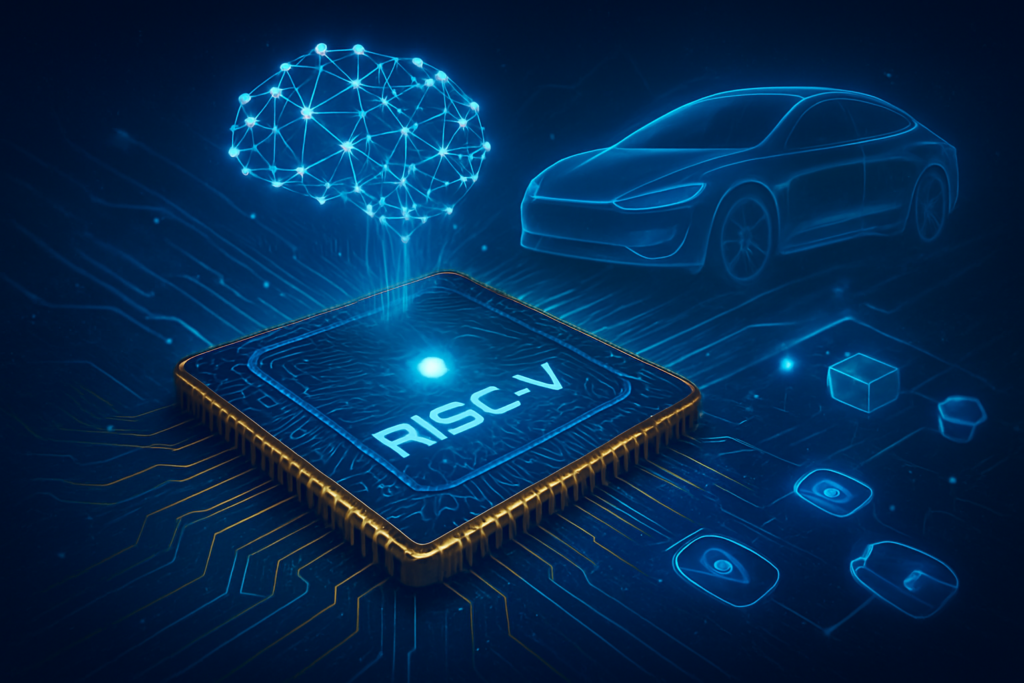
The global semiconductor landscape is undergoing a seismic shift as the open-source RISC-V architecture transitions from a niche academic experiment to a dominant force in mainstream computing. As of late 2024 and throughout 2025, RISC-V has emerged as the primary challenger to the decades-long hegemony of ARM Holdings (NASDAQ: ARM), particularly as industries seek to insulate themselves from rising licensing costs and geopolitical volatility. With an estimated 20 billion cores in operation by the end of 2025, the architecture is no longer just an alternative; it is becoming the foundational "hedge" for the world’s largest technology firms.
The momentum behind RISC-V is being driven by a perfect storm of technical maturity and strategic necessity. In sectors ranging from automotive to high-performance AI data centers, companies are increasingly viewing RISC-V as a way to reclaim "architectural sovereignty." By adopting an open standard, manufacturers are avoiding the restrictive licensing models and legal vulnerabilities associated with proprietary Instruction Set Architectures (ISAs), allowing for a level of customization and cost-efficiency that was previously unattainable.
Standardizing the Revolution: The RVA23 Milestone
The defining technical achievement of 2025 has been the widespread adoption of the RVA23 profile. Historically, the primary criticism against RISC-V was "fragmentation"—the risk that different implementations would be incompatible with one another. The RVA23 profile has effectively silenced these concerns by mandating standardized vector and hypervisor extensions. This allows major operating systems and AI frameworks, such as Linux and PyTorch, to run natively and consistently across diverse RISC-V hardware. This standardization is what has enabled RISC-V to move beyond simple microcontrollers and into the realm of complex, high-performance computing.
In the automotive sector, this technical maturity has manifested in the launch of RT-Europa by Quintauris—a joint venture between Bosch, Infineon, Nordic, NXP Semiconductors (NASDAQ: NXPI), Qualcomm (NASDAQ: QCOM), and STMicroelectronics (NYSE: STM). RT-Europa represents the first standardized RISC-V profile specifically designed for safety-critical applications like Advanced Driver Assistance Systems (ADAS). Unlike ARM’s fixed-feature Cortex-M or Cortex-R series, RISC-V allows these automotive giants to add custom instructions for specific AI sensor processing without breaking compatibility with the broader software ecosystem.
The technical shift is also visible in the data center. Ventana Micro Systems, recently acquired by Qualcomm in a landmark $2.4 billion deal, began shipping its Veyron V2 platform in 2025. Featuring 32 RVA23-compatible cores clocked at 3.85 GHz, the Veyron V2 has proven that RISC-V can compete head-to-head with ARM’s Neoverse and high-end x86 processors from Intel (NASDAQ: INTC) or AMD (NASDAQ: AMD) in raw performance and energy efficiency. Initial reactions from the research community have been overwhelmingly positive, noting that RISC-V’s modularity allows for significantly higher performance-per-watt in specialized AI workloads.
Strategic Realignment: Tech Giants Bet Big on Open Silicon
The strategic shift toward RISC-V has been accelerated by high-profile corporate maneuvers. Qualcomm’s acquisition of Ventana is perhaps the most significant, providing the mobile chip giant with high-performance, server-class RISC-V IP. This move is widely interpreted as a direct response to Qualcomm’s protracted legal battles with ARM over Nuvia IP, signaling a future where Qualcomm’s Oryon CPU roadmap may eventually transition away from ARM entirely. By owning their own RISC-V high-performance cores, Qualcomm secures its roadmap against future licensing disputes.
Other tech titans are following suit to optimize their AI infrastructure. Meta Platforms (NASDAQ: META) has successfully integrated custom RISC-V cores into its MTIA v2 (Artemis) AI inference chips to handle scalar tasks, reducing its reliance on both ARM and Nvidia (NASDAQ: NVDA). Similarly, Google (Alphabet Inc. – NASDAQ: GOOGL) and Meta have collaborated on the "TorchTPU" project, which utilizes a RISC-V-based scalar layer to ensure Google’s Tensor Processing Units (TPUs) are fully optimized for the PyTorch framework. Even Nvidia, the leader in AI hardware, now utilizes over 40 custom RISC-V cores within every high-end GPU to manage system functions and power distribution.
For startups and smaller chip designers, the benefit is primarily economic. While ARM typically charges royalties ranging from $0.10 to $2.00 per chip, RISC-V remains royalty-free. In the high-volume Internet of Things (IoT) market, which accounts for 30% of RISC-V's market share in 2025, these savings are being redirected into internal R&D. This allows smaller players to compete on features and custom AI accelerators rather than just price, disrupting the traditional "one-size-fits-all" approach of proprietary IP providers.
Geopolitical Sovereignty and the New Silicon Map
The rise of RISC-V carries profound geopolitical implications. In an era of trade restrictions and "chip wars," RISC-V has become the cornerstone of "architectural sovereignty" for regions like China and the European Union. China, in particular, has integrated RISC-V into its national strategy to minimize dependence on Western-controlled IP. By 2025, Chinese firms have become some of the most prolific contributors to the RISC-V standard, ensuring that their domestic semiconductor industry can continue to innovate even in the face of potential sanctions.
Beyond geopolitics, the shift represents a fundamental change in how the industry views intellectual property. The "Sputnik moment" for RISC-V occurred when the industry realized that proprietary control over an ISA is a single point of failure. The open-source nature of RISC-V ensures that no single company can "kill" the architecture or unilaterally raise prices. This mirrors the transition the software industry made decades ago with Linux, where a shared, open foundation allowed for a massive explosion in proprietary innovation built on top of it.
However, this transition is not without concerns. The primary challenge remains the "software gap." While the RVA23 profile has solved many fragmentation issues, the decades of optimization that ARM and x86 have enjoyed in compilers, debuggers, and legacy applications cannot be replicated overnight. Critics argue that while RISC-V is winning in new, "greenfield" sectors like AI and IoT, it still faces an uphill battle in the mature PC and general-purpose server markets where legacy software support is paramount.
The Horizon: Android, HPC, and Beyond
Looking ahead, the next frontier for RISC-V is the consumer mobile and high-performance computing (HPC) markets. A major milestone expected in early 2026 is the full integration of RISC-V into the Android Generic Kernel Image (GKI). While Google has experimented with RISC-V support for years, the 2025 standardization efforts have finally paved the way for RISC-V-based smartphones that can run the full Android ecosystem without performance penalties.
In the HPC space, several European and Japanese supercomputing projects are currently evaluating RISC-V for next-generation exascale systems. The ability to customize the ISA for specific mathematical workloads makes it an ideal candidate for the next wave of scientific research and climate modeling. Experts predict that by 2027, we will see the first top-10 supercomputer powered primarily by RISC-V cores, marking the final stage of the architecture's journey from the lab to the pinnacle of computing.
Challenges remain, particularly in building a unified developer ecosystem that can rival ARM’s. However, the sheer volume of investment from companies like Qualcomm, Meta, and the Quintauris partners suggests that the momentum is now irreversible. The industry is moving toward a future where the underlying "language" of the processor is a public good, and competition happens at the level of implementation and innovation.
A New Era of Silicon Innovation
The rise of RISC-V marks one of the most significant shifts in the history of the semiconductor industry. By providing a high-performance, royalty-free, and extensible alternative to ARM, RISC-V has democratized chip design and provided a vital safety valve for a global industry wary of proprietary lock-in. The year 2025 will likely be remembered as the point when RISC-V moved from a "promising alternative" to an "industry standard."
Key takeaways from this transition include the critical role of standardization (via RVA23), the massive strategic investments by tech giants to secure their hardware roadmaps, and the growing importance of architectural sovereignty in a fractured geopolitical world. While ARM remains a formidable incumbent with a massive installed base, the trajectory of RISC-V suggests that the era of proprietary ISA dominance is drawing to a close.
In the coming months, watchers should keep a close eye on the first wave of RISC-V-powered consumer laptops and the progress of the Quintauris automotive deployments. As the software ecosystem continues to mature, the question is no longer if RISC-V will challenge ARM, but how quickly it will become the de facto standard for the next generation of intelligent devices.
This content is intended for informational purposes only and represents analysis of current AI developments.
TokenRing AI delivers enterprise-grade solutions for multi-agent AI workflow orchestration, AI-powered development tools, and seamless remote collaboration platforms.
For more information, visit https://www.tokenring.ai/.