As of January 16, 2026, the landscape of retail finance has been irrevocably altered. What began as a high-stakes legal battle between Kalshi and federal regulators in late 2024 has blossomed into a multi-billion dollar industry, with Robinhood Markets, Inc. (NASDAQ: HOOD) standing at the center of the storm. The integration of prediction markets—once a niche hobby for policy wonks and crypto enthusiasts—into the pockets of millions of retail traders has transformed "event contracts" from a speculative novelty into a foundational asset class.
Current market data shows that trading volume for event contracts on Robinhood is reaching new heights, with participation in Federal Reserve interest rate markets and geopolitical "yes/no" contracts rivaling traditional options volume. This shift is not merely about betting; it is the realization of a new era of "Information Finance," where the collective wisdom of the crowd is priced in real-time, providing a "truth engine" that often outpaces traditional news media and polling.
The Market: What's Being Predicted
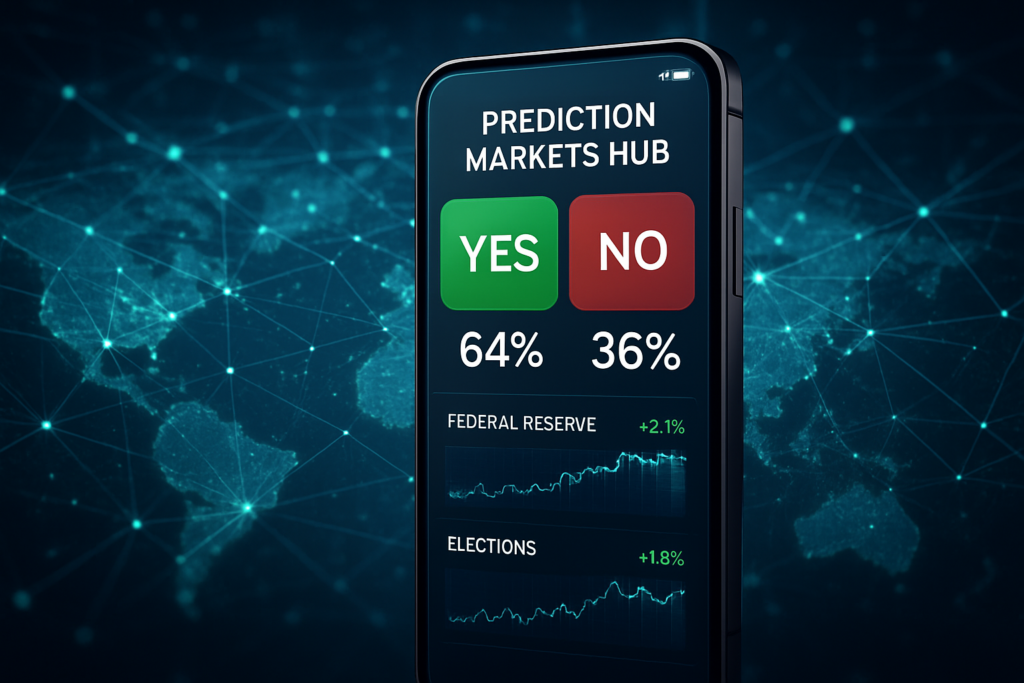
The current prediction market ecosystem on Robinhood is a far cry from its humble beginnings during the 2024 election cycle. Through its strategic partnership with Kalshi, Robinhood launched its "Prediction Markets Hub" in March 2025, which has since expanded to include thousands of daily contracts. While the 2024 U.S. Presidential Election served as the definitive "proof of concept," today's traders are focused on a more diverse array of outcomes.
Currently, the most liquid markets center on macroeconomic indicators. Traders are currently pricing in a 68% probability that the Federal Reserve will hold interest rates steady at its next meeting, a figure that has fluctuated wildly following recent CPI data releases. Beyond the Fed, the "Hub" offers contracts on everything from the outcome of the 2026 midterm primaries to the winner of the upcoming Super Bowl and even the year-end closing price of Brent Crude oil.
These contracts are structured as binary options, typically trading between $0.02 and $0.99. A "Yes" contract that settles correctly pays out $1.00, while an incorrect prediction goes to zero. This simplicity has been the key to Robinhood’s success, allowing retail investors to trade on their beliefs with the same ease they buy a fractional share of a tech stock.
Why Traders Are Betting
The surge in prediction market activity is driven by a fundamental shift in how retail investors perceive information. Robinhood CEO Vlad Tenev has championed the concept of "Information Finance," arguing that putting "skin in the game" is the most effective way to filter through the noise of the modern news cycle. For many, these markets are not just about profit; they are about accuracy and hedging.
Traders are increasingly using event contracts to protect their broader portfolios. For example, an investor heavily weighted in real estate might buy "Yes" contracts on a Fed rate hike as a direct hedge against mortgage rate volatility. "In a world of deepfakes and biased media, the market is the only unbiased source of truth," says one high-volume trader on the platform. "The price doesn't have an agenda; it only has an incentive to be right."
Notable "whale" activity has also been observed, with large positions being taken by institutional players who use Robinhood’s liquidity to signal their conviction on policy outcomes. This "wisdom of the crowd" has proven remarkably resilient; during the 2024 election, Robinhood and Kalshi's prices often stabilized and predicted state-level outcomes hours before major networks called them, cementing the platform's reputation as a leading indicator.
Broader Context and Implications
The mainstreaming of prediction markets represents a major victory for Kalshi, which fought a grueling legal battle against the Commodity Futures Trading Commission (CFTC) to prove that election contracts were not "gaming" but legitimate financial instruments. The court's decision in late 2024 paved the way for the current environment, where event contracts are regulated with the same rigor as futures and options.
This evolution has significant real-world implications. Governments and corporations are now looking to prediction market data as a more reliable metric than traditional sentiment surveys. If a market gives a 90% chance of a specific regulatory change, businesses can begin adjusting their capital expenditures months in advance.
However, the rapid growth has not been without controversy. Regulators continue to scrutinize the potential for market manipulation, particularly in lower-liquidity cultural markets. In response, Robinhood recently co-founded the Coalition for Prediction Markets alongside other industry leaders like Coinbase Global, Inc. (NASDAQ: COIN), aimed at establishing self-regulatory standards and lobbying for federal frameworks that protect participants while fostering innovation.
What to Watch Next
The next major milestone for Robinhood is the full transition to its proprietary derivatives exchange. Following the 2025 acquisition of a majority stake in LedgerX (now operating as MIAXdx), Robinhood is moving to bring the clearing and hosting of event contracts in-house. This move is expected to significantly reduce transaction costs and allow for even more exotic contract types, such as "bracket-style" betting on multi-candidate elections or tournament outcomes.
Investors should also keep an eye on the upcoming 2026 midterm elections. This will be the first major political cycle where prediction markets are fully integrated into the retail trading experience from the start of the primary season. The liquidity expected for these markets is predicted to dwarf the 2024 cycle, potentially reaching tens of billions in total volume.
Additionally, keep a close watch on international expansion. While currently centered in the U.S., Robinhood has signaled intentions to bring its "Information Finance" hub to the U.K. and EU markets, pending local regulatory approvals. A global, 24/7 truth engine could redefine how geopolitical risk is priced worldwide.
Bottom Line
The partnership between Robinhood and Kalshi has successfully moved prediction markets from the fringes of the internet to the center of the financial world. By framing these markets as "Information Finance" rather than "betting," Robinhood has tapped into a deep-seated desire among retail traders for more transparency and direct participation in the events that shape their lives.
As of January 2026, it is clear that prediction markets are no longer a fad. They have become an essential tool for price discovery and risk management in an increasingly volatile world. While the risks of binary "all-or-nothing" trading remain, the utility of a real-time, incentivized forecasting tool is proving too valuable for the market to ignore.
Ultimately, the success of this integration suggests that the future of finance is not just about what you own, but what you know—and how much you’re willing to back that knowledge with capital.
This article is for informational purposes only and does not constitute financial or betting advice. Prediction market participation may be subject to legal restrictions in your jurisdiction.
PredictStreet focuses on covering the latest developments in prediction markets.
Visit the PredictStreet website at https://www.predictstreet.ai/.