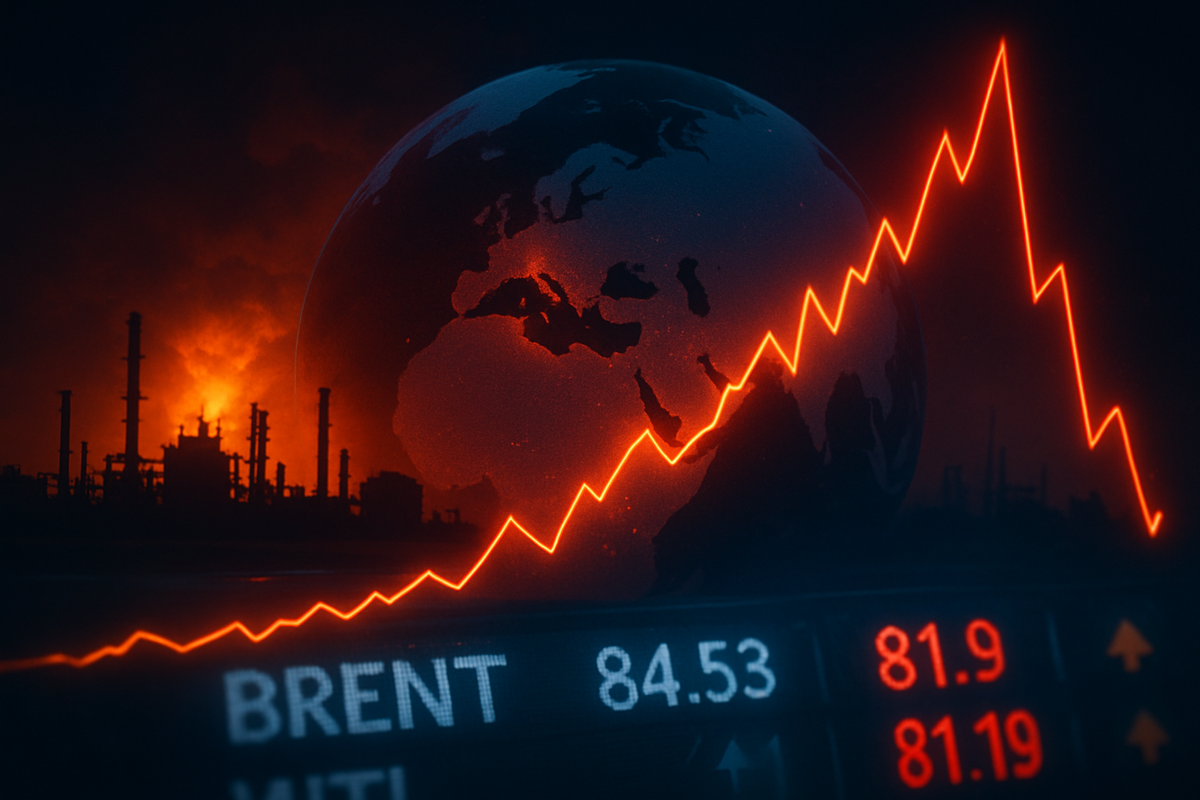
Global financial markets are reeling as a direct military confrontation between a U.S.-Israeli coalition and Iran has effectively shuttered the world’s most critical energy transit point, the Strait of Hormuz. As of March 9, 2026, the geopolitical landscape has shifted from regional tension to open warfare, sending Brent Crude prices screaming past $119 per barrel and West Texas Intermediate (WTI) to $114. The sudden disappearance of approximately 20 million barrels of daily global oil supply has ignited fears of a "stagflationary" spiral, threatening to undo years of central bank efforts to stabilize the post-pandemic global economy.
The Dow Jones Industrial Average and the S&P 500 have entered a period of extreme volatility, with the CBOE Volatility Index (VIX) spiking to 32.14—its highest level in nearly a year. Investors are frantically repositioning portfolios, fleeing high-growth tech stocks and consumer discretionary sectors in favor of defense contractors, domestic energy producers, and the safe-haven U.S. Dollar. The immediate market reaction reflects a grim realization: the "soft landing" projected by economists only months ago is now under direct threat from a massive energy-driven inflationary shock.
The Fog of War: Operation Epic Fury and the Path to Escalation
The current crisis traces its immediate origin to February 28, 2026, when the United States and Israel launched a massive, coordinated air and missile campaign dubbed "Operation Epic Fury." The operation targeted dozens of Iranian ballistic missile sites, drone manufacturing hubs, and hardened nuclear facilities at Natanz and Fordow. Military analysts suggest the scale of the strikes was unprecedented, involving nearly 900 sorties in the first 12 hours alone. The geopolitical vacuum created by the reported deaths of several high-ranking Iranian military officials during the initial wave triggered an immediate and chaotic response from Tehran.
Iran’s retaliation was swift and multi-pronged, designed to inflict maximum economic and operational pain on the West. By early March, Iran had launched a massive barrage of hundreds of "Fattah" hypersonic missiles and thousands of "Shahed" loitering munitions at U.S. military installations in Qatar, Bahrain, and the UAE. More critically for the global economy, Iranian naval forces moved to mine and blockade the Strait of Hormuz, while drone strikes targeted regional refineries and loading terminals. This effective closure of the world’s most vital oil artery has caused a literal "blackout" of energy exports from the Persian Gulf, leaving tankers stranded and global supply chains in disarray.
Key stakeholders, including the European Union and major Asian importers like China and Japan, have called for an immediate ceasefire, yet the escalation continues. As of this morning, the Pentagon has moved additional carrier strike groups into the North Arabian Sea, while Tehran maintains that oil prices will hit $200 per barrel unless all coalition forces withdraw from the region. The timeline of events has moved so rapidly that market participants have had little time to hedge, resulting in the aggressive sell-off currently witnessed across major exchanges.
Market Bifurcation: The Strategic Winners and Economic Losers
The surge in geopolitical risk has created a stark divide in the U.S. equity markets. Leading the "winners" column are major defense contractors and domestic energy explorers who stand to gain from increased military spending and the supply vacuum. RTX Corporation (NYSE: RTX) and Lockheed Martin Corporation (NYSE: LMT) have both seen their stock prices rise as the U.S. Department of Defense accelerates procurement for missile defense systems and advanced munitions. Similarly, smaller tactical players like AeroVironment, Inc. (NASDAQ: AVAV) have gained traction as their drone systems prove critical in the unfolding conflict.
On the energy front, U.S.-based producers with minimal exposure to the Middle East are being viewed as vital alternatives. Occidental Petroleum Corporation (NYSE: OXY) and Diamondback Energy, Inc. (NASDAQ: FANG) have outperformed the broader market, as high oil prices pad their bottom lines. Even integrated giants like Exxon Mobil Corporation (NYSE: XOM) and Chevron Corporation (NYSE: CVX) are seeing renewed interest, though their global logistical footprints remain vulnerable to shipping disruptions.
Conversely, the losers are numerous and highly visible. The airline industry, already sensitive to fuel costs, has been decimated. United Airlines Holdings, Inc. (NASDAQ: UAL) and other major carriers have seen double-digit percentage drops as jet fuel prices track the surge in crude. Consumer-facing companies and leisure stocks, such as Carnival Corporation & plc (NYSE: CCL), are also under heavy fire, as investors bet that $5-per-gallon gasoline will sap discretionary spending. Furthermore, major financial institutions like Morgan Stanley (NYSE: MS) and Citigroup Inc. (NYSE: C) have faced selling pressure; a prolonged energy crisis threatens to trigger a recession, leading to a potential spike in loan defaults and a cooling of the M&A market.
Broader Significance: Stagflation and the Federal Reserve’s Dilemma
The wider significance of this conflict extends far beyond the immediate price of oil. We are witnessing a potential shift in the global economic paradigm. For the past year, the Federal Reserve had been hinting at interest rate cuts as inflation moderated toward its 2% target. However, the current energy shock has fundamentally upended that narrative. With diesel and gasoline prices spiking, the cost of transporting everything from groceries to industrial equipment is rising, threatening to embed inflation deeper into the supply chain.
This event bears a haunting resemblance to the 1973 oil embargo, albeit in a more interconnected and digitally fast-paced world. The risk of "stagflation"—stagnant economic growth coupled with high inflation—is now the primary concern for institutional investors. If the Federal Reserve is forced to keep interest rates "higher for longer" to combat this energy-driven inflation, the resulting pressure on the housing market and corporate debt could be catastrophic. The 10-year Treasury yield has already climbed to 4.2%, its highest level since late 2025, signaling that the bond market is bracing for a more hawkish Fed than previously anticipated.
Furthermore, the conflict is accelerating the fragmentation of global trade. The "weaponization" of energy transit points like the Strait of Hormuz is forcing nations to reconsider their reliance on Middle Eastern supply chains. We are likely to see a massive policy shift toward "energy reshoring," with increased subsidies for domestic renewable projects and nuclear energy, as well as intensified drilling in the Americas. This regulatory pivot will have long-term implications for ESG (Environmental, Social, and Governance) investing, as national security concerns take precedence over immediate climate goals.
The Horizon: Potential Scenarios and Strategic Pivots
Looking forward, the short-term outlook depends entirely on the duration of the blockade in the Strait of Hormuz. If the U.S. Navy and its allies can successfully clear the mines and re-open the waterway within the next 30 days, we might see oil prices stabilize near $90. However, if Iran manages to sustain the disruption or if the conflict spreads to include Saudi Arabian facilities, analysts at Goldman Sachs and Rystad Energy warn that $150 per barrel is not only possible but likely. Such a scenario would almost certainly trigger a global recession by the third quarter of 2026.
For corporations, the strategic pivot must be toward resilience. We expect to see companies across all sectors aggressively hedging their energy exposure and diversifying their supply chains away from the region. Market opportunities may emerge in the cybersecurity sector, as the physical conflict is expected to be accompanied by state-sponsored cyberattacks on financial and energy infrastructure. Investors should look for companies with strong balance sheets and "pricing power"—the ability to pass on rising costs to consumers without losing market share.
Long-term, this crisis may serve as the final catalyst for a total overhaul of the global energy map. The strategic value of the Middle East, while still high, is being challenged by the sheer risk volatility it introduces into the global system. We may see a "Permanent War Footing" in the energy markets, where the risk premium on oil remains elevated for years to come, regardless of the immediate outcome of "Operation Epic Fury."
Wrap-Up: Navigating a New Era of Geopolitical Risk
The events of March 2026 serve as a stark reminder that the global economy remains tethered to the volatile geopolitics of the Middle East. The U.S.-Israeli strikes and subsequent Iranian retaliation have dismantled the relative stability of the energy markets, replacing it with a triple-digit oil environment and widespread inflationary anxiety. For the S&P 500, the path forward is fraught with uncertainty, as the dual pressures of rising costs and a potentially more aggressive Federal Reserve weigh on corporate earnings.
Key takeaways for the market include the renewed dominance of the energy and defense sectors, the extreme vulnerability of the travel and consumer industries, and the sudden return of "inflationary expectations" as a primary market driver. Moving forward, the market will likely remain in a "wait-and-see" mode, sensitive to every headline regarding diplomatic negotiations or further military escalation.
Investors should closely watch the weekly inventory reports from the Energy Information Administration (EIA), the Federal Reserve’s upcoming policy statements, and any movement in the 10-year Treasury yield. In this new era of high-stakes geopolitical confrontation, the only certainty is volatility. The coming months will determine whether this is a temporary shock or the beginning of a sustained period of economic hardship.
This content is intended for informational purposes only and is not financial advice.