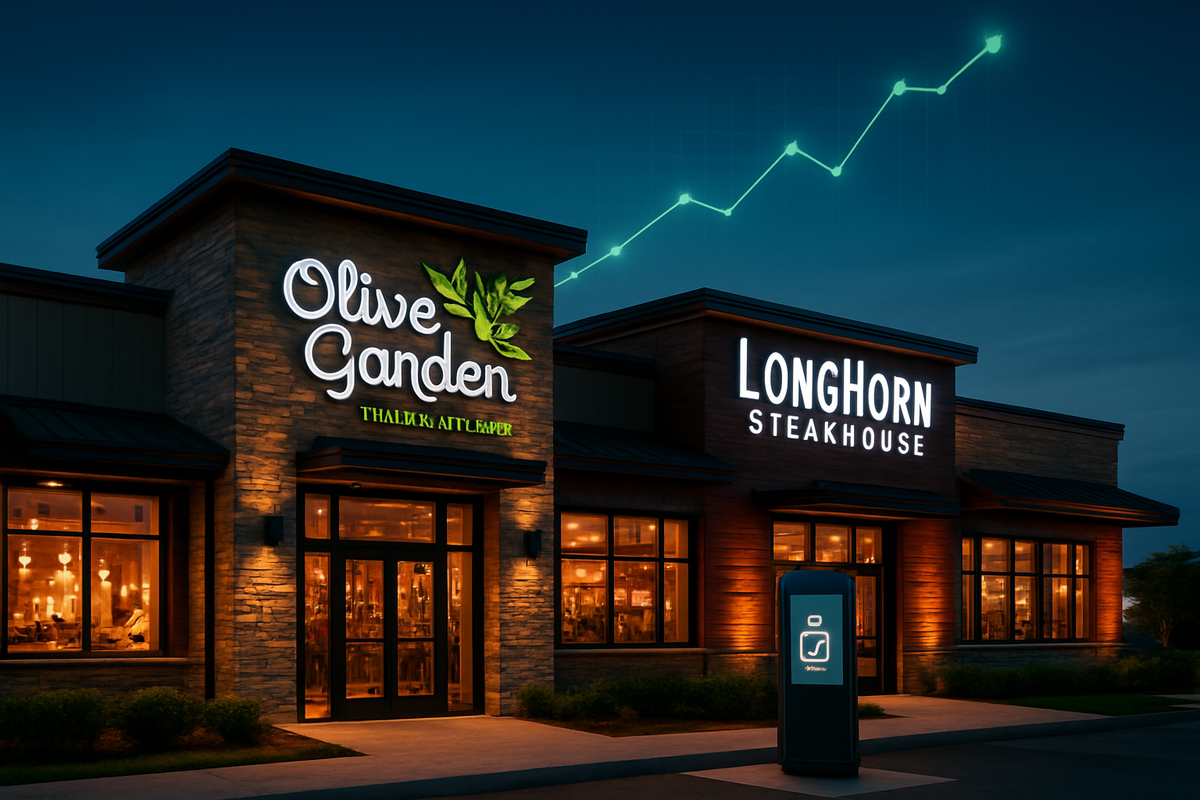
ORLANDO, FL — Darden Restaurants (NYSE: DRI) reported its fiscal third-quarter 2026 financial results today, March 19, 2026, posting a solid 5.9% increase in total sales that outperformed analyst expectations. The hospitality giant’s performance was anchored by the continued resilience of its flagship brands, Olive Garden and LongHorn Steakhouse, which capitalized on a shifting consumer preference for sit-down dining value over increasingly expensive quick-service alternatives.
Despite the positive top-line growth, the quarter was marked by a significant shift in corporate strategy. Darden officially announced the conclusion of its strategic review for the Bahama Breeze brand, confirming a planned exit from the concept in its current form. The move signals CEO Rick Cardenas’ commitment to streamlining the portfolio toward high-growth, scalable assets like the recently acquired Chuy’s and the established powerhouse brands that drove this quarter’s success.
Core Brands Lead the Charge Amidst Strategic Realignment
The 5.9% jump in total sales for the quarter ending February 2026 was largely fueled by a 4.1% same-store sales increase at Olive Garden and a robust 6.2% surge at LongHorn Steakhouse. Management attributed these gains to a "brilliance with the basics" philosophy, which has seen LongHorn achieve record-high scores for kitchen execution and historically low employee turnover rates. Olive Garden, meanwhile, successfully leveraged its "Never Ending Pasta Bowl" promotion, maintaining a $13.99 entry price for the fourth consecutive year to anchor its value proposition in an inflationary environment.
The timeline leading up to this quarter’s results has been defined by Darden’s aggressive digital pivot. Throughout 2025, the company integrated Uber Direct (NYSE: UBER) for delivery services across the Olive Garden footprint, a move that reversed years of resistance to third-party delivery. This integration contributed approximately 150 basis points to the quarter's sales growth, capturing "crave" occasions from younger, more affluent demographics who had previously opted for fast-casual delivery.
However, the spotlight of the earnings call remained on Bahama Breeze. After a 12-month strategic evaluation, Darden announced it will shutter 14 underperforming Bahama Breeze locations in non-core markets and convert the remaining 14 sites into either Olive Garden or LongHorn Steakhouse prototypes. The restructuring resulted in a $0.05 per share one-time charge this quarter but is expected to be accretive to earnings by the start of fiscal 2027. Investors reacted positively to the news, with shares of DRI rising 3.4% in early morning trading as the market applauded the focus on higher-margin brands.
Market Winners and Losers: The Casual Dining Landscape
Darden Restaurants (NYSE: DRI) emerges as the clear winner in the current landscape, demonstrating that scale and operational discipline can overcome the headwinds of rising beef costs and labor pressures. By exiting Bahama Breeze, Darden is effectively reallocating capital toward its more profitable "Tier 1" brands. Furthermore, the successful integration of Ruth’s Chris and Chuy’s into the Darden infrastructure has provided a blueprint for how the company can continue to grow through acquisition without diluting its core operational focus.
Conversely, competitors that lack Darden’s massive supply chain scale may find themselves at a disadvantage. While Texas Roadhouse (NASDAQ: TXRH) continues to perform exceptionally well, posting similar same-store sales growth, mid-tier players like Bloomin' Brands (NASDAQ: BLMN)—the parent of Outback Steakhouse—may struggle to match Darden’s aggressive value pricing. Brinker International (NYSE: EAT), the owner of Chili’s, remains a formidable challenger, but Darden’s recent move to dominate the "delivery-to-casual" pipeline via Uber Direct puts additional pressure on Brinker to innovate its off-premise offerings to maintain market share.
Analyzing the "Casual Dining Renaissance" of 2026
The broader significance of Darden’s Q3 results lies in what analysts are calling the "Casual Dining Renaissance." For much of the early 2020s, quick-service and fast-casual brands dominated the market. However, by 2026, the price gap between a premium fast-food meal and a sit-down experience at Olive Garden has narrowed significantly. Consumers are increasingly viewing casual dining as a better "holistic value," where the marginal cost increase is justified by the service and atmosphere.
Darden’s success also highlights a major shift in industry policy regarding delivery. For years, the casual dining sector viewed third-party delivery as a margin-eroding necessity. Darden’s strategic, slow-roll partnership with Uber (NYSE: UBER) has proven that a "delivery-on-our-terms" model—where the restaurant maintains control over the customer data and the delivery is handled by a white-label partner—can be both incremental and profitable. This is likely to set a new precedent for how large-scale restaurant groups approach the delivery market moving forward.
What Lies Ahead: Scalability and the "Small-Format" Future
Looking toward the remainder of 2026 and into 2027, Darden is expected to pivot toward "smaller-format" store designs for Yard House and Cheddar’s Scratch Kitchen. These prototypes, which require 20% less square footage while maintaining 90% of the traditional revenue capacity, are designed to penetrate suburban markets where real estate costs remain high. The capital freed up from the Bahama Breeze exit will likely be funneled into these high-efficiency builds.
The primary challenge for Darden in the short term will be the full integration of Chuy’s and the potential for "deal fatigue" among investors. While the company’s balance sheet remains strong, the focus must stay on organic growth. Market observers will be watching closely to see if the 6.2% growth at LongHorn is sustainable or if a plateau in beef demand will eventually force a cooling of the steakhouse segment.
Wrapping Up: A New Chapter for the Industry Leader
Darden’s Q3 2026 results confirm its status as the bellwether for the American casual dining industry. With 5.9% sales growth and a decisive plan to trim the fat from its portfolio, the company is positioning itself for a decade of lean, data-driven expansion. The strategic exit from Bahama Breeze, while sentimental for some, reflects a cold-eyed commitment to shareholder value and operational excellence that has become the hallmark of Rick Cardenas’ tenure.
For investors, the key takeaway is Darden's ability to maintain "value dominance" without engaging in a race to the bottom on pricing. As the company moves into the final quarter of the fiscal year, all eyes will be on the conversion rate of the Bahama Breeze sites and the continued synergy of the Uber Direct partnership. In a market where every dollar of consumer discretionary spending is fought for, Darden currently holds the high ground.
This content is intended for informational purposes only and is not financial advice.