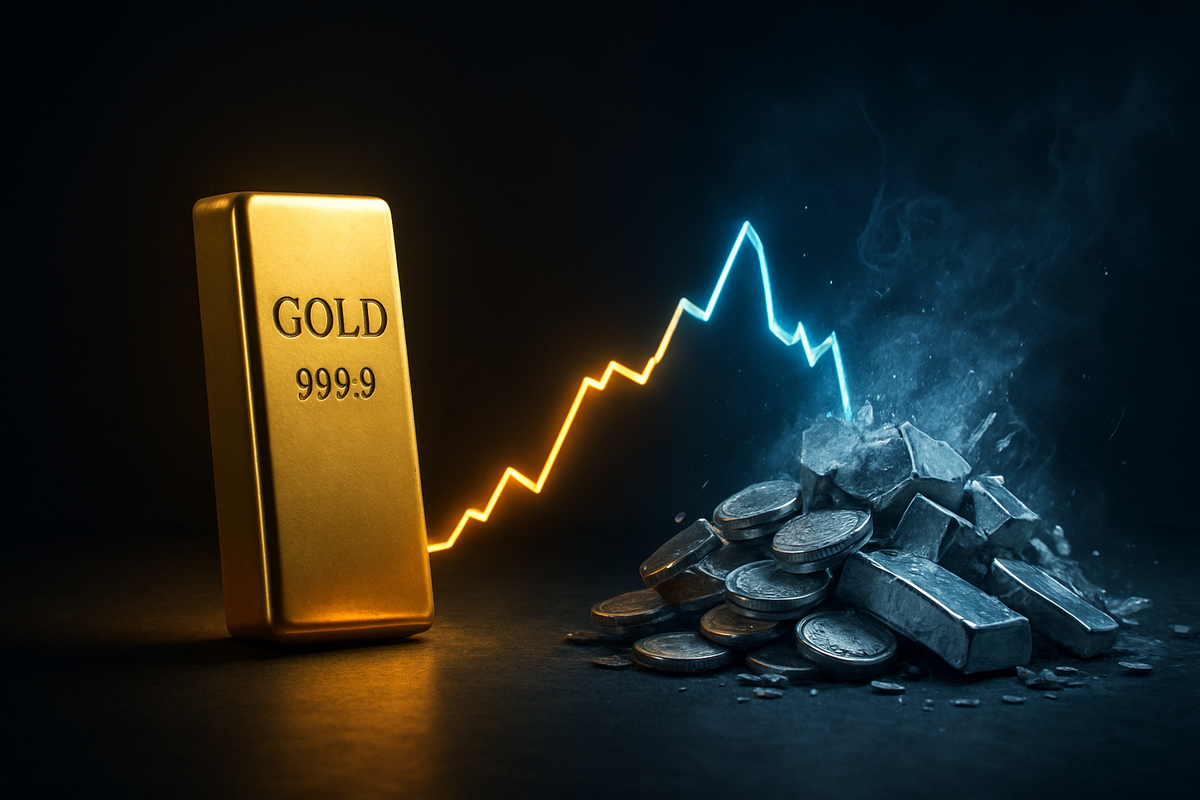
The opening month of 2026 has etched a stark divide into the precious metals market, characterized by a massive migration of capital from high-octane speculation to traditional safe havens. In January, the SPDR Gold Trust (NYSE Arca: GLD) attracted a staggering $2.6 billion in net inflows, while the iShares Silver Trust (NYSE Arca: SLV) suffered a punishing $2.9 billion exodus. This "great rotation" underscores a growing investor preference for stability over the extreme volatility that has recently gripped the silver market, turning what began as a unified metals rally into a fragmented landscape of risk management.
The divergence reached a fever pitch on January 30, 2026, when silver prices collapsed by 26% in a single trading session—the largest one-day drop in modern history. As the "debasement trade" that fueled silver's 160% gain over the previous year suddenly unwound, gold investors held their ground, treating the yellow metal as a relative sanctuary. While gold fell roughly 10% in sympathy during the silver flash crash, the fundamental appetite for gold remains robust, driven by a "flight to quality" as political and monetary uncertainties in the U.S. reach levels not seen in decades.
A Tale of Two Metals: The January Meltdown
The seeds of this divergence were sown in mid-January as silver reached overbought conditions reminiscent of the "Civil War era." By late month, technical indicators like the Relative Strength Index (RSI) for silver hit a staggering 89.1, a level of speculative fervor that historically precedes a violent correction. On Friday, January 30, the trigger was pulled: the nomination of Kevin Warsh to replace Jerome Powell as Chair of the Federal Reserve. Warsh’s hawkish reputation sparked an instantaneous rally in the U.S. dollar and a spike in Treasury yields, dealing a lethal blow to the leveraged silver trade.
The ensuing chaos saw silver prices plunge from an opening of $115 to a close of $85 per ounce. At its intraday nadir, the metal was down 35%, erasing trillions in perceived market value. To maintain order, the CME Group (NASDAQ: CME) intervened with aggressive margin hikes, raising silver requirements to as high as 16.5% for certain profiles. These margin calls acted as a forced liquidation mechanism, accelerating the downward spiral as retail and institutional speculators alike were squeezed out of their positions. In contrast, gold's inflows suggest that institutional "big money" is using the volatility to build defensive positions, anticipating long-term instability despite the short-term shock of a stronger dollar.
Winners and Losers in the Volatility Vortex
The dramatic shift in ETF flows and the underlying price action has created a polarized environment for public mining companies and financial institutions. Newmont Corporation (NYSE: NEM) and Barrick Gold (NYSE: GOLD), the world’s largest gold miners, have seen their shares under pressure due to the broader sector sell-off, yet they remain primary beneficiaries of the $2.6 billion inflow into gold products. Their relative stability compared to silver peers suggests that investors are distinguishing between "monetary assets" (gold) and "speculative industrial assets" (silver).
Conversely, pure-play silver producers like Pan American Silver (NASDAQ: PAAS) and Wheaton Precious Metals (NYSE: WPM) have borne the brunt of the January 30 collapse. For these companies, the 26% drop in the spot price directly impacts their quarterly revenue projections and NAV (Net Asset Value) calculations. Financial giants like Goldman Sachs (NYSE: GS) and JPMorgan Chase & Co. (NYSE: JPM) find themselves in a complex position; while their trading desks likely navigated the volatility, their research arms have been forced to defend highly bullish year-end targets in the face of a technical "flash crash."
The "Civil War" Comparison and Regulatory Blowback
Market historians have been quick to point out that silver’s monthly gain prior to the crash matched only one other period in U.S. history: January 1864. During that phase of the American Civil War, the erosion of the greenback led to a doubling of silver prices, a precedent that many analysts used to justify the parabolic move in late 2025 and early 2026. This comparison highlights a deeper concern among investors: the potential breakdown of the modern monetary system. The volatility is viewed by some as a symptom of extreme distrust in fiat currency, even if the January 30 crash provided a temporary reprieve for the dollar.
The regulatory response has been swift. Beyond the margin hikes by the CME Group, there is growing chatter in Washington about the role of ETFs in magnifying price swings. Critics argue that the massive concentration of silver in the iShares Silver Trust (NYSE Arca: SLV) creates a "tail wags the dog" effect, where ETF redemptions force physical selling that the market cannot absorb. This event is likely to trigger a renewed debate over position limits and the transparency of precious metal holdings within the largest exchange-traded products.
The Road to $6,000: Bullish Outlooks Remain Intact
Despite the carnage of late January, the world's most influential investment banks are not backing down from their aggressive price targets. JPMorgan Chase & Co. (NYSE: JPM) recently raised its end-2026 gold target to $6,300 per ounce, arguing that the "next demand leg" will be driven by a sustained increase in private sector allocations to gold ETFs. JPMorgan strategists suggest that if private investors increase their gold holdings from 3% to just 4.6%, the metal could see an "upside band" reaching as high as $8,500.
Goldman Sachs (NYSE: GS) maintains a similarly optimistic stance, lifting its year-end 2026 target to $5,400. Their thesis rests on two pillars: "fear" and "central bank demand." While the nomination of a hawkish Fed Chair may temporarily strengthen the dollar, the structural deficits of the U.S. and the ongoing diversification of global central banks away from the dollar are seen as irreversible trends. Goldman analysts characterized the January 30 silver crash as a "necessary flush of leverage" that clears the path for a more sustainable, institutional-led rally in the second half of the year.
Summary: A Necessary Reset for a Sustainable Bull Run
The divergence between GLD and SLV flows in early 2026 serves as a powerful reminder of the differing roles these two metals play in a portfolio. While gold remains the ultimate arbiter of value and a hedge against systemic risk, silver continues to behave like a high-beta speculative play, prone to violent "Civil War-era" swings. The $5.5 billion gap in monthly flows suggests that investors are increasingly wary of the volatility that comes with the "poor man's gold."
Moving forward, the market will be watching the Fed’s transition and the stability of the new margin requirements. If gold can hold its support levels following the January 30 shock, it may validate the "flight to quality" narrative and pave the way for the ambitious $5,400–$6,300 targets set by Wall Street. For now, the "Great Divorce" between gold and silver remains the defining story of the 2026 financial landscape, marking a transition from a retail-driven speculative frenzy to a more calculated, institutional accumulation phase.
This content is intended for informational purposes only and is not financial advice.