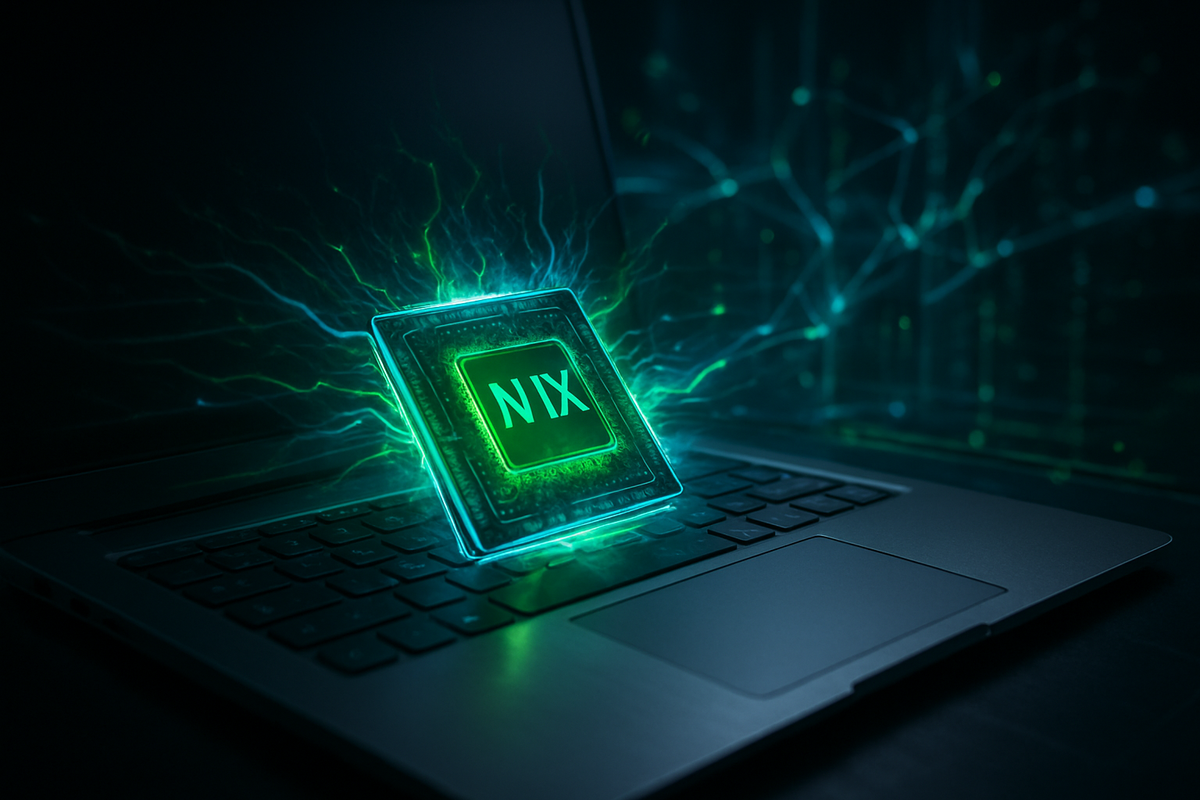
In a move that marks the end of the traditional x86 processor's decades-long dominance, Nvidia (NASDAQ: NVDA) today officially unveiled its N1 and N1X series of AI-powered laptop processors. Announced at the 2026 AI Mobile Summit in Barcelona, these chips represent Nvidia’s first comprehensive push into the consumer System-on-a-Chip (SoC) market, integrating high-performance Arm-based central processing units (CPUs) with its world-class Blackwell graphics architecture. The launch is not merely an expansion of a product line; it is a calculated strike at the heart of the personal computing industry, designed to turn every laptop into a localized AI powerhouse capable of tasks once reserved for massive data centers.
The immediate implications for the market are profound. By merging the CPU and GPU into a single, highly efficient "AI-first" silicon package, Nvidia is challenging the long-standing duopoly of Intel (NASDAQ: INTC) and AMD (NASDAQ: AMD). With Microsoft (NASDAQ: MSFT) simultaneously updating its Windows on Arm platform to support the N1X architecture, the tech giant is effectively signaling that the "AI PC" era has moved past the experimental phase and into the mainstream. For consumers, this promises a leap in both battery life and local AI performance, but for the industry, it sets the stage for a brutal war over who controls the "brain" of the next generation of computing.
Inside the N1X: The Architecture of an AI Revolution
The centerpiece of today’s announcement is the N1X, a flagship SoC co-developed with MediaTek (TPE:2454). Built on a cutting-edge 3nm process, the N1X features 20 custom Grace-based Arm cores and a massive GPU cluster consisting of 6,144 Blackwell-generation CUDA cores—roughly equivalent to the power of a high-end desktop RTX 5070 graphics card. This integration allows for a unified memory architecture (up to 128GB of LPDDR5X), mirroring the high-bandwidth efficiency that has made Apple (NASDAQ: AAPL) Silicon so successful. Early benchmarks shared by Nvidia CEO Jensen Huang show the N1X delivering over 100 TOPS (Tera Operations Per Second) of AI performance, more than doubling the baseline requirements for current "Copilot+" PCs.
The timeline leading to this moment has been years in the making. Following the 2024–2025 explosion in generative AI, Nvidia recognized that the future of computing was moving toward "on-device" inference to reduce latency and cloud costs. Throughout 2025, rumors circulated about Nvidia’s Project "Blackwell Mobile," but the shift from a discrete GPU supplier to a full SoC manufacturer remained a closely guarded secret until late last year. Key stakeholders, including major original equipment manufacturers (OEMs) like Dell (NYSE: DELL), HP (NYSE: HPQ), and Lenovo (HKG:0992), have reportedly been testing N1X prototypes for months, with the first flagship laptops expected to hit shelves in late Spring 2026.
Market reaction has been swift and largely optimistic, though cautious regarding the transition's complexity. While NVDA shares rose 2.4% following the announcement, trading near $192, analysts noted that the success of this venture depends heavily on software compatibility. "Nvidia is no longer just selling a component; they are selling the entire platform," noted one senior semiconductor analyst. "This is the most aggressive move we've seen in the PC space since the launch of the original Pentium, and it forces every other player to redefine their value proposition."
Winners, Losers, and the Shifting Silicon Balance
The launch of the N1 series creates a clear set of winners, most notably Nvidia itself, which is successfully diversifying its revenue streams away from a heavy reliance on cloud service providers. TSMC (NYSE: TSM), as the primary foundry for these high-margin 3nm chips, also stands to benefit significantly from the increased volume. Similarly, laptop OEMs like ASUS (TPE:2357) and Dell are likely to win by offering premium, "AI-native" devices that command higher average selling prices (ASPs), helping them recover from years of stagnating PC margins.
Conversely, Intel faces perhaps its most existential threat to date. Despite the recent launch of its Panther Lake processors, Intel’s mobile CPU market share has already eroded to approximately 72% in early 2026. Nvidia’s entry into the "brain" of the laptop directly cannibalizes Intel’s core business. AMD, while currently enjoying record share in the gaming x86 market with its Ryzen AI Max+ series, now finds its graphics superiority challenged by Nvidia’s integrated Blackwell cores. Qualcomm (NASDAQ: QCOM), which pioneered the current Windows on Arm resurgence with its Snapdragon X series, also faces a formidable rival that possesses a far more mature software ecosystem in CUDA.
Software developers may also find themselves in a bind. While Nvidia’s dominance in AI software gives them a "moat," the fragmentation of the Windows ecosystem between x86 (Intel/AMD) and Arm (Nvidia/Qualcomm/Apple) creates a complex development environment. Companies that can quickly optimize their applications for Nvidia’s N1X architecture—particularly in the creative and engineering sectors—will gain a competitive edge, while those slow to adapt risk being left behind in a market that is rapidly moving toward localized AI workflows.
The Broader Significance: AI Sovereignty on Your Desk
This event is a landmark moment in the broader industry trend of vertical integration. Following in Apple's footsteps, Nvidia is proving that the most efficient way to run complex AI models is to tightly couple the CPU, GPU, and memory on a single die. This shift marks the beginning of the "post-CPU" era, where the central processor is no longer the star of the show, but rather a coordinator for the AI engines surrounding it. It is a fundamental architectural change that mirrors the transition from the mainframe to the PC in the late 20th century.
However, Nvidia’s growing shadow over the entire AI hardware stack has not gone unnoticed by regulators. The U.S. Federal Trade Commission (FTC) and European Commission have both signaled increased scrutiny into whether Nvidia is using its data center dominance to unfairly influence the PC market. There are growing concerns regarding "technical tying"—the practice of optimizing software so it only runs efficiently on Nvidia hardware—which could lead to a "pre-emptive monopoly" in the AI PC space. The 2026 launch will likely serve as a catalyst for a new wave of antitrust investigations focused on the AI ecosystem.
Historically, this event draws comparisons to the "Wintel" era of the 1990s, where Microsoft and Intel moved in lockstep to dominate the industry. Today, we are seeing the emergence of an "Nvidiasoft" alliance, where Microsoft’s AI ambitions are increasingly reliant on Nvidia’s silicon roadmap. This dependency creates a ripple effect throughout the global supply chain, forcing competitors to either innovate at a frantic pace or seek strategic mergers to survive the "AI-driven consolidation" that is now well underway.
The Road Ahead: 2027 and the Rubin Horizon
Looking toward the short-term future, the market will be hyper-focused on the adoption rates of these N1X-powered laptops. If the first wave of devices from Dell and Lenovo meets their high performance and battery life claims, we could see a massive replacement cycle as enterprise customers rush to equip their workforces with local AI capabilities for data privacy reasons. By late 2026, we may see Nvidia expand this architecture into the workstation and even the entry-level server markets, further squeezing traditional x86 providers.
Longer term, the focus shifts to Nvidia’s next-generation "Rubin" architecture, expected to debut in late 2027. While the N1 series uses Blackwell technology, Rubin promises even more radical efficiency gains and specialized AI instructions. The strategic pivot required for Intel and AMD will be massive; they must not only catch up in NPU (Neural Processing Unit) performance but also find a way to counter Nvidia’s massive software advantage. We may see a scenario where the PC market splits into "AI-native" Arm systems (led by Nvidia and Apple) and legacy x86 systems, which could eventually become a niche for specialized industrial and backward-compatible applications.
The challenge for Nvidia will be managing its own success. The company must balance its high-margin data center business with the high-volume, lower-margin consumer PC market. Furthermore, any supply chain disruptions at TSMC or a slowdown in AI software development could temper the current enthusiasm. Investors will be watching for the first "AI PC" sales data in Q3 2026 to see if Nvidia can translate its technological dominance into a sustainable consumer business model.
Summary and Final Assessment
Nvidia’s launch of the N1 and N1X laptop chips is a watershed moment that officially brings the AI revolution to the consumer's lap. By integrating its Blackwell GPU architecture with an Arm-based CPU, Nvidia has effectively declared war on the x86 status quo. This move solidifies its position as the undisputed leader of the AI hardware ecosystem, stretching from the smallest portable devices to the largest cloud supercomputers.
Moving forward, the market should be viewed as a battlefield of architectures. While Nvidia holds the current technological and software lead, the regulatory landscape and the resilience of incumbents like Intel and AMD provide significant hurdles. For investors, the key metric to watch over the coming months will be OEM adoption and "AI-first" software launches that utilize the N1X’s 100+ TOPS capability. As we approach the end of 2026, the question will no longer be if Nvidia can dominate the PC market, but how much of it they will be allowed to control.
This content is intended for informational purposes only and is not financial advice.