As of February 20, 2026, the global financial landscape has been fundamentally altered by a historic surge in precious metals, ushering in what analysts are calling the "Era of Super-Margins." With gold prices consolidating at a staggering $5,100 per ounce after a brief spike to nearly $5,600 in late January, the world's largest mining operations are reporting financial results that were once considered impossible. Leading the charge are industry titans Newmont (NYSE: NEM) and Barrick Gold (NYSE: GOLD), both of which have reported gross profit margins as high as 70%, a level of profitability typically reserved for high-growth software companies rather than capital-intensive industrial miners.
This unprecedented windfall is the result of a perfect storm: a massive global reallocation of capital into hard assets and a successful, decade-long effort by major miners to decouple their operating costs from the volatile price of the commodities they extract. For decades, rising gold prices were almost immediately offset by "cost creep"—inflation in diesel, labor, and machinery. Today, however, through aggressive automation and a pivot toward captive renewable energy, the industry’s "All-In Sustaining Costs" (AISC) have remained remarkably stable between $1,400 and $1,600 per ounce, even as the selling price of their product has more than doubled in less than two years.
The Great Decoupling: A Timeline to $5,100 Gold
The road to $5,100 gold began in earnest during the spring of 2025. Following a period of systemic de-dollarization by global central banks and escalating geopolitical friction in the Middle East—specifically intensified US-Iran tensions—gold breached the $3,000 mark in April 2025. By October, it had cleared $4,000, driven by a "flight to safety" as sovereign debt concerns mounted across the G7 nations. The final push above $5,000 occurred in January 2026, catalyzed by a tactical pivot in Federal Reserve policy toward aggressive rate cuts to combat a cooling global economy.
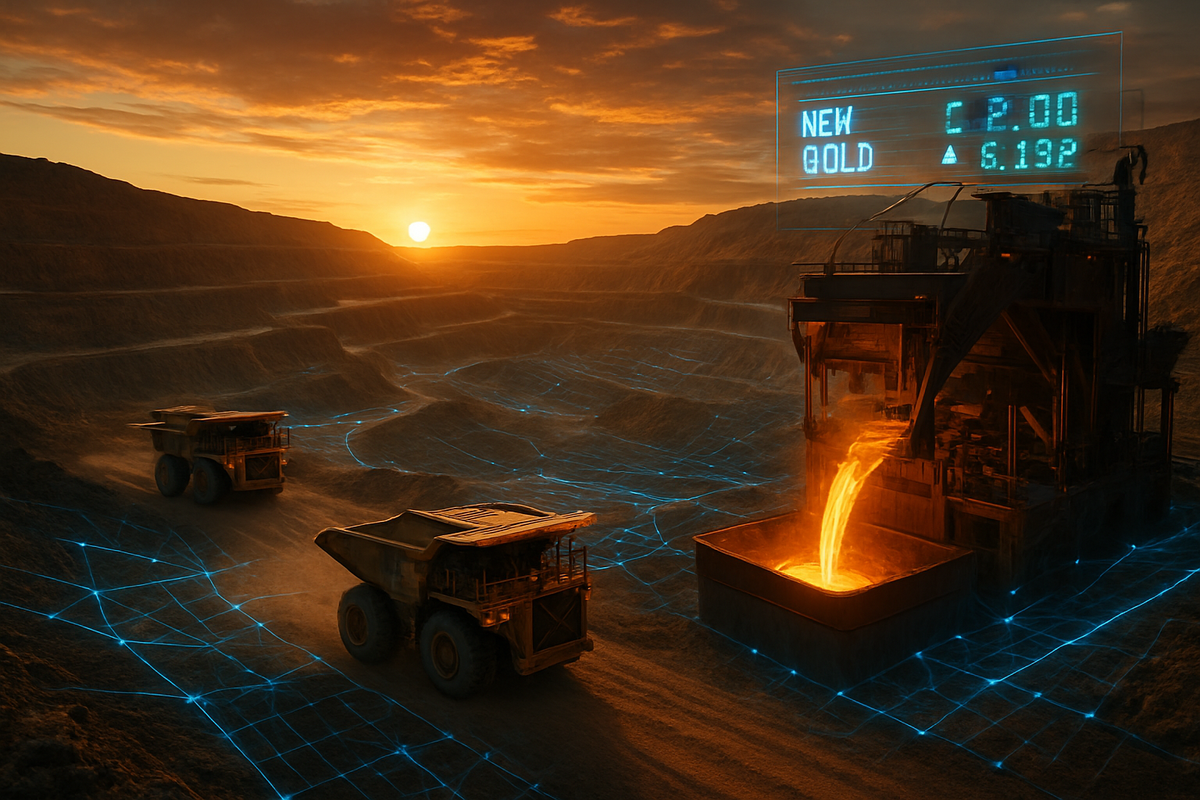
While the price action was spectacular, the real story lies in the technological transformation of the mines themselves. Beginning in 2023, Barrick Gold (NYSE: GOLD) and Newmont (NYSE: NEM) invested billions in autonomous hauling systems and AI-driven ore recovery. By early 2026, Barrick reported that 30% of its global operations were fully automated, significantly insulating the company from labor-related inflation. Simultaneously, the integration of on-site solar and wind farms has protected major sites like Newmont’s Boddington and Barrick’s Loulo-Gounkoto from the volatility of the global energy grid. This technological "moat" has allowed these companies to keep costs pinned to the floor while revenue has gone through the roof.
The Market Leaders: Newmont’s Surge and Barrick’s Dual Identity
The financial markets have responded to these super-margins with a re-rating of mining stocks not seen since the 1970s. Newmont (NYSE: NEM) has emerged as the clear heavyweight champion of the sector. Following the appointment of Natascha Viljoen as CEO in early 2026 and a successful divestment of non-core assets like the Musselwhite and Akyem mines, the company’s stock has surged over 70% in the last six months. Trading near the $150 mark in late February—up from roughly $40 just two years prior—Newmont has become a staple in diversified portfolios, boasting a market capitalization of approximately $137 billion and returning over $3.4 billion to shareholders in the last fiscal year alone.
Barrick Gold (NYSE: GOLD), meanwhile, has pursued a distinct "dual-commodity" strategy that has set it apart from its peers. Under CEO Mark Bristow, the company has aggressively expanded its copper portfolio, positioning it as a critical player in the global green energy transition. With the $2 billion "Super Pit" expansion at the Lumwana mine in Zambia reaching full production and the massive Reko Diq project in Pakistan moving toward its first ore, copper now accounts for nearly 30% of Barrick’s EBITDA. This strategy has provided Barrick with a unique resilience; while gold provides the high-margin "glitter," copper provides the industrial backbone, allowing the company to thrive even during periods when gold sentiment might fluctuate.
A Paradigm Shift in Mining Economics
The "Era of Super-Margins" represents a broader shift in the mining industry's role within the global economy. Traditionally viewed as a cyclical hedge, gold miners are now being analyzed as high-yield cash flow machines. This event fits into a wider trend of "precision mining," where AI and satellite-based mineral detection have optimized extraction rates to such a degree that waste is minimized and yield is maximized. This shift has significant policy implications, as resource-rich nations are increasingly looking to renegotiate royalty agreements to capture a larger share of these historic profits—a move that could spark fresh regulatory challenges for the industry.
Historically, periods of high gold prices were often followed by reckless M&A activity and over-leveraged balance sheets. However, the current cycle is different. Having learned the lessons of the 2011-2012 crash, Newmont and Barrick have utilized their record cash flows to retire debt and build "fortress balance sheets." Newmont enters mid-2026 with a near-zero net debt position, a feat almost unheard of in the history of capital-intensive mining. This fiscal discipline has created a ripple effect across the industry, forcing junior miners to adopt similar "value over volume" strategies to attract increasingly discerning investors.
The Path Forward: Sustainability of the $5,000 Floor
Looking ahead, the primary question for investors is whether the $5,100 gold price and the associated super-margins are sustainable. In the short term, continued central bank buying and the lack of new major gold discoveries suggest that the supply-demand imbalance will keep prices elevated. However, as profit margins remain at 70%, the industry may face increased pressure from environmental, social, and governance (ESG) advocates to accelerate their decarbonization efforts and increase social investment in mining communities.
In the long term, we may see a wave of strategic pivots. With Newmont sitting on a record $7.3 billion in free cash flow, the market is rife with speculation regarding a potential mega-merger or the acquisition of high-quality copper assets to mirror Barrick’s successful dual-commodity model. Additionally, as the "low-hanging fruit" of automation is picked, the next frontier for cost reduction will likely involve deep-sea mining or ultra-deep underground extraction technologies, both of which carry significant technical and regulatory risks.
Investor Takeaway: A New Benchmark for Value
The transition of gold mining from a high-risk gamble to a high-margin certainty has redefined the sector for 2026. The key takeaway for the market is that the "Big Two"—Newmont and Barrick—have successfully broken the link between commodity price inflation and operating costs. This decoupling has transformed their stocks into legitimate alternatives to traditional tech-growth plays, offering both a hedge against global instability and the lucrative returns of a high-margin business.
Moving forward, investors should watch for any signs of "resource nationalism" in key jurisdictions like South America and Africa, as well as the progress of Barrick’s Reko Diq project, which serves as a bellwether for large-scale mining in complex regions. As long as gold remains above the $4,500 level and AISC remains below $1,800, the "Era of Super-Margins" will continue to dominate the financial headlines, making this the most profitable period in the history of the "Midas" industry.
This content is intended for informational purposes only and is not financial advice