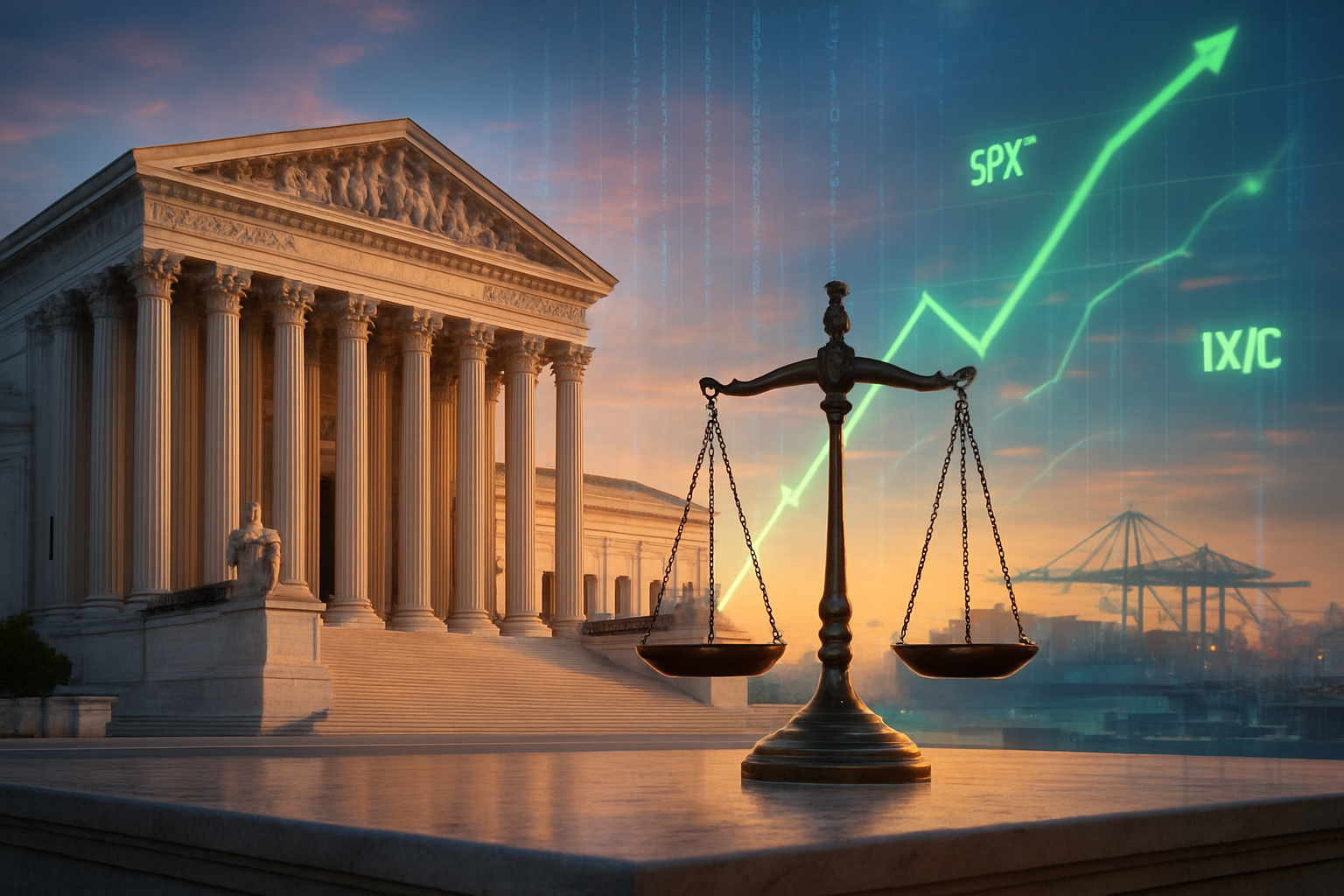
In a historic 6-3 decision handed down today, February 20, 2026, the United States Supreme Court struck down President Trump’s sweeping "reciprocal tariffs," ruling that the executive branch overstepped its constitutional authority by bypassing Congress to levy taxes on foreign goods. The decision in Learning Resources, Inc. v. Trump marks the most significant legal check on presidential trade power in a generation, effectively dismantling the "United States Reciprocal Trade Act" framework that had redefined American commerce since early 2025.
The ruling sent shockwaves through global financial markets, with the S&P 500 and the Nasdaq Composite surging in mid-day trading as investors cheered the removal of a major inflationary headwind and the potential for billions of dollars in tariff refunds. For trade-sensitive sectors ranging from consumer electronics to automotive manufacturing, the decision offers a definitive reprieve from the "tit-for-tat" trade war that has dominated the economic landscape for the past eleven months.
The Death of the "Emergency" Tariff: Legal Reasoning and Timeline
The road to today’s ruling began on April 2, 2025—a day the administration dubbed "Liberation Day"—when President Trump invoked the International Emergency Economic Powers Act (IEEPA) to declare a national emergency. Citing chronic trade deficits and the influx of illicit fentanyl as "extraordinary threats" to national security, the President bypassed a divided Congress to implement a reciprocal tariff regime, mirroring the import duties of any nation that taxed U.S. goods at higher rates than the United States.
Writing for the 6-3 majority, Chief Justice John Roberts focused on the limits of the IEEPA, asserting that while the act allows the President to "regulate" or "prohibit" transactions during an emergency, it does not grant the power to impose taxes or duties—a power explicitly reserved for Congress under Article I, Section 8 of the Constitution. The Court applied the "Major Questions Doctrine," stating that an economic shift of this magnitude, projected to generate over $3 trillion in revenue over a decade, requires "clear and unmistakable" authorization from the legislative branch. Justice Gorsuch, concurring, noted that "the power of the purse cannot be seized by the executive under the guise of an emergency declaration."
The legal battle moved with unprecedented speed through the lower courts after Learning Resources, Inc., a toy manufacturer, led a coalition of thousands of importers in challenging the duties. Throughout 2025, businesses operated under a cloud of "strategic paralysis," unsure if the billions they were paying into U.S. Customs and Border Protection (CBP) would ever be returned. Today’s ruling provides that answer, declaring the tariffs unlawful ab initio—from the beginning.
Winners and Losers: Tech, Auto, and Retail Breathe a Sigh of Relief
The immediate market reaction highlighted the sectors most burdened by the 2025 trade policy. Shares of Apple Inc. (NASDAQ: AAPL) jumped 4.2% on the news, as the company had been facing mounting costs for its global supply chain. Similarly, NVIDIA Corporation (NASDAQ: NVDA) saw a significant boost, as the ruling mitigates the risk of reciprocal duties on high-end semiconductor components that are essential for the ongoing AI infrastructure build-out.
The automotive sector, perhaps the hardest hit by the 2025 tariffs, emerged as the day's biggest winner. General Motors Company (NYSE: GM) and Ford Motor Company (NYSE: F), which had warned of multi-billion dollar hits to their annual earnings due to duties on both finished vehicles and critical parts, saw their stock prices rally by over 6%. Tesla, Inc. (NASDAQ: TSLA) also saw gains, as the ruling removes uncertainty surrounding its international gigafactory exports and component imports.
Conversely, the ruling is a blow to the "America First" manufacturing proponents who had hoped the tariffs would force a rapid "reshoring" of industry. Domestic steel and aluminum producers, which had benefited from the protective umbrella of the reciprocal duties, saw a modest pullback in afternoon trading. However, for retail giants like Walmart Inc. (NYSE: WMT) and Amazon.com, Inc. (NASDAQ: AMZN), the decision is a pure catalyst. These companies had been forced to raise prices on thousands of consumer SKUs throughout 2025; the removal of the tariffs is expected to bolster margins and consumer spending power heading into the second half of 2026.
A Constitutional Correction: Wider Significance and Historical Precedent
Today’s decision serves as a powerful reassertion of the "Non-Delegation Doctrine," signaling that the Supreme Court will no longer tolerate the broad use of 20th-century emergency statutes to enact 21st-century economic policy. The administration had frequently cited the 1975 Yoshida International case, which allowed for temporary import surcharges, but the Court today distinguished that precedent, noting that IEEPA was specifically designed by Congress in 1977 to curb—not expand—presidential overreach.
The ripple effects will be felt far beyond U.S. borders. International trade partners, many of whom had prepared retaliatory measures against American agricultural and aerospace exports, are expected to stand down. This de-escalation could lead to a normalization of trade relations with the European Union and Southeast Asian nations, potentially lowering the cost of global logistics.
Furthermore, the ruling settles a long-standing debate among trade lawyers regarding whether "national security" is a blank check for economic protectionism. By requiring specific Congressional intent for new tariffs, the Court has effectively raised the bar for any future administration seeking to use trade as a primary tool of foreign policy without legislative consensus.
The Great Refund: What Comes Next for Businesses
The most immediate practical consequence of the ruling is the potential for a massive "refund rally." Since the implementation of the reciprocal tariffs in mid-2025, the U.S. Treasury has collected an estimated $133 billion in duties. Because the Court ruled the tariffs were unconstitutional from their inception, legal experts believe that any company that filed "protective claims" with the U.S. Court of International Trade (CIT) may be eligible for a full refund, plus interest.
In the short term, the administrative burden on U.S. Customs and Border Protection will be immense. The process of "reliquidating" thousands of entries will likely take months, if not years. Businesses will need to work closely with trade counsel to ensure their claims are properly documented. Investors should keep a close eye on the quarterly earnings of mid-cap industrial and retail firms, where a significant tariff refund could represent a one-time "windfall" that dramatically alters their balance sheets.
Strategically, many companies that had begun moving production out of overseas hubs to avoid the 2025 duties may now hit the "pause" button on those capital-intensive pivots. The "return to normalcy" in trade policy suggests that the globalized supply chain, while battered, remains the most cost-effective path for the majority of U.S. multinationals.
Summary and Final Assessment for Investors
The Supreme Court’s decision on February 20, 2026, is a watershed moment for the U.S. economy. It effectively ends a period of executive-led trade volatility and restores the constitutional balance of power over commerce to Congress. The key takeaways for the market are clear: the threat of a broad-based, inflationary trade war has been neutralized, and the "tax" on American consumers and manufacturers has been lifted.
As we move forward, the market will likely focus on the "reliquidation" process and the potential for a surge in corporate liquidity as refund checks begin to flow. However, investors should remain watchful for the administration's next move. While the "blunt instrument" of IEEPA has been taken off the table, the President still retains other authorities, such as Section 232 or Section 301, though these require more rigorous investigative processes that are easier for industry to navigate and lobby against.
The lasting impact of this ruling will be a more stable, predictable environment for global trade. For the trade-sensitive sectors that have been under pressure for the last year, the "SCOTUS bounce" may be just the beginning of a sustained recovery as the "uncertainty discount" is finally removed from their valuations.
This content is intended for informational purposes only and is not financial advice.