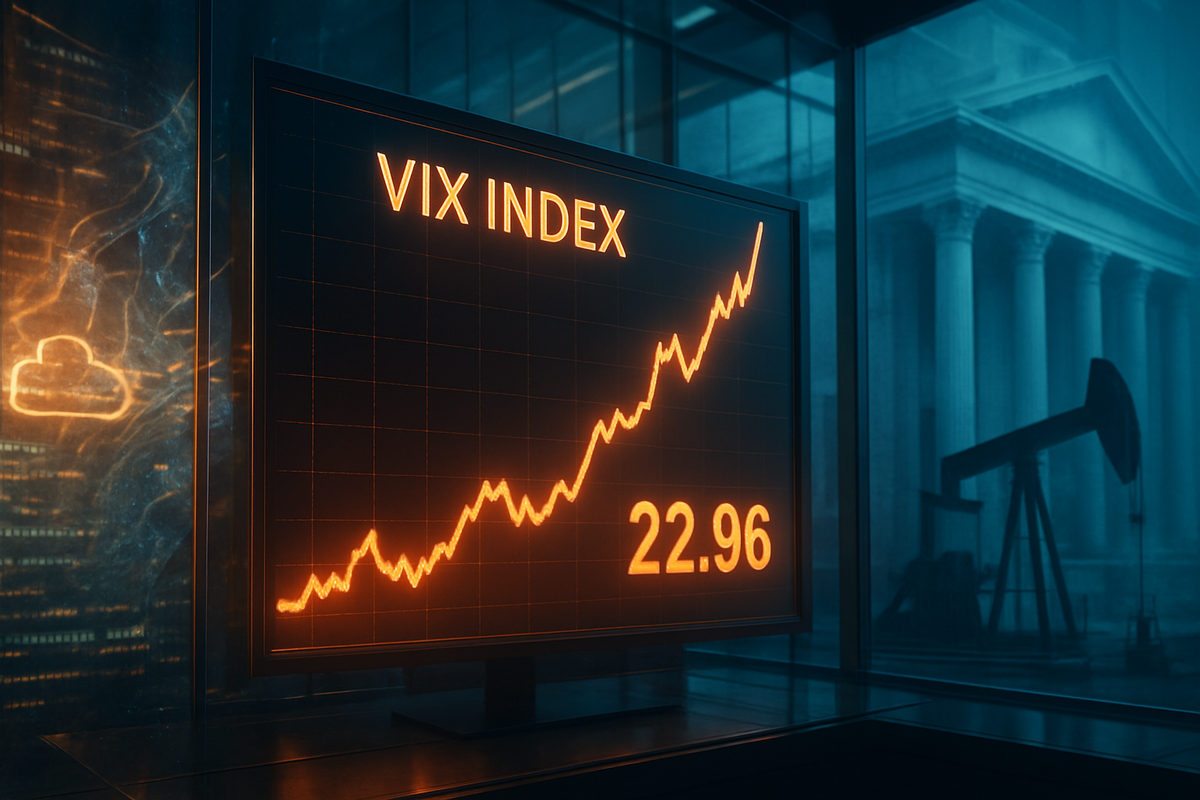
Wall Street’s primary measure of market anxiety, the Cboe Volatility Index (VIX), surged to a fresh year-to-date high of 22.96 on Tuesday, February 17, 2026. The spike sent a clear signal through global markets: the period of relative calm enjoyed by technology-led indices is under serious threat. As investors grappled with a potent mix of "AI disruption" fears and a hawkish shift in expectations for the Federal Reserve, the "fear gauge" reflected a growing consensus that the high-flying growth trade may finally be hitting a wall.
The immediate implications of this spike were felt across the board, sparking a aggressive rotation out of software and high-multiple technology stocks into defensive sectors and "real economy" value plays. While the VIX moderated slightly to settle near 21.00 by the afternoon, the volatility served as a "needle-scratch" moment for a bull market that has been largely fueled by the promise of artificial intelligence for the last three years. Investors are now moving from a phase of "investment-led growth" to one of "disruption-led risk," where the winners of the AI era are no longer guaranteed.
The 'Warsh Shock' and the Timeline of Volatility
The road to the February 17 spike began in late January following the nomination of Kevin Warsh to succeed Jerome Powell as Chair of the Federal Reserve. Viewed as a "reformist hawk," Warsh’s impending leadership has kept the 10-year Treasury yield stubbornly above 4.5%, placing immense pressure on the valuation multiples of growth stocks. The tension reached a boiling point on Tuesday morning after a secondary shock from North of the border: Statistics Canada reported a 7.3% spike in food inflation, reigniting global fears that "sticky" inflation could prevent central banks from providing a safety net if the economy stumbles.
By 9:45 AM ET, the VIX had cleared the 22-point threshold as institutional sell orders hit the tape. The catalyst was a fundamental reassessment of the enterprise software sector, now being dubbed the "SaaSpocalypse" by analysts at Jefferies. The emergence of highly capable agentic AI models from firms like OpenAI and Anthropic has shifted the narrative from AI being a tool for software companies to AI being a replacement for software companies. This existential dread, combined with the "Warsh Shock," created a perfect storm for the 5% intraday surge in volatility.
The day was further complicated by the release of a pivotal 13F filing from Berkshire Hathaway (NYSE: BRK.B). The filing revealed that Warren Buffett’s conglomerate had aggressively slashed its position in Amazon (NASDAQ: AMZN) by 77% and further trimmed its Apple (NASDAQ: AAPL) holdings. Buffett’s move into "old world" media via the New York Times (NYSE: NYT) served as a stark confirmation for many institutional players that the time had come to rotate into undervalued, cash-flow-positive assets.
Winners and Losers in the Great Rotation
The primary casualties of the VIX spike were the former darlings of the AI boom. Microsoft (NASDAQ: MSFT) saw its shares slide 1.3% as investors questioned whether its massive $600 billion capital expenditure program for 2026 would be cannibalized by the very AI agents it helped create. Similarly, legacy software giants like Salesforce (NYSE: CRM), Adobe (NASDAQ: ADBE), and CrowdStrike (NASDAQ: CRWD) faced intense selling pressure, dropping between 2% and 5% during the session. These companies are now at the center of the "disruption risk" debate, as investors fear their traditional subscription models may be obsolete in a world of autonomous AI workflows.
Conversely, the "Value Trade" found its footing amidst the chaos. JPMorgan Chase (NYSE: JPM) gained 1.1%, benefiting from both the rotation into financials and the expectation that a Warsh-led Fed would be more favorable to the banking sector’s regulatory environment. Walmart (NYSE: WMT) also approached all-time highs as it positioned itself as a defensive haven ahead of its highly anticipated earnings report on February 19. The retail giant has become a primary destination for capital fleeing the volatility of the Nasdaq, seen as a reliable beneficiary of resilient consumer spending.
Even Nvidia (NASDAQ: NVDA), the undisputed king of the AI era, was not immune to the day's swings. The stock experienced wild intraday fluctuations, at one point dipping deep into the red before clawing back to finish up 1.1%. While Nvidia remains the hardware provider of choice, the "SaaSpocalypse" narrative has raised questions about the long-term sustainability of demand if its primary customers—the software companies—are themselves under threat of disruption.
A Fundamental Shift in Market Leadership
This event marks a significant departure from the market trends of 2024 and 2025. For years, "AI" was a magic word that justified expanding multiples; today, it has become a source of uncertainty. This shift fits into a broader industry trend where the infrastructure of AI is being built out, but the actual economic return for the software layer is being called into question. The VIX spike to 22.96 is a manifestation of the "Greenland Crisis" of confidence—a term market observers are using to describe the cold realization that not every tech company will survive the transition to an agent-based economy.
Historically, VIX spikes above 20 often precede a period of increased "broadening" in the market. Similar to the rotation seen in late 2000 during the dot-com bubble’s deflation, capital is seeking refuge in sectors with tangible earnings and lower price-to-earnings ratios. The regulatory environment also plays a role here; with a new Fed Chair on the horizon and a government focused on tariffs and "real economy" revitalization, the tailwinds for traditional growth stocks are weakening while the winds favor sectors like domestic manufacturing, financials, and consumer staples.
Scenarios for the Spring of 2026
In the short term, all eyes remain on the 10-year Treasury yield and the upcoming earnings from the retail sector. If Walmart and other consumer giants can demonstrate that the American consumer is absorbing the current inflationary pressures, the rotation into value may accelerate. However, if the "SaaSpocalypse" deepens, we could see the VIX remain elevated in the 20-25 range for an extended period, a level not seen consistently since the early 2020s.
Potential strategic pivots are already underway. Expect to see major software firms announce massive "agentic pivots" or aggressive share buybacks to defend their valuations in the coming weeks. For investors, the challenge will be distinguishing between companies that are being disrupted and those that are being unfairly punished by the general exodus from tech. The "Warsh-led" market is likely to be one where liquidity is less abundant, meaning stock picking will matter more than it has in a decade.
Conclusion and Investor Outlook
The February 17 spike in the VIX Index is more than just a momentary flash of fear; it is a signal that the market's internal mechanics are shifting. The combination of AI-driven disruption fears, a more hawkish Federal Reserve, and a definitive move by institutional leaders like Berkshire Hathaway suggests that the "growth at any price" era is ending. The VIX reaching 22.96 acts as a warning shot, reminding participants that volatility is returning to a market that had perhaps become too complacent.
Moving forward, investors should watch for the sustainability of the "value rotation." If the S&P 500 Financials and Consumer Staples continue to outperform while the Nasdaq lags, the transition to a value-led market will be confirmed. Key metrics to monitor in the coming months include AI-related capital expenditure returns, food inflation data, and the rhetoric from Kevin Warsh as his confirmation process nears its end. In this new environment, protection and dividends may once again become as important as growth and innovation.
This content is intended for informational purposes only and is not financial advice.