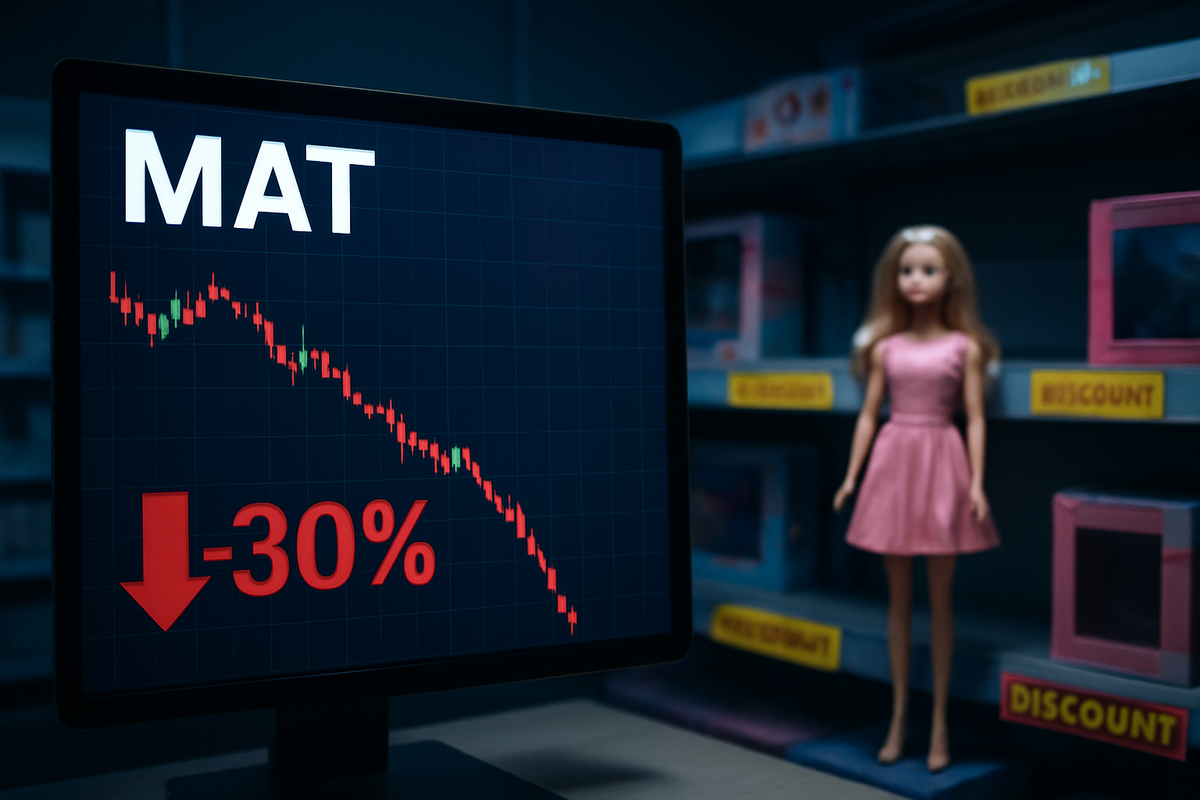
The toy industry was sent into a tailspin this week as Mattel (NASDAQ: MAT) saw its market capitalization evaporate by nearly a third in a single trading session. The legendary toymaker reported a staggering 30% drop in share price following a fourth-quarter earnings report that missed Wall Street expectations on nearly every key metric. The sudden collapse marks the company’s worst performance since the 2020 pandemic, signaling a definitive end to the "Barbie boom" that had buoyed the stock for the past two years.
The immediate implications are dire for the El Segundo-based giant. By erasing almost all gains made throughout 2025, Mattel now faces intense pressure from institutional investors to accelerate its pivot into digital entertainment. The stock, which had been trading near $21.00, bottomed out at approximately $15.00, triggering a wave of analyst downgrades and raising questions about the viability of the company’s long-term "IP-driven" growth strategy in a cooling consumer environment.
A "Soft December" and the Margin Squeeze
The catalyst for the sell-off was the release of Mattel’s 2025 holiday quarter results on the evening of Tuesday, February 10, 2026. While management initially expressed optimism about the early holiday season, they revealed a disastrous "soft" December in the North American market. Retailers, wary of carrying excess inventory into the new year, reportedly stalled replenishment orders in the final two weeks of December, leaving Mattel with a glut of unsold products. To clear the shelves, the company was forced into aggressive promotional discounting, which ravaged its bottom line.
The financial fallout was visible in the company's compressed margins. Mattel’s adjusted gross margin plummeted by 480 basis points to 46.0%. Executives attributed this decline to a "triple threat" of heavy holiday clearance sales, rising logistics costs, and the lingering impact of new import tariffs that the company was unable to pass on to increasingly price-sensitive consumers. Chief Executive Officer Ynon Kreiz, who had previously been lauded for the company’s turnaround, faced a grueling earnings call where he described the quarter as "atypically volatile."
The timeline of the collapse was swift. When the markets opened on Wednesday, February 11, Mattel shares "gapped down" immediately, opening 28% lower than the previous day's close. High-volume selling continued throughout the day as major institutions like JPMorgan (NYSE: JPM) and Citigroup (NYSE: C) slashed their price targets. By the closing bell, the stock had stabilized at a multi-year low, with over $2 billion in market value wiped out in less than eight hours.
Winners and Losers in the Toy Chest
The market’s reaction created a sharp divide between the industry’s major players. The primary winner in this reshuffle appears to be Hasbro (NASDAQ: HAS), Mattel's long-time rival. Reporting on the same day, Hasbro shares surged 7.5% after the company demonstrated a successful transition to a digital-first model. While Hasbro’s physical toy sales remained modest, its digital gaming segment—led by Magic: The Gathering and Dungeons & Dragons—saw an 86% revenue explosion. Investors clearly favored Hasbro’s high-margin digital recurring revenue over Mattel’s hardware-heavy dependency.
On the losing end, mid-tier manufacturers and specialty retailers are feeling the heat. Spin Master (TSX: TOY) saw its stock remain relatively stable but faced similar inventory headwinds in its preschool categories. Meanwhile, major retailers like Walmart (NYSE: WMT) and Target (NYSE: TGT) may face a shorter-term challenge as they work through the discounted Mattel inventory, though they are likely to benefit from the lower wholesale prices Mattel will offer in 2026 to recapture shelf space.
For Mattel’s shareholders, the losses are exacerbated by the "Barbie Hangover." After the 2023 film drove record-breaking sales, the brand finally hit a saturation point in late 2025. Constant currency sales for the Barbie brand were essentially flat for the quarter, rising a meager 2%. This stagnation suggests that the "movie effect" has fully dissipated, leaving a vacuum that the company’s other brands, like Hot Wheels and Fisher-Price, have been unable to fill.
The Digital Pivot and Macroeconomic Headwinds
The plummet in Mattel’s stock highlights a broader industry trend: the "death of the middle" in the toy market. As consumers shift toward either ultra-cheap unbranded toys or high-end digital entertainment, traditional mid-priced toy manufacturers are finding themselves squeezed. Mattel’s announcement that 2026 would be an "investment year"—with $150 million allocated to AI initiatives and digital gaming—was met with skepticism by an market that currently prioritizes immediate profitability over long-term technological pivots.
Furthermore, the impact of international trade policy cannot be ignored. The import tariffs mentioned in the earnings call have become a significant drag on toy companies that rely on global supply chains. Unlike digital software companies, Mattel’s business model is tethered to the physical movement of goods across borders. The 30% drop reflects a realization among investors that Mattel may be more vulnerable to geopolitical friction than its digital-focused competitors.
Historically, this event mirrors the "Video Game Crash" of the 1980s or the more recent struggles of traditional retail, where established giants failed to adapt quickly enough to a fundamental change in consumer behavior. Analysts are now drawing parallels between Mattel’s current predicament and the struggles of The Walt Disney Company (NYSE: DIS) a few years prior, as it attempted to transition from traditional media to streaming.
The Road Ahead: An "Investment Year" or a Lost Year?
As Mattel enters 2026, the company faces a crossroads. Management’s guidance for the coming year was the final nail in the coffin for the stock’s short-term prospects. Projecting an Adjusted EPS of $1.18–$1.30 against a consensus of $1.75 has forced a complete re-evaluation of the company's earnings power. In the short term, Mattel must focus on "right-sizing" its inventory and stabilizing its margins, likely through further cost-cutting measures and potentially divesting underperforming smaller brands.
In the long term, the success of the $150 million digital and AI investment will determine the company's survival. If Mattel can successfully translate its massive IP library—which includes everything from American Girl to Masters of the Universe—into a high-margin digital ecosystem, the current 30% discount may eventually look like a buying opportunity. However, building a digital gaming powerhouse from the ground up is an expensive and risky endeavor that will take years to bear fruit.
Strategic pivots are already underway. Market insiders expect Mattel to seek out more aggressive partnerships with tech giants or perhaps explore a major merger if the stock price remains suppressed. The emergence of AI-driven personalized toys is one potential avenue for growth, but Mattel will have to move faster than its more agile, tech-native competitors to capture that market.
Summary of a Market in Flux
The 30% collapse of Mattel shares is a sobering reminder of how quickly sentiment can turn in the consumer discretionary sector. The key takeaway for investors is that IP alone is no longer a shield against macroeconomic headwinds and shifting play patterns. While the Barbie movie provided a spectacular temporary lift, it was not a permanent solution to the structural challenges facing the toy industry.
Moving forward, the market will be watching Mattel’s gross margin recovery and the performance of its first "AI-integrated" product lines later this summer. If margins continue to erode or if the digital pivot shows signs of stalling, further downward pressure on the stock is likely. Conversely, if the company can demonstrate that it is successfully following Hasbro’s digital roadmap, a slow recovery could begin.
For now, the message from Wall Street is clear: the era of relying on plastic and nostalgia is over. To regain its footing, Mattel must prove it can thrive in a world where children are just as likely to ask for a digital skin for an avatar as they are for a physical doll. Investors should remain cautious in the coming months, keeping a close eye on inventory levels and any further updates on the 2026 "investment" spending.
This content is intended for informational purposes only and is not financial advice.