In a move that underscores the tightening intersection between metabolic health and systemic inflammation, Eli Lilly and Company (NYSE: LLY) officially announced on January 7, 2026, its definitive agreement to acquire Ventyx Biosciences (NASDAQ: VTYX) for approximately $1.2 billion. The all-cash transaction, priced at $14.00 per share, represents a significant 62% premium over Ventyx's 30-day volume-weighted average price. This acquisition marks a pivotal moment for Lilly as it seeks to fortify its immunology portfolio and explore the "holy grail" of drug development: the combination of weight-loss therapies with oral anti-inflammatory agents.
The immediate market reaction was swift and decisive. Shares of Ventyx Biosciences surged over 60% following the announcement, while Eli Lilly saw its stock jump 3.3% in early trading, clearing a critical technical resistance level of $1,080. For Lilly, which recently became the first healthcare entity to surpass a $1 trillion market capitalization in late 2025, the acquisition is seen as a strategic "bolt-on" that could yield exponential returns if Ventyx’s oral small-molecule pipeline successfully navigates upcoming Phase 2 readouts.
The Crown Jewels of the Ventyx Pipeline
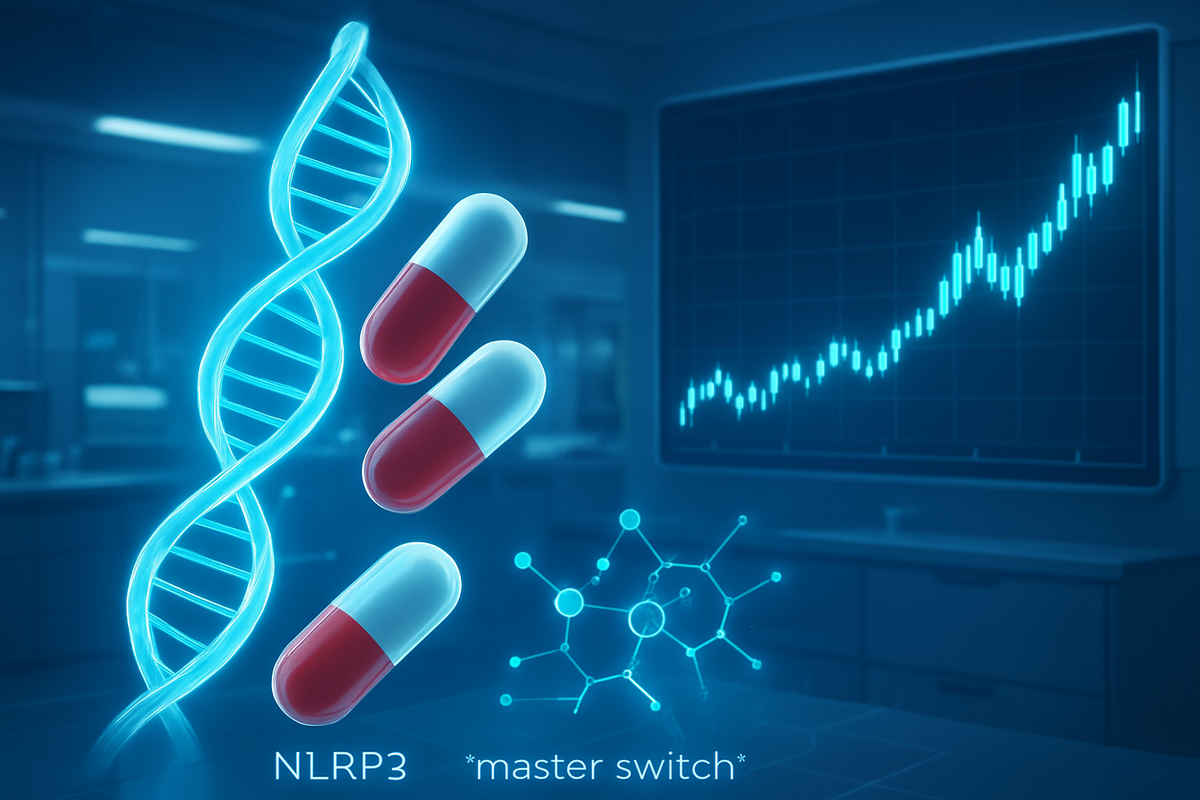
The centerpiece of this deal is Ventyx’s portfolio of NLRP3 inhibitors, specifically VTX3232 and VTX2735. NLRP3 is a protein complex that acts as a "master switch" for the body's inflammatory response. VTX3232 is a central nervous system-penetrant inhibitor currently in Phase 2 trials for Parkinson’s disease and obesity-associated cardiometabolic diseases. Data released in late 2025 indicated that VTX3232 could reduce inflammation biomarkers, such as high-sensitivity C-reactive protein (hsCRP), by nearly 80% in patients with obesity. By acquiring this asset, Lilly aims to pair it with its blockbuster GLP-1 agonist, Zepbound (tirzepatide), to treat the underlying inflammation that often persists even after significant weight loss.
Beyond NLRP3, the acquisition brings tamuzimod (VTX002), an oral S1P1 receptor modulator in Phase 2 for ulcerative colitis, and VTX958, a highly selective allosteric TYK2 inhibitor. These assets are designed to compete in the high-growth immunology market, where the shift from injectable biologics to convenient oral pills is rapidly accelerating. The timeline leading to this deal was catalyzed by Ventyx's successful mid-stage data in late 2025, which caught the eye of Lilly’s business development team as they looked for ways to diversify beyond their core diabetes and weight-loss franchises.
Winners and Losers in the Biotech Shakeup
The primary winner in this transaction is undoubtedly Eli Lilly (NYSE: LLY). By securing Ventyx’s oral platform, Lilly gains a technological edge over competitors who are still reliant on injectable immunology treatments. The deal also validates Lilly's strategy of using its massive cash flow from GLP-1 sales to "buy the future" of the biotech sector. Ventyx shareholders are also clear victors, realizing a substantial premium after a volatile 2024 and 2025 for the small-cap biotech space.
Conversely, the "losers" or those under increased pressure include legacy immunology giants like AbbVie (NYSE: ABBV) and Bristol Myers Squibb (NYSE: BMY). AbbVie, which has long dominated the space with Humira and its successors Rinvoq and Skyrizi, now faces a formidable rival in Lilly that can offer a combined metabolic-immunology approach. Bristol Myers Squibb, which markets the TYK2 inhibitor Sotyktu, may see its market share threatened if Ventyx’s VTX958 proves to have a superior safety profile or better efficacy in Crohn's disease. Furthermore, Novo Nordisk (NYSE: NVO) may find itself playing catch-up in the "inflammation-obesity nexus," as it currently lacks a comparable NLRP3 asset to pair with its own GLP-1, Wegovy.
A New Era of "Oral Biologics" and Metabolic Synergy
This acquisition fits into a broader industry trend toward "oral biologics"—small molecules that offer the potency of traditional injectable antibodies but with the convenience of a daily pill. As the pharmaceutical sector moves toward 2030, the ability to provide oral treatments for complex autoimmune diseases like ulcerative colitis and Crohn’s is expected to be a major differentiator. The deal also highlights the growing realization that obesity is not just a metabolic condition but a chronic inflammatory state, suggesting that the next generation of "super-blockbusters" will likely be combination therapies.
Historically, this move mirrors Lilly’s previous successful acquisitions, such as the $2.4 billion purchase of Dice Therapeutics in 2023, which also focused on oral immunology. However, the Ventyx deal is more ambitious in its scope, targeting the CNS-penetrant NLRP3 pathway. Regulatory scrutiny is expected to be manageable, as the deal is relatively small for a company of Lilly’s size and does not present immediate antitrust concerns in any single therapeutic market, given that most of Ventyx's assets are still in the clinical stage.
Technical Breakout and the Path Ahead
From a technical perspective, Eli Lilly's stock is currently in a "blue sky" breakout phase. After consolidating between $700 and $800 for much of mid-2025, the stock surged through the $1,000 psychological barrier in November. The Ventyx announcement acted as a catalyst to push the stock toward its all-time high of $1,117. Analysts at major firms have already begun raising their 2026 price targets, with some forecasting a move toward $1,500 by year-end, contingent on the successful integration of Ventyx’s assets and continued growth in the GLP-1 market.
In the short term, investors should watch for Phase 2 data readouts for VTX3232 in Parkinson's and obesity, expected in mid-2026. These results will be the first real test of whether Lilly’s $1.2 billion bet will pay off. Long-term, the strategic pivot will require Lilly to successfully manage a sprawling pipeline that now touches everything from Alzheimer’s and Parkinson’s to IBD and obesity. The challenge will be maintaining the clinical momentum of these diverse assets without spreading its research and development resources too thin.
Summary and Investor Outlook
The acquisition of Ventyx Biosciences by Eli Lilly is a masterclass in strategic M&A, perfectly timed to coincide with Lilly's peak market influence and technical stock strength. By securing a leading position in the NLRP3 and TYK2 pathways, Lilly is not just expanding its immunology footprint; it is redefining the treatment paradigm for metabolic and inflammatory diseases.
For investors, the key takeaways are clear: Lilly is aggressively defending its $1 trillion valuation by diversifying its revenue streams. Moving forward, the market will be hyper-focused on the synergy between Zepbound and Ventyx’s anti-inflammatory molecules. As the "obesity wars" between Lilly and Novo Nordisk evolve into the "inflammation wars," the ability to provide a comprehensive, oral, multi-disease solution will likely determine the next decade's healthcare leader. Watch for further consolidation in the small-cap biotech space as other pharmaceutical titans look to replicate Lilly's bold move.
This content is intended for informational purposes only and is not financial advice.