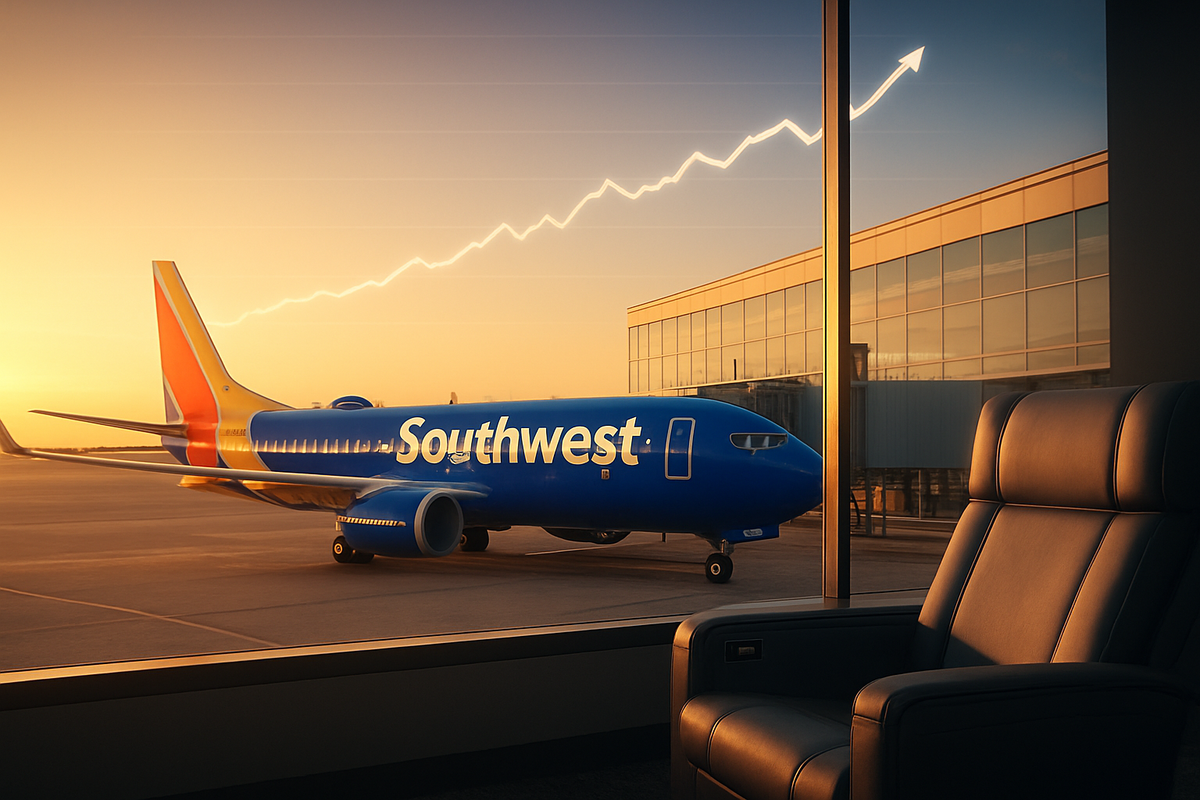
DALLAS — Shares of Southwest Airlines (NYSE: LUV) surged 5% in early trading following the company’s release of its fourth-quarter 2025 financial results and an unexpectedly aggressive profit forecast for 2026. The Dallas-based carrier, which has spent the last year undergoing the most radical transformation in its 53-year history, told investors to expect 2026 earnings to reach at least $4.00 per share. This outlook significantly outperformed Wall Street’s consensus of $3.20 to $3.40, providing a clear signal that the airline's pivot away from its "no-frills" roots is already yielding financial dividends.
The market’s enthusiastic reaction underscores a growing confidence in the "New Southwest," which officially retired its iconic open-seating policy on January 27, 2026. By introducing assigned seating and premium "Even More Room" cabin sections, the airline is directly challenging legacy competitors for high-yield business and premium-leisure travelers. This shift is seen as a pivotal moment for the U.S. domestic travel sector, suggesting that even the most stubborn low-cost models must adapt to a consumer base that is increasingly willing to pay for comfort and predictability.
A Historic Shift in the Skies
The bullish guidance was the centerpiece of Southwest’s January 28 earnings report, which detailed a fourth quarter characterized by resilient demand despite operational challenges. The airline reported an adjusted earnings per share (EPS) of $0.58 for Q4 2025, topping the $0.56 consensus. While revenue of $7.44 billion narrowly missed some analyst targets, it represented a record for the quarter and a 7.4% increase year-over-year. The primary driver of the stock's rally, however, was the 2026 forecast, which implies a more than 300% profit increase compared to 2025 levels.
This transformation did not happen in a vacuum. The timeline leading to this week's surge began in 2024 and 2025, when activist investor Elliott Management pushed for a leadership overhaul and a modernization of the airline's business model. Under CEO Bob Jordan, the airline spent much of late 2025 retrofitting its fleet and overhauling its industry-leading IT infrastructure to support assigned seating. COO Andrew Watterson noted during the earnings call that approximately 50% of customers are now "buying up" to higher-tier products, a drastic increase from the sub-20% levels seen under the old egalitarian model.
The transition has not been without its hurdles. In the days leading up to the report, the entire industry was rocked by "Winter Storm Fern," which caused over 11,000 flight cancellations across the U.S. Southwest’s ability to issue a positive 2026 forecast in the immediate aftermath of such a disruption signaled to investors that its new revenue streams—including the introduction of basic economy fares and more sophisticated ancillary fees—are robust enough to weather operational volatility.
Market Winners and Shifting Competitive Sands
Southwest (NYSE: LUV) is the clear winner in this week’s market action, but the ripple effects are being felt across the industry. Boeing (NYSE: BA) also stands to benefit as Southwest continues its aggressive fleet modernization. The airline is scheduled to take delivery of 66 Boeing 737-8 (MAX 8) aircraft throughout 2026, all of which will arrive with the new premium-heavy interior. Furthermore, the massive project of reconfiguring Southwest’s existing 311 Boeing 737-700s—which involved removing a row of seats to provide extra legroom—has provided a steady stream of work for aviation services and component manufacturers.
Conversely, the success of Southwest’s pivot puts intense pressure on legacy giants Delta Air Lines (NYSE: DAL), United Airlines (NASDAQ: UAL), and American Airlines (NASDAQ: AAL). While Delta and United have long dominated the premium market, they now face a Southwest that can offer a similar product but often at a more competitive cost structure. United has already responded by pledging to match capacity "flight-for-flight" in key hubs like Chicago to prevent Southwest from eroding its market share. Meanwhile, ultra-low-cost carriers (ULCCs) like Frontier Airlines (NASDAQ: ULCC) and Spirit Airlines (NYSE: SAVE) find themselves in a difficult position; as Southwest moves upmarket, it leaves a vacuum in the extreme budget tier that is becoming increasingly difficult to monetize in a high-cost environment.
The End of the Low-Cost Era?
Southwest’s 2026 outlook is a bellwether for the broader "premiumization" of the U.S. travel industry. The distinction between "low-cost" and "legacy" carriers is blurring as all major players converge on a tiered-service model. This industry-wide trend is fueled by the reality that global airline revenues are projected to top $1 trillion for the first time in 2026. The U.S. market, while maturing, is finding growth not through adding more seats, but by increasing the value—and the price—of the seats it already has.
This shift is perfectly timed for the 2026 FIFA World Cup, which is expected to be the largest demand driver in aviation history. With the tournament hosted across North America, airlines are preparing for a record 5.2 billion passengers globally this year. Southwest’s move to assigned seating and premium cabins allows it to capture a larger slice of the high-spending international fans who will be traversing the country between match venues. Without these changes, analysts argue that Southwest would have been left behind in what is being described as the "premium arms race" of 2026.
Navigating the 2026 Horizon
Looking ahead, the primary challenge for Southwest will be execution. While the financial forecast is promising, the airline must manage the operational complexity of its new seating model. Short-term risks include potential friction from long-time "Rapid Rewards" members accustomed to the old way of flying and the ongoing delays in the certification of the Boeing 737 MAX 7, now expected in August 2026. The airline has notably excluded the MAX 7 from its 2026 active schedules to avoid the scheduling chaos that plagued it in previous years.
Strategically, Southwest is likely to focus on deepening its corporate travel partnerships. With assigned seating and a "premium economy" product, the airline is finally a viable option for many corporate travel departments that previously mandated assigned seats for their employees. If Southwest can maintain its high-frequency "point-to-point" schedule while offering these new amenities, it may see a permanent shift in its passenger mix toward higher-margin business travelers.
Investor Takeaway and Market Outlook
The 5% surge in Southwest’s stock is more than just a reaction to a good earnings report; it is a validation of a corporate metamorphosis. The airline has successfully navigated the pressure from activist investors and emerged with a clear, profitable path forward. For investors, the key metric to watch in the coming months will be "Revenue Per Available Seat Mile" (RASM), which Southwest projected will grow by 9.5% in the first quarter of 2026 alone.
As the industry moves toward the summer of 2026 and the World Cup, the focus will remain on whether Southwest can hit its $4.00 EPS target. If the current trajectory holds, Southwest’s transformation will likely be studied for years as the blueprint for how a legacy brand can reinvent itself in a changing economy. For now, the "New Southwest" appears to have successfully cleared the runway for a new era of profitability.
This content is intended for informational purposes only and is not financial advice.