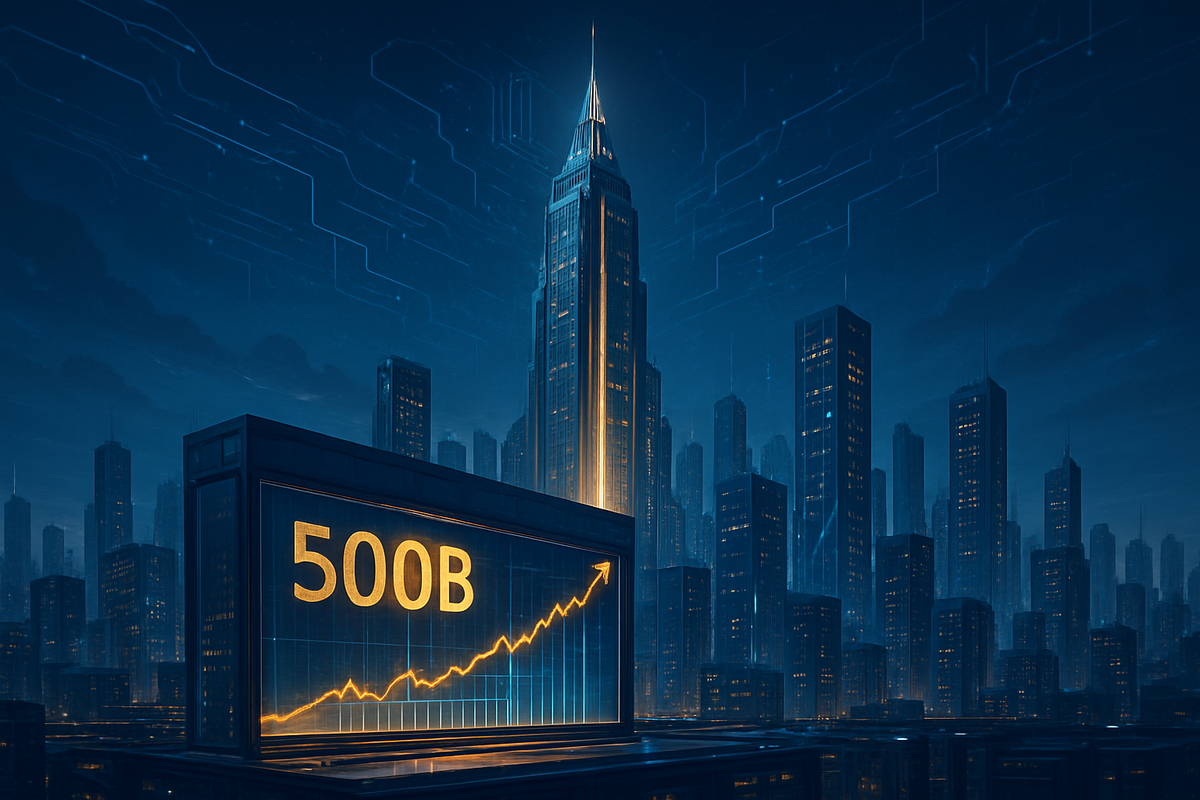
The artificial intelligence sector has entered a new era of "hyper-valuation" following a landmark secondary share sale by OpenAI that valued the San Francisco-based firm at a staggering $500 billion. This milestone, which briefly placed OpenAI among the ranks of the world’s most valuable corporate entities, has served as a primary catalyst for a massive rally across the U.S. technology landscape, pushing indices like the S&P 500 past the 7,000 mark for the first time in history.
The implications of this valuation go far beyond a single company’s balance sheet. By establishing a $500 billion floor for the leader in generative AI, private and public markets alike have undergone a massive "re-rating." Investors are no longer treating AI as a speculative software trend, but as the foundational infrastructure of the 21st-century economy, sparking a "Great AI Decoupling" where firms with tangible AI assets are surging ahead of the traditional tech pack.
The Path to $500 Billion and Beyond
The $500 billion valuation was solidified through a massive secondary tender offer led by Thrive Capital in late 2025, allowing employees and early investors to liquidate shares at prices that would have been unthinkable just twenty-four months prior. This event marked OpenAI’s transition from a high-growth startup into what analysts are calling a "hectocorn"—a private entity valued at hundreds of billions. The momentum has not slowed; as of late January 2026, CEO Sam Altman is reportedly finalizing a follow-on funding round that could push the company’s valuation toward $830 billion, fueled by an insatiable appetite from global sovereign wealth funds and institutional giants like SoftBank Group Corp. (OTC: SFTBY).
The timeline leading to this moment has been defined by a relentless pace of product iteration and massive capital expenditure. Following the release of GPT-5 in mid-2025, OpenAI demonstrated a shift toward "agentic" AI—systems capable of performing complex multi-step tasks without human oversight. This breakthrough transformed the company’s revenue profile from simple subscriptions to enterprise-scale automation contracts. Key stakeholders, including Microsoft (NASDAQ: MSFT), which holds a 27% stake in the restructured for-profit entity, have seen their internal valuations of the partnership skyrocket, despite the immense operational costs associated with training these models.
Initial market reactions to the $500 billion mark were a mix of awe and renewed aggressive positioning. In the weeks following the announcement, venture capital flowed into the AI sector at record levels, with rival Anthropic seeking its own $350 billion valuation. This "private-market heat" has bled directly into public equities, as investors seek exposure to any company that provides the hardware or energy required to sustain OpenAI’s gargantuan compute requirements.
Winners, Losers, and the "Halo Effect"
Nvidia (NASDAQ: NVDA) remains the undisputed champion of this rally. In January 2026, the chipmaker's market capitalization briefly touched the $5 trillion mark, driven by the rollout of its "Rubin" architecture. With OpenAI and its peers requiring millions of these next-generation GPUs for "Project Stargate"—a $1.4 trillion global data center initiative—Nvidia has transitioned from a component supplier to the literal backbone of the modern economy. Its shares have surged as it captures the lion's share of the capital being poured into the AI arms race.
Alphabet (NASDAQ: GOOGL) has emerged as another primary beneficiary of the AI re-rating. After a successful integration of Gemini 3.0 and a landmark deal to power Apple’s next-generation Siri, Google’s parent company saw its market cap surge toward $4 trillion. The market has rewarded Alphabet for its "full-stack" capabilities—owning the chips, the models, and the consumer distribution channels. Conversely, companies dubbed "Capex Black Holes"—those spending billions on AI without a clear path to monetization—have begun to struggle. Legacy SaaS providers that failed to integrate agentic AI into their core products are seeing their multiples contract as OpenAI’s "Agents" begin to cannibalize traditional software workflows.
Microsoft (NASDAQ: MSFT) presents a complex case for investors. While its stake in OpenAI is now worth over $220 billion, the company has faced "AI anxiety" from some analysts. The massive $17 billion annual cash burn reported by OpenAI in its latest filings has weighed on Microsoft’s earnings, forcing the tech giant to balance its role as a supportive partner with its responsibility to its own shareholders. The divide between "Infrastructure Victors" and "Execution Laggards" is becoming the defining theme of the 2026 trading year.
Significance of the "Great AI Decoupling"
This event represents a fundamental shift in the global industrial order, often compared to the railroad booms of the 19th century. The $500 billion valuation is the first time a private software company has reached a scale comparable to national GDPs, signaling that the "AI supercycle" is moving into a capital-intensive "heavy industry" phase. No longer just about code, the industry is now focused on "Project Stargate" and the acquisition of 10-gigawatt energy clusters, creating ripple effects that have sent utility and nuclear energy stocks to all-time highs as the market realizes that AI’s growth is limited only by electricity and silicon.
Regulatory scrutiny is also intensifying in the wake of this valuation surge. Policymakers in the U.S. and EU are increasingly concerned about the "compute divide"—the idea that only a handful of trillion-dollar entities will have the resources to develop frontier AI models. The concentration of wealth and power in OpenAI, Microsoft, and Nvidia has sparked renewed calls for "compute sovereignity" and anti-monopoly measures aimed at ensuring the AI infrastructure remains accessible to smaller innovators.
Historically, such rapid valuation growth has preceded either a long-term industrial golden age or a painful market correction. Comparisons to the 1999 dot-com bubble are frequent, yet proponents argue that unlike the late 90s, the current AI leaders are generating tens of billions in real revenue and building tangible physical infrastructure. The "Decoupling" refers to how AI-related stocks are now moving independently of the broader macro economy, insulated by the sheer volume of institutional capital committed to the transition.
The Road to the Trillion-Dollar Private Entity
Looking ahead, the primary question is whether OpenAI can successfully navigate its transition to a fully commercialized global utility. The short-term goal is the completion of the rumored $100 billion funding round, which would make OpenAI the first private company to surpass a $1 trillion valuation. To achieve this, the company will likely need to formalize its "Project Stargate" partnerships, potentially spinning off its hardware and energy divisions into separate entities to manage the astronomical capital requirements.
Strategic pivots are already underway. OpenAI is expected to move deeper into "vertical AI," developing specialized models for healthcare, law, and engineering that can replace entire departments of human labor. The challenge will be the "brittleness" of the current market; with the top ten tech stocks now representing nearly 40% of the S&P 500's total value, any significant delay in the rollout of GPT-6 or a failure to meet the lofty revenue projections for 2026 could trigger a systemic "sentiment washout."
A Global Pivot Point for Investors
The $500 billion milestone for OpenAI is a clear signal that the AI revolution has moved past the "proof of concept" stage and into the "infrastructure deployment" stage. For the market, this has meant record-breaking valuations for the winners and a ruthless weeding out of the laggards. The rally across the US AI sector is a reflection of a world being rebuilt on a foundation of neural networks, and the capital flows suggest that this is only the beginning of a multi-decade transformation.
Moving forward, investors should watch for the "revenue-to-burn" ratio in OpenAI’s quarterly disclosures and the progress of the "Rubin" chip rollout at Nvidia. While the valuations are historic, they are underpinned by a belief that AI will be the primary driver of global productivity growth for the next twenty years. As we move further into 2026, the distinction between those who build the AI and those who merely use it will become the most critical factor in portfolio performance.
This content is intended for informational purposes only and is not financial advice.