In a week that has redefined the landscape of global entertainment, Netflix (NASDAQ: NFLX) has delivered a stunning double-blow to its competitors. Reporting its fourth-quarter 2025 results on the evening of January 20, 2026, the streaming pioneer shattered analyst expectations by adding 12.4 million new subscribers, bringing its global total to a staggering 325 million. This growth, coupled with a bold revenue guidance of $51 billion for 2026, signals that the "streaming wars" may effectively be over, with Netflix emerging as the undisputed victor in the digital age.
Beyond the balance sheet, the narrative surrounding the company has shifted from organic growth to aggressive consolidation. Simultaneously with its earnings release, reports have intensified regarding Netflix’s strategic pursuit of Warner Bros. Discovery (NASDAQ: WBD). Following an initial bid in December 2025, Netflix recently amended its offer to an all-cash $82.7 billion proposal specifically for WBD’s premium studio and streaming assets, including HBO and Max. This move suggests Netflix is no longer content with being the world’s largest library; it aims to become the definitive home for prestige cinema and live television.
A Record-Breaking Quarter and a Bid for Dominance
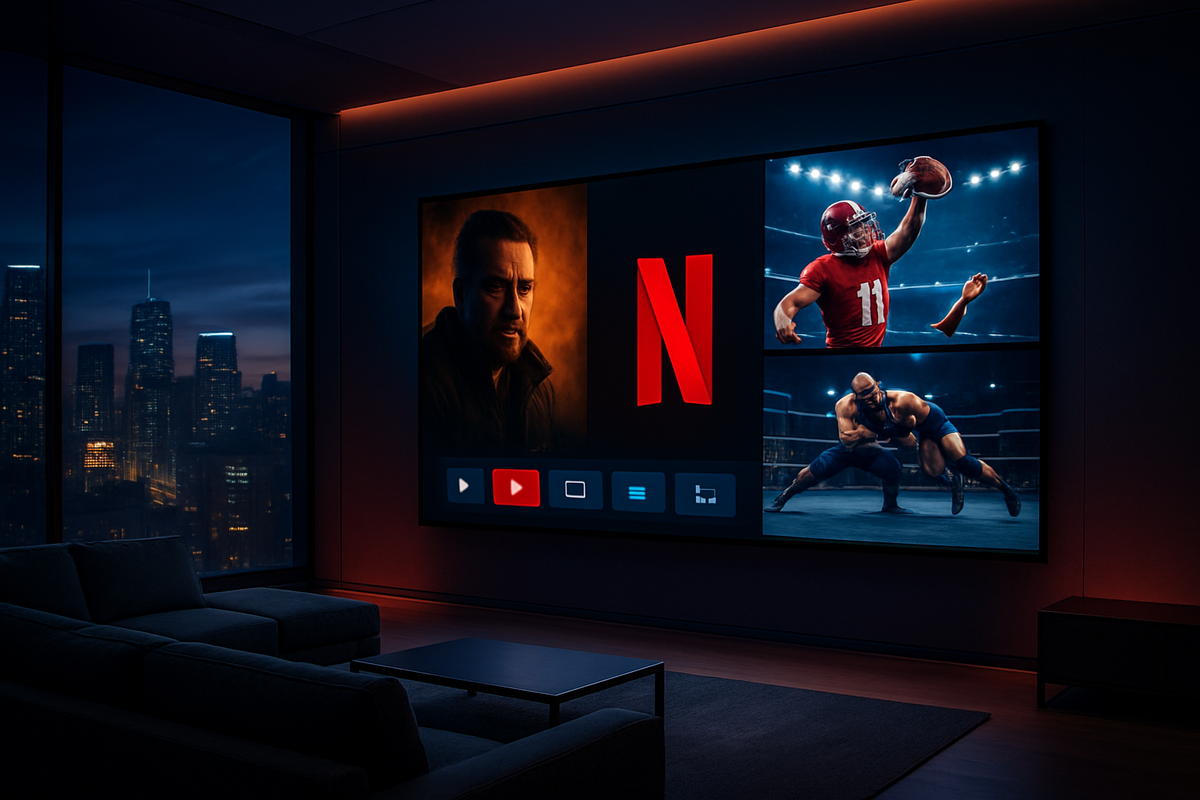
The Q4 2025 earnings report reflects a company firing on all cylinders. The 12.4 million net new subscribers far exceeded the consensus estimate of 9 million, a feat largely attributed to Netflix’s successful transition into "appointment viewing." Revenue for the quarter hit $12.05 billion, an 18% increase year-over-year, while operating margins expanded to 29.5%. The primary catalyst for this surge was the company’s decisive embrace of live events. The Christmas Day 2025 NFL broadcasts reportedly drew over 30 million concurrent viewers, proving that Netflix can command the same cultural gravity as traditional linear networks.
The timeline leading to this moment began in early 2025 with the launch of WWE Raw on the platform, a 10-year, $5 billion deal that secured a consistent, weekly audience of millions. By mid-2025, Netflix had solidified its advertising tier, which is now expected to generate $3 billion in revenue by 2026. In December 2025, rumors of a Warner Bros. Discovery acquisition began to circulate as WBD struggled under the weight of its linear debt. Netflix’s management, led by Co-CEOs Greg Peters and Ted Sarandos, moved quickly to capitalize on the distress of its rival, culminating in the January 20, 2026, pivot to an all-cash offer to outmaneuver a competing bid from Paramount Global (NASDAQ: PARA).
Market reaction has been overwhelmingly positive, with Netflix shares climbing nearly 7% in after-hours trading following the announcement. Investors appear to be rewarding the company’s "all-of-the-above" strategy: maintaining a dominant lead in scripted content while aggressively moving into high-margin advertising and live sports. The proposed acquisition of HBO and the Warner Bros. film library would represent the largest consolidation in media history, potentially giving Netflix control over the DC Universe, Harry Potter, and a century of cinematic IP.
The High Stakes of Consolidation: Winners and Losers
Netflix (NASDAQ: NFLX) is the clear winner in the current environment, leveraging its massive free cash flow to buy its way into the "prestige" market that HBO long dominated. If the WBD deal closes, Netflix would effectively neutralize its most significant creative threat while absorbing 95 to 100 million additional subscribers. This would push its total base past the 400 million mark, creating a scale that would be nearly impossible for any other single service to match. The move also secures a massive library of content that will reduce the company's reliance on expensive, high-risk original productions.
Warner Bros. Discovery (NASDAQ: WBD) finds itself in a precarious yet potentially lucrative position. While the company has been plagued by debt and a declining linear television business, the Netflix bid offers a way out for shareholders. By spinning off its struggling cable networks into a separate entity—tentatively called Discovery Global—and selling its "crown jewels" (HBO and the film studio) to Netflix for $27.75 per share, WBD could provide a definitive exit strategy for investors who have endured years of volatility. However, the loss of its premium assets would mark the end of Warner Bros. as an independent Hollywood powerhouse.
On the losing side of this shift are legacy players like The Walt Disney Company (NYSE: DIS) and Comcast (NASDAQ: CMCSA). Disney, despite its own successes in streaming, now faces a competitor with significantly deeper pockets for live sports and a similar volume of high-end IP. As Netflix moves into the NFL and WWE, it is encroaching on the traditional territory of ESPN. Similarly, Amazon (NASDAQ: AMZN) may find its Prime Video service relegated to a "secondary" streaming option as Netflix aggregates the most valuable content on the planet under a single, increasingly expensive subscription.
The Death of the "Niche" and the Rise of the Mega-Platform
The wider significance of Netflix's Q4 performance lies in the fundamental restructuring of the media industry. We are witnessing the transition from a fragmented landscape of dozens of streaming apps back toward a "Big Three" or "Big Two" model, reminiscent of the early days of broadcast television. Netflix is no longer just a technology company that distributes movies; it is becoming a vertically integrated media utility. Its $51 billion revenue guidance for 2026 suggests that the company believes it can extract significantly more value from its users through a combination of price hikes, ad-supported tiers, and "eventized" programming.
This event also signals the end of the "Peak TV" era of overproduction. By acquiring existing IP from Warner Bros., Netflix is signaling to the industry that it is more cost-effective to buy established franchises than to build new ones from scratch. This mirrors broader industry trends where capital is flowing toward "sure bets" like live sports and existing fandoms. The move toward live events like the NFL and WWE represents a structural shift in the advertising market, as billions of dollars in ad spend migrate from dying linear cable networks to the highly targeted, data-rich environment of Netflix’s ad-supported tier.
From a regulatory standpoint, the pursuit of WBD will likely face intense scrutiny. Under the current antitrust climate of early 2026, a merger of this magnitude will be viewed as a potential monopoly on digital attention. However, Netflix’s strategy of leaving the "linear" networks behind in the WBD deal is a clever attempt to avoid the regulatory baggage associated with traditional broadcasting. If successful, this deal will set a historical precedent for how "New Media" companies can legally dismantle and absorb "Old Media" giants without triggering the same roadblocks that have hindered previous telecommunications mergers.
Looking Ahead: The Road to $51 Billion
In the short term, the market will focus on the completion of the Warner Bros. Discovery acquisition. The "bidding war" with Paramount Global remains a wild card, but Netflix’s shift to an all-cash offer suggests it has the liquidity and the confidence to win. If the deal is finalized by mid-2026, the integration of the Max library into the Netflix interface will be the most anticipated tech update of the decade. Strategically, Netflix will need to prove it can maintain the "prestige" brand of HBO while scaling it for a mass-market audience that is increasingly used to reality shows and live sports.
Longer-term, the $51 billion revenue target for 2026 hinges on the success of the advertising tier and the continued "eventization" of the platform. Investors should expect Netflix to bid on more sports rights—potentially including the NBA or UEFA Champions League—as it seeks to fill the remaining gaps in its live calendar. The challenge will be managing the rising cost of content as it competes not just for viewers’ time, but for the world's most expensive licenses. The transition to a 31.5% operating margin will require ruthless efficiency and likely more aggressive measures against account sharing and price elasticity.
Final Assessment: The Netflix Era
The Q4 2025 earnings report marks a turning point where Netflix ceased to be a disruptor and officially became the establishment. With 12.4 million new members in a single quarter and a clear path toward a $51 billion annual revenue run rate, the company has demonstrated an unmatched ability to evolve. Its pivot toward live events and the audacious bid for Warner Bros. Discovery assets show a leadership team that is not content with its current lead but is instead looking to build a "moat" that no competitor can cross.
For investors, the coming months will be defined by two key factors: the regulatory approval of the WBD deal and the performance of the advertising business. While the 2026 guidance is ambitious, the successful execution of the NFL and WWE deals suggests that Netflix has found the "holy grail" of streaming: a model that combines the high-margin stability of subscriptions with the massive upside of live television advertising. As we move further into 2026, Netflix (NASDAQ: NFLX) remains the benchmark for large-cap growth in the technology and media sectors.
This content is intended for informational purposes only and is not financial advice.