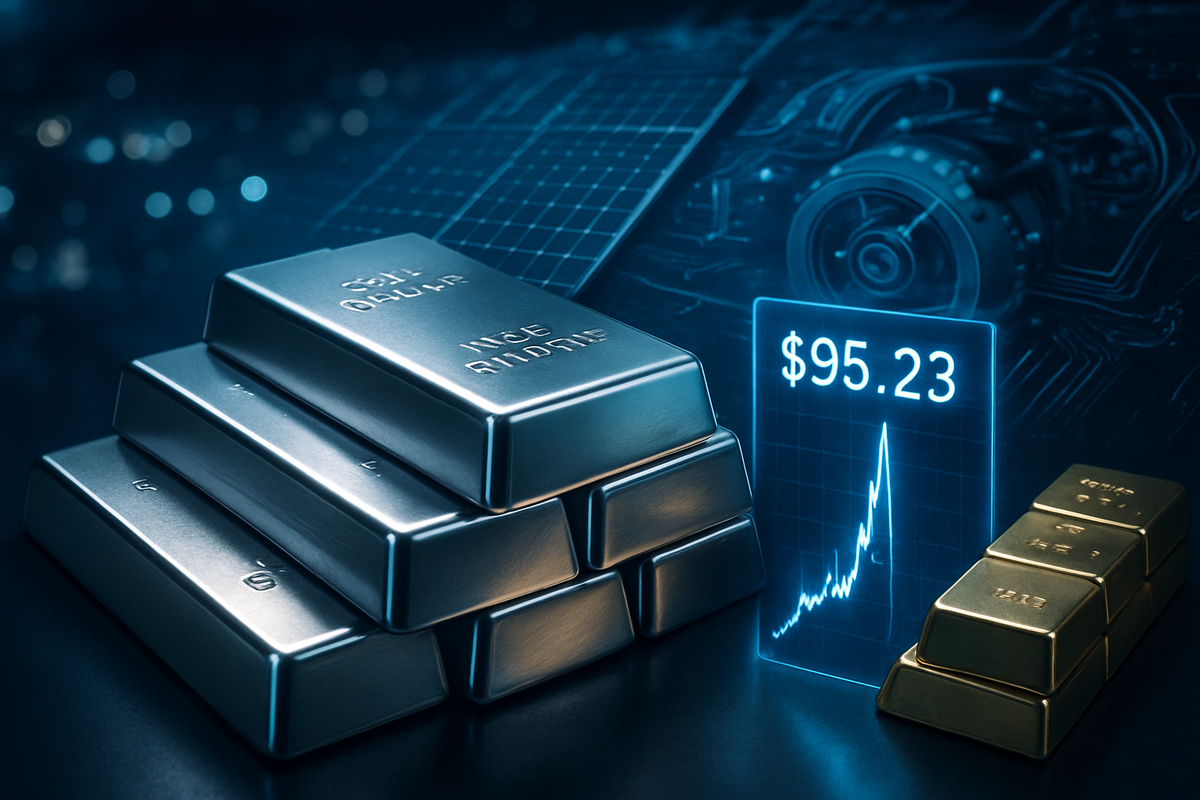
In a historic trading session that has sent shockwaves through global commodity desks, silver prices surged 7.5% today to settle at $95.23 per ounce. This dramatic spike marks a definitive decoupling from its traditionally more stable counterpart, gold, as silver continues its meteoric rise. Over the past 12 months, silver prices have now tripled, transforming from a neglected industrial metal into the best-performing asset class of the mid-2020s.
The rally is no longer driven by mere speculative fervor or inflationary hedging; instead, the market is grappling with a severe "industrial demand crisis." As of January 20, 2026, the global economy is facing a structural supply-demand imbalance that has been building for half a decade. With silver’s critical role in the green energy transition—specifically within solar photovoltaics and electric vehicle (EV) architectures—the "white metal" is now witnessing a fundamental re-pricing that many analysts believe is only just beginning.
The Perfect Storm: A Five-Year Structural Deficit
The current price explosion is the culmination of a five-year structural supply deficit that the mining industry has struggled to address. According to data from the Silver Institute, 2025 marked the fifth consecutive year where global demand significantly outstripped mine production and recycling combined. While 2023 and 2024 saw deficits of roughly 140 to 200 million ounces, preliminary estimates for the start of 2026 suggest the gap has widened further as above-ground stocks at the COMEX and LBMA reach critically low levels.
The timeline leading to today’s $95.23 print began in late 2024, when silver first broke the $30 resistance level. Throughout 2025, a series of supply disruptions in major producing regions like Mexico and Peru, combined with a lack of new "pure-play" silver mines coming online, created a floor for prices. Unlike gold, approximately 70% of silver is produced as a byproduct of lead, zinc, and copper mining. This means that even as prices soar, miners cannot simply "turn on the taps" for silver without massive capital expenditures in other base metal sectors—a process that takes years, not months.
Market participants today reacted with a mixture of awe and alarm. The 7.5% daily move was triggered by reports that several major electronics manufacturers in East Asia were struggling to secure physical bullion for their Q3 production cycles. This "scramble for physical" has forced a massive short-squeeze in the futures markets, further compressing the gold-to-silver ratio. Historically, this ratio has hovered around 80:1; today, with gold trading near $4,000, the ratio has collapsed to approximately 42:1, signaling silver's aggressive outperformance.
Winners and Losers in the $95 Silver Era
The primary beneficiaries of this price surge are the primary silver miners, many of whom have seen their valuations catch up to the spot price in spectacular fashion. First Majestic Silver Corp. (NYSE: AG) and Pan American Silver Corp. (NYSE: PAAS) have emerged as the "blue chips" of this bull run, reporting record margins as their all-in sustaining costs (AISC) remain significantly below current spot levels. Similarly, royalty and streaming companies like Wheaton Precious Metals Corp. (NYSE: WPM) are reaping the rewards of high-margin silver streams without the direct operational risks of mining. Coeur Mining, Inc. (NYSE: CDE), which expanded its Rochester mine just in time for this cycle, has seen its stock price reflect its newfound status as a premier North American producer.
Conversely, the "industrial demand crisis" is creating significant headwinds for the very industries driving the consumption. In the solar sector, companies like First Solar, Inc. (NASDAQ: FSLR) and JinkoSolar Holding Co., Ltd. (NYSE: JKS) are facing a margin squeeze. Silver paste is a non-negotiable component for conducting electricity in solar cells; as prices triple, the "cost per watt" of solar energy is rising for the first time in a decade. This could potentially slow the pace of global decarbonization efforts unless significant "thrifting" (reducing the amount of silver used) or alternative materials are fast-tracked.
The automotive sector is also feeling the heat. Tesla, Inc. (NASDAQ: TSLA) and Rivian Automotive, Inc. (NASDAQ: RIVN) utilize silver extensively in battery management systems, sensors, and charging infrastructure. An average electric vehicle contains between 25 and 50 grams of silver—roughly double that of an internal combustion engine vehicle. At nearly $100 per ounce, the silver content alone is becoming a tangible line item in the bill of materials, threatening to offset the manufacturing efficiencies these companies have worked years to achieve.
Broader Significance and Historical Context
This event marks a paradigm shift in how the market views precious metals. For decades, silver was treated as "gold’s volatile little brother." However, the 2026 crisis highlights silver's status as a critical strategic mineral. The current situation draws comparisons to the 1980 Hunt Brothers cornering of the market and the 2011 spike to $50, but with a crucial difference: those rallies were driven by speculation and inflation fears. The 2026 rally is driven by the physical necessity of the metal in the modern power grid.
The ripple effects are extending into the regulatory sphere. We are already seeing whispers of "strategic silver reserves" being proposed by governments concerned about their domestic solar and EV industries. Just as petroleum was the geopolitical flashpoint of the 20th century, highly conductive metals like silver and copper are becoming the front lines of 21st-century industrial policy. If supply remains this tight, we may see export restrictions from silver-producing nations, further balkanizing the global commodity trade.
Furthermore, the compression of the gold-to-silver ratio suggests a fundamental re-rating of silver’s scarcity. If the world continues to prioritize electrification, the historical 15:1 ratio (the geological occurrence of silver to gold in the Earth's crust) may no longer seem like a fringe "silver bug" fantasy, but a mathematical inevitability as industrial consumption consumes the majority of annual mine supply.
The Road Ahead: Scarcity as the New Normal
In the short term, the market is likely to remain extremely volatile. Scarcity pricing often leads to "blow-off tops," but the underlying deficit suggests that any major pullbacks will be aggressively bought by industrial end-users looking to secure future inventory. We should expect to see a surge in silver recycling initiatives and a frantic R&D push to replace silver with copper or aluminum in solar cells—though these transitions are technically difficult and often result in lower efficiency.
Long-term, the mining industry requires a massive infusion of capital. However, with many silver deposits located in jurisdictions with increasing political risk or environmental regulations, bringing new supply to market will be a slow process. Investors should watch for strategic pivots from tech giants, who may begin following the lead of EV makers in the lithium space by signing direct "offtake" agreements with miners or even acquiring mining assets outright to guarantee their supply chains.
The emergence of a "two-tier" market is also possible: a paper market for speculators and a physical market where a significant premium is paid for immediate delivery. As exchange inventories continue to dwindle, the "delivery failure" risk could become a central theme for the remainder of 2026.
Final Assessment: A Transformed Marketplace
Silver's jump to $95.23 is more than a daily headline; it is a signal that the era of cheap, abundant industrial inputs is over. The "white metal" has finally stepped out of gold's shadow, driven by the inescapable reality of physics and the global mandate for green energy. For investors, the tripling of prices in 12 months represents a generational wealth transfer from those who viewed silver as a relic to those who recognized it as the "indispensable metal" of the future.
Moving forward, the market will be defined by how quickly industry can adapt to these higher costs. The key indicators to watch in the coming months will be the monthly drawdown rates at the LBMA vaults and the quarterly earnings calls of major solar manufacturers. If these companies cannot pass on the costs to consumers, we may see a temporary cooling of demand; however, as long as the structural deficit remains, the path of least resistance for silver appears to be higher.
The silver market has entered a new epoch. Whether this leads to a stable $100+ floor or a period of hyper-volatility, one thing is certain: the world can no longer afford to ignore the importance of the silver supply chain.
This content is intended for informational purposes only and is not financial advice.