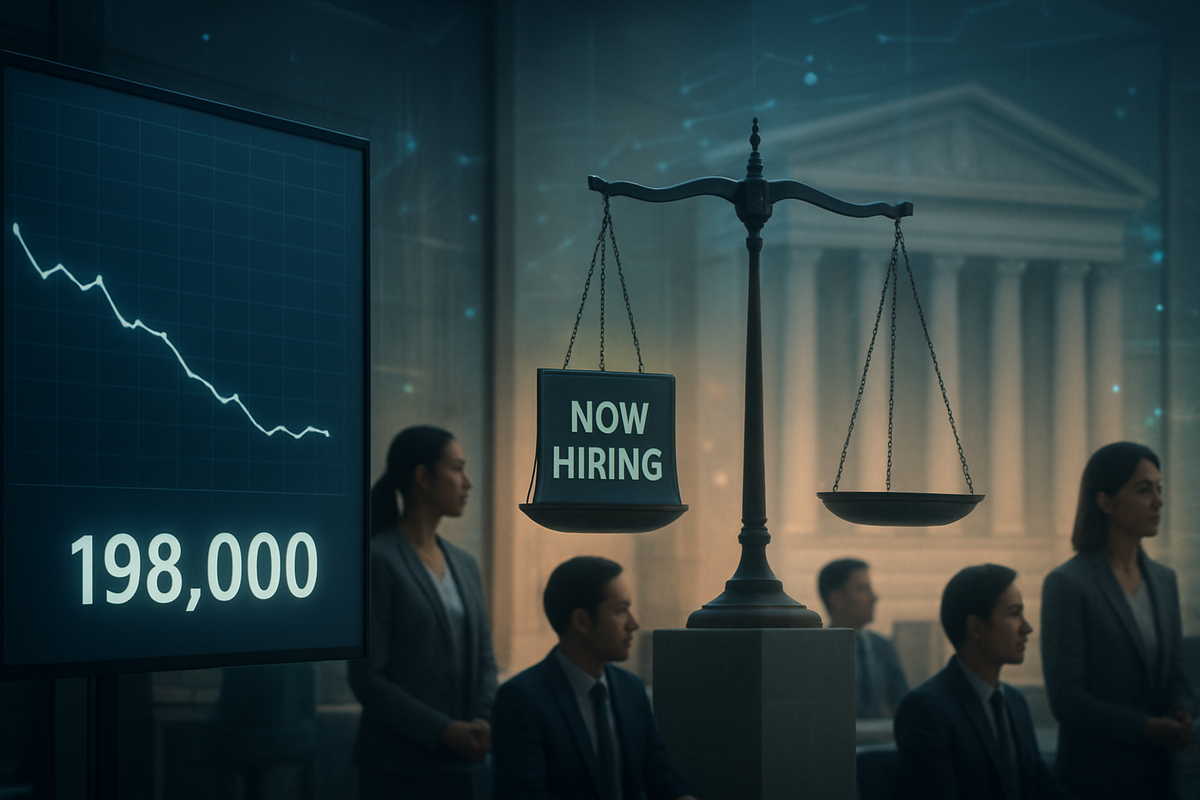
In a data release that has left economists both impressed and uneasy, the U.S. Department of Labor reported on Thursday that initial jobless claims for the week ending January 10, 2026, fell to a seasonally adjusted 198,000. This marks the first time since the early post-pandemic recovery that claims have dipped below the psychological 200,000 threshold for a sustained period, signaling an exceptionally tight lid on layoffs across the American workforce.
While the headline figure suggests a picture-perfect labor market, the underlying reality is more complex. The data confirms a state of "labor stasis"—a "no hire, no fire" equilibrium where companies, traumatized by previous talent shortages and wary of future policy shifts, are hoarding their current staff while simultaneously freezing new headcount. For the Federal Reserve, this data provides a significant hurdle, complicating the path for further interest rate cuts as they balance a low-layoff environment with stagnant job creation.
The 198,000 Surprise: A Portrait of Corporate Caution
The drop to 198,000 claims came as a shock to Wall Street analysts, who had widely projected a figure closer to 215,000. This 9,000-claim decline from the previous week represents the culmination of a multi-month trend where employers have effectively halted the firing cycle. The timeline leading to this moment began in late 2025, when a cooling economy led many to predict a surge in unemployment. Instead, the "Great Resignation" of years past has been replaced by the "Great Stay," with quit rates hitting historic lows and employers refusing to let go of trained personnel.
Key stakeholders, including Federal Reserve Chair Jerome Powell and various regional Fed presidents, have noted that while the low claims are a sign of resilience, they are paired with the slowest pace of job creation in five years. Throughout 2025, the U.S. added an average of only 49,000 jobs per month. Market reaction to Thursday’s report was immediate but cautious: the S&P 500 (SPY) remained largely flat, while the yield on the 10-year Treasury note ticked slightly higher as investors bet that the Fed would have less incentive to lower rates in its upcoming January 27–28 meeting.
Winners and Losers in the Era of Stasis
In this "no hire, no fire" environment, the traditional winners and losers of the labor market have shifted. Large-scale recruitment and staffing firms are facing significant headwinds. Robert Half Inc. (NYSE: RHI) and ManpowerGroup Inc. (NYSE: MAN) have seen their margins squeezed as the volume of new job placements declines and employee turnover remains at a standstill. Without the churn of "the fire" or the growth of "the hire," these companies are forced to pivot toward consulting and specialized talent management rather than high-volume placement.
Conversely, companies that specialize in internal productivity and AI-driven efficiency are seeing a surge in demand. Microsoft Corp. (NASDAQ: MSFT) and Salesforce Inc. (NYSE: CRM) are positioned as winners, as corporations seek to squeeze more output from their existing, hoarded workforce using automated tools and Copilot-style agents. Similarly, high-retention retail giants like Costco Wholesale Corp. (NASDAQ: COST) are benefiting from the stability; with low turnover, their training costs have plummeted, allowing them to maintain sector-leading margins even as consumer spending softens slightly.
Fed Policy and the New Labor Paradigm
The broader significance of the 198,000 figure lies in its impact on the Federal Reserve's "neutral" rate trajectory. After implementing three 25-basis-point cuts in the second half of 2025, the Fed now finds itself in a precarious position. Traditionally, low jobless claims would signal an overheating economy, but with inflation currently hovering around 2.8%, the lack of job growth suggests the economy is not "hot," but rather "stuck." This departs from historical precedents, such as the 2010s recovery, where low claims were usually accompanied by robust job gains.
The "stasis" is further fueled by regulatory and policy uncertainty. With aggressive trade tariffs and shifting immigration policies coming into play in early 2026, many CEOs are in "strategic hibernation." The fear is that firing workers now could be a permanent mistake if labor supply tightens further due to border restrictions, yet hiring is too risky given the potential for increased supply chain costs. This ripple effect has created a "wait-and-see" culture that prevents the labor market from functioning as a fluid mechanism of economic adjustment.
What Comes Next: Breaking the Deadlock
In the short term, the market should expect the Federal Reserve to hold interest rates steady at the 3.50% to 3.75% range during the January meeting. The "no hire, no fire" state is likely to persist through the first half of 2026, but observers are watching for two potential "break points." The first is a potential "capitulation" by small businesses that can no longer afford to hoard labor if consumer demand drops further. The second is a sudden surge in layoffs if AI integration reaches a tipping point where human "backfilling" is no longer necessary.
Strategic pivots will be required for companies currently in hibernation. We may see a rise in internal "reskilling" programs as firms realize they cannot hire their way out of technical debt. Market opportunities will likely emerge in the "internal mobility" software space, as companies like Workday, Inc. (NASDAQ: WDAY) develop better tools for shuffling existing employees into new roles rather than looking to the external market.
Conclusion: The Market in 2026
The latest jobless claims report is a testament to the strange resilience of the 2026 economy. Falling to 198,000 claims is a historic feat, but it masks an underlying exhaustion in the hiring market. For investors, the takeaway is clear: the era of explosive growth fueled by labor expansion is over, replaced by a focus on retention, productivity, and the optimization of current resources.
Moving forward, the market will likely remain in a state of low-volatility tension. The Fed is no longer in a rush to save the labor market, as the "fire" has yet to materialize. Investors should keep a close eye on the "Quit Rate" and "Job Openings" (JOLTS) data in the coming months. If hiring remains stagnant while jobless claims eventually begin to creep up, it will signal that the "stasis" is breaking—and the Fed may be forced to act more aggressively to prevent a hard landing.
This content is intended for informational purposes only and is not financial advice.