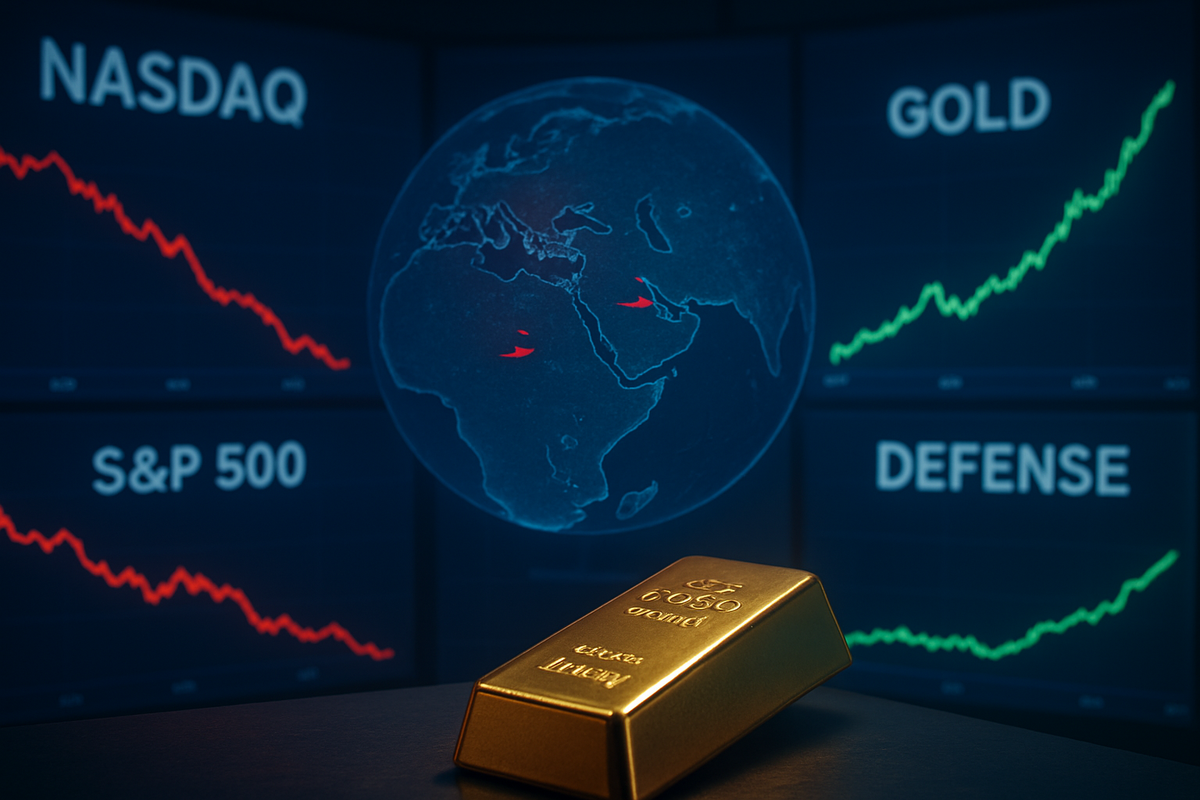
NEW YORK — As of January 15, 2026, global financial markets are grappling with a sharp pivot toward "risk-off" sentiment as escalating tensions between the United States and Iran move toward a potential military flashpoint. The Nasdaq 100 and S&P 500 have faced their most significant back-to-back losses of the year, driven by fears of a naval blockade in the Strait of Hormuz and a novel "Iran Tariff" policy that threatens to disrupt global trade.
Investors have begun a rapid rotation out of high-growth technology sectors and into traditional safe havens, sending gold prices to all-time highs above $2,700 per ounce. While energy prices have spiked, a global supply surplus led by U.S. production has so far prevented a full-scale oil shock, though the "geopolitical risk premium" is now firmly embedded in market pricing.
A Flashpoint in the Middle East: From Protest to Pentagon Deployment
The current crisis was ignited in late December 2025 by a widespread civil uprising in Iran, spurred by the collapse of the Iranian rial and runaway inflation. By mid-January 2026, the Iranian regime's crackdown on protesters led to reports of mass casualties, prompting a stern ultimatum from Washington. On January 13, the Pentagon confirmed the redeployment of a U.S. carrier strike group from the South China Sea to the Middle East, while non-essential personnel were evacuated from Al Udeid Air Base in Qatar.
The situation escalated further when the U.S. administration announced a secondary sanctions strategy dubbed the "Iran Tariff." This policy imposes a 25% tariff on any nation continuing to trade with Iran, directly targeting major economies like China and India. The move has introduced a new layer of complexity to global markets, as traders weigh the possibility of a two-front economic and military conflict. On January 14, the CBOE Volatility Index (VIX) spiked nearly 5%, reflecting a surge in demand for downside protection as the threat of a naval confrontation loomed.
Defense Giants Surge as Growth Stocks Retreat
The shift in geopolitical reality has created a stark divide between market winners and losers. Defense contractors are currently in the midst of a "rearmanent cycle," with the iShares U.S. Aerospace & Defense ETF (ITA) gaining over 8% in the first two weeks of January. Lockheed Martin (NYSE: LMT), Northrop Grumman (NYSE: NOC), and RTX Corporation (NYSE: RTX) have seen their shares rally as the Pentagon fast-tracks orders for missile defense systems and long-range strike capabilities.
Conversely, the technology sector, particularly semiconductor firms, has felt the brunt of the "risk-off" move. Nvidia (NASDAQ: NVDA) and Advanced Micro Devices (NASDAQ: AMD) faced selling pressure not only from the general market retreat but also from concerns that the new "Iran Tariff" could further complicate the global chip supply chain and international trade relations. Interestingly, Taiwan Semiconductor Manufacturing Co. (NYSE: TSM) acted as a partial buffer for the Nasdaq; despite the chaos, TSM reported record earnings on January 15, suggesting that the underlying AI secular trend remains robust even in the face of geopolitical instability.
Broader Significance: The "Defense Super-Cycle" and Energy Dynamics
This event marks a significant departure from previous Middle Eastern conflicts due to the structural changes in the global energy market. In past decades, a threat to the Strait of Hormuz might have sent oil prices toward $100 per barrel instantly. However, in 2026, a massive production surplus from the U.S. and Guyana has acted as a "natural ceiling." Even as ExxonMobil (NYSE: XOM) and Chevron (NYSE: CVX) see temporary boosts from higher crude prices, the market's focus has shifted toward the sustainability of these gains in a well-supplied world.
Furthermore, the conflict is accelerating a shift in defense spending toward autonomous systems. Companies like Palantir Technologies (NYSE: PLTR) and L3Harris Technologies (NYSE: LHX) are benefiting from an executive focus on "American Drone Dominance." This shift indicates that the market is pricing in a future of "kinetic" operations that are more tech-heavy and less reliant on traditional boots-on-the-ground, a trend that may outlast the current standoff.
What Lies Ahead: Diplomacy or Escalation?
The short-term trajectory of the market depends heavily on the effectiveness of back-channel diplomacy. On the morning of January 15, 2026, markets saw a tenuous recovery in futures as reports emerged that the Iranian regime had paused its crackdown on civilians, leading to a slight retreat in oil prices. However, the "Iran Tariff" remains a wild card. If the U.S. follows through with these secondary sanctions against China, it could trigger a broader trade war that would weigh on global GDP growth throughout the remainder of 2026.
Strategic pivots will be required for multi-national corporations caught in the crossfire of the new tariff regime. Investors should watch for whether the U.S. softens its stance on secondary sanctions in exchange for Iranian concessions, or if the redeployed carrier strike group begins active operations. Any sign of a naval blockade would likely send the VIX back into the 20s and prompt another leg down for the S&P 500.
Final Assessment for Investors
The mid-January volatility serves as a stark reminder that geopolitical risk can quickly overshadow even the strongest economic data. While the AI-driven growth of the past year provided a cushion for the Nasdaq and S&P 500, the "risk-off" rotation proves that capital preservation remains a priority when military action becomes a viable possibility.
Moving forward, investors should closely monitor Brent crude levels and the performance of safe-haven assets like gold. The "defense super-cycle" appears to have legs, but the broader equity market will likely remain in a "wait-and-see" mode until the threat of a wider conflict in the Middle East or a trade war with Iran's partners is fully de-risked. For now, the resilience of companies like TSM provides some hope that the core drivers of the bull market are delayed, but not necessarily defeated.
This content is intended for informational purposes only and is not financial advice.