As of January 15, 2026, the global agricultural landscape is grappling with a paradox of plenty and peril originating from Brazil. While the agricultural powerhouse is on track to deliver a staggering record-breaking soybean harvest of nearly 178 million metric tons, the triumph is being shadowed by a relentless series of climatic disasters in the south. Severe flooding in Rio Grande do Sul throughout late December 2025 and into the first weeks of January 2026 has crippled local infrastructure, triggered emergency government interventions, and injected a fresh wave of volatility into international commodity futures.
The immediate implications are a stark divide in the market. On the Chicago Board of Trade (CBOT), soybean and corn futures have plummeted to multi-month lows as the sheer volume of the Mato Grosso harvest begins to flood the global supply chain. However, this downward pressure on prices is being countered by a "logistical premium" as exporters struggle to move grain through a broken transportation network. For the global public, this means that while wholesale grain prices are falling, the costs of getting those goods to market—and onto grocery shelves—remain stubbornly high due to catastrophic bottlenecks at Brazil’s most vital ports.
A Tale of Two Brazils: From Cyclone Storms to Bumper Crops
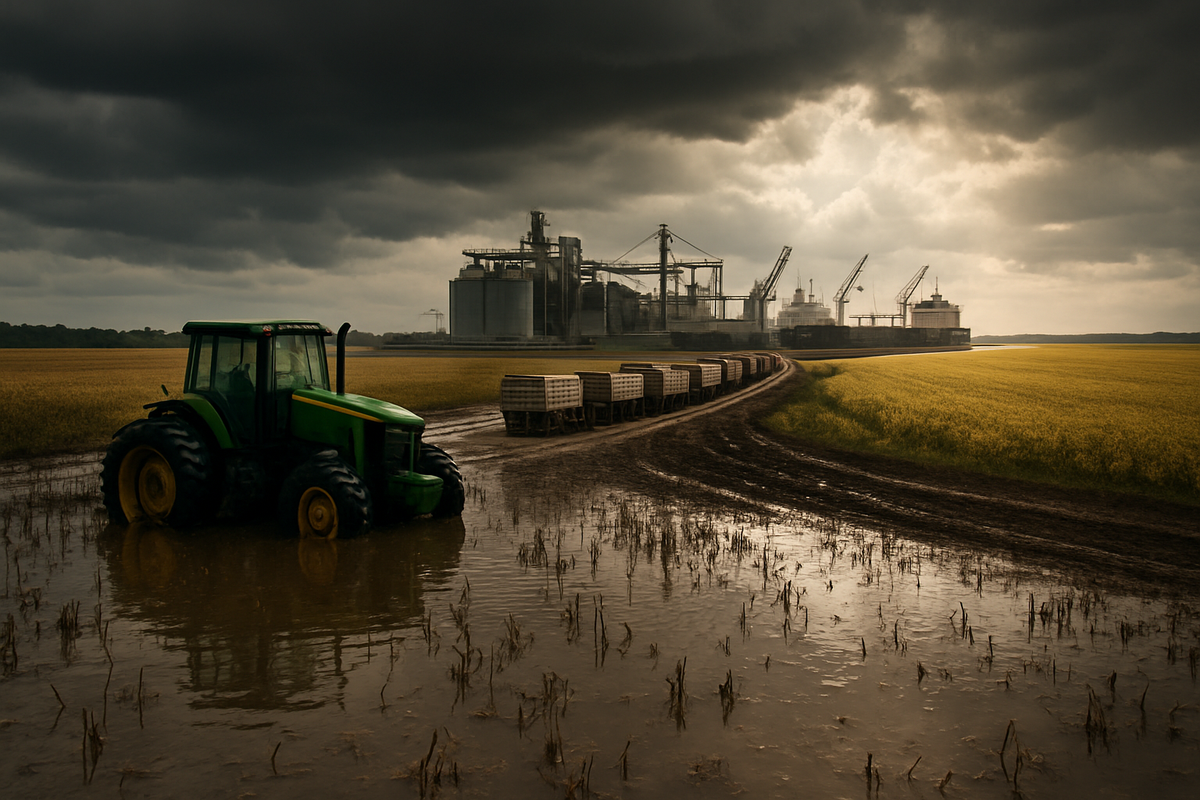
The current crisis is the result of a volatile weather pattern that has split the country's agricultural heartland in two. In the southern state of Rio Grande do Sul, the memory of the catastrophic 2024 floods had barely faded before a new series of extratropical cyclones and flash floods struck between December 10, 2025, and January 10, 2026. These storms brought winds exceeding 80 km/h and torrential rains that have submerged early-season corn crops and halted the final development stages of soybeans. The regional agricultural GDP, already fragile, is facing another year of contraction as soil oversaturation prevents machinery from entering the fields.
In contrast, the Center-West region, led by the state of Mato Grosso, has enjoyed "ideal" growing conditions. As of mid-January, the national soybean harvest is estimated to be roughly 0.6% complete—ahead of last year's pace—driven almost entirely by high-yielding early varieties in the north. This divergence has created a chaotic environment for stakeholders. While organizations like the United States Department of Agriculture (USDA) and Brazil’s Conab have raised production estimates, triggering a "bearish" sentiment that sent soybean futures to $10.38 per bushel this week, local physical prices in Brazil tell a different story of scarcity and delay.
The market reaction has been one of deep uncertainty. The January 12 WASDE report served as a catalyst for a price drop, but traders are now pivoting their focus toward the "anchoring times" at Brazil's ports. At the Port of Santos, weather-related shutdowns and a massive influx of grain have led to vessel wait times of up to six days. Meanwhile, the Port of Rio Grande is operating under strict draft restrictions due to heavy silting from the recent floods, effectively limiting the amount of cargo each ship can carry and further tightening the global supply of "available" grain despite the record harvest.
Corporate Resilience vs. Regional Exposure
The fallout from this "harvest of extremes" is creating clear winners and losers among the giants of the agribusiness sector. BRF S.A. (NYSE: BRFS) has emerged as one of the most vulnerable players in the current environment. With a heavy concentration of processing plants and integrated farmers in Rio Grande do Sul, the company has faced significant disruptions. Blocked roads in the Taquari Valley have hindered the delivery of animal feed, forcing temporary production halts. While lower global grain prices should theoretically benefit meat processors by reducing feed costs, BRF is currently trapped by localized "delivery premiums" and spiked freight rates, which have risen 12% in the south due to damaged infrastructure.
Conversely, diversified giants like Bunge Global SA (NYSE: BG) and Archer-Daniels-Midland Co (NYSE: ADM) are leveraging their massive logistical footprints to navigate the chaos. Bunge, following its high-profile integration with Viterra in 2025, has successfully pivoted its sourcing toward the booming Mato Grosso and Argentinian markets, effectively insulating its bottom line from the southern Brazilian floods. ADM has similarly capitalized on its robust export chain, focusing on managing the "export avalanche" at the Port of Santos. While they face higher berthing costs, their ability to guarantee delivery in a fractured market allows them to capture higher margins than regional competitors.
Domestic producers are also seeing a divergence in fortunes. SLC Agricola S.A. (B3: SLCE3) recently approved a R$ 914.1 million capital increase to fund climate-resilient infrastructure, including advanced irrigation and elevated storage. Their heavy presence in the Center-West has allowed them to participate in the record harvest while their proactive investments in "climate hedging" have made them a favorite among institutional investors looking for stability in a volatile sector. Meanwhile, major meatpackers like JBS S.A. (OTC: JBSAY) are navigating a complex landscape; while their beef division is managing a national decline in cattle slaughter, their global diversification provides a buffer that regional players like BRF simply do not have.
The Long Shadow of Climate Instability and Policy Shifts
The current flooding is not an isolated event but fits into a broader trend of "extreme weather cycles" that are redefining the agricultural industry. The 2025-2026 season marks the continued influence of the La Niña phenomenon, which has historically brought erratic rainfall to South America. This event is drawing comparisons to the "Great Flood" of May 2024, highlighting a systemic failure in regional infrastructure. The recurring silting of the Port of Rio Grande has moved from a localized nuisance to a global trade concern, prompting the Brazilian government to propose a radical shift in policy: the privatization of port dredging and access channel management by mid-2026.
Regulatorily, the Brazilian government has been forced to double down on its support for the sector. The "Plano Safra 2025/2026" has injected approximately $16.2 billion into the market, with a significant portion earmarked for debt suspension and "climate-resilient" credit for farmers in flood-affected zones. This massive fiscal outlay reflects the state's recognition that the agricultural sector is too big to fail, yet it also raises concerns about the long-term sustainability of such bailouts in an era of increasing climate frequency.
The ripple effects are being felt by competitors and partners worldwide. U.S. farmers, seeing the record Brazilian soy yields, are facing a "price ceiling" that makes their own exports less competitive. Meanwhile, global shipping firms are rerouting vessels to avoid the 140% increase in anchoring times at Santos, a move that is driving up global freight indices. Historically, such bottlenecks have often led to a permanent shift in trade routes, with some buyers looking toward smaller, more efficient ports in the "Northern Arc" of Brazil to bypass the congested south.
Navigating the 2026 Outlook: Port Auctions and Weather Pivots
As we look toward the remainder of the 2026 harvest season, the primary variable remains the transition of the La Niña cycle. While the record soybean harvest is largely "locked in" for the Center-West, the second-crop corn (safrinha) remains at the mercy of the late-season rains. If the flooding in the south transitions into a late-season drought—a common La Niña trajectory—the projected 131 million metric tons of corn could see significant downward revisions, potentially sending corn futures on a volatile recovery from their current $4.20 per bushel lows.
In the short term, the market will be laser-focused on the proposed private auctions for port concessions. If the Brazilian government successfully transitions dredging responsibilities to private operators like Santos Brasil Participações S.A. (B3: STBP3) or international consortia, it could signal a long-term fix for the "draft restrictions" that currently plague the Port of Rio Grande. However, the immediate challenge remains the "logistical mountain" of moving 178 million tons of soybeans through a system that is still repairing bridges and roads destroyed in the December storms.
Strategic pivots are already underway. Companies are increasingly investing in "intermodal" solutions, shifting more volume to rail to avoid the kilometers-long truck queues on Highway BR-050. Investors should also watch for a potential wave of consolidation among smaller southern cooperatives that may not survive a second consecutive year of climate-driven losses, potentially leaving the door open for further expansion by the likes of SLC Agricola or Bunge.
Summary of the 2026 Grain Crisis
The Brazilian agricultural crisis of early 2026 serves as a potent reminder of the fragility of global food systems. The key takeaway for the market is that "record production" does not always equate to "record supply." While the fields of Mato Grosso are yielding more than ever before, the literal and metaphorical "mud" in the south is preventing that bounty from reaching its destination efficiently. The resulting volatility in futures—plunging on supply reports but spiking on logistics news—reflects a market that is struggling to price in the true cost of climate change.
Moving forward, the market will likely see a widening "basis" (the difference between local cash prices and futures prices) as the logistical nightmare in Brazil continues. For investors, the coming months will require a close watch on two things: the weekly port congestion reports from Santos and the government's progress on the Plano Safra implementation. The 2026 harvest will be remembered not just for its size, but for the resilience—or lack thereof—shown by the companies and infrastructure tasked with moving it.
As the global community looks toward the second half of 2026, the success of the Brazilian agricultural model will depend less on the fertility of its soil and more on the durability of its ports and the speed of its policy response. In a world of "Harvest Extremes," the only certainty is that the volatility is far from over.
This content is intended for informational purposes only and is not financial advice.