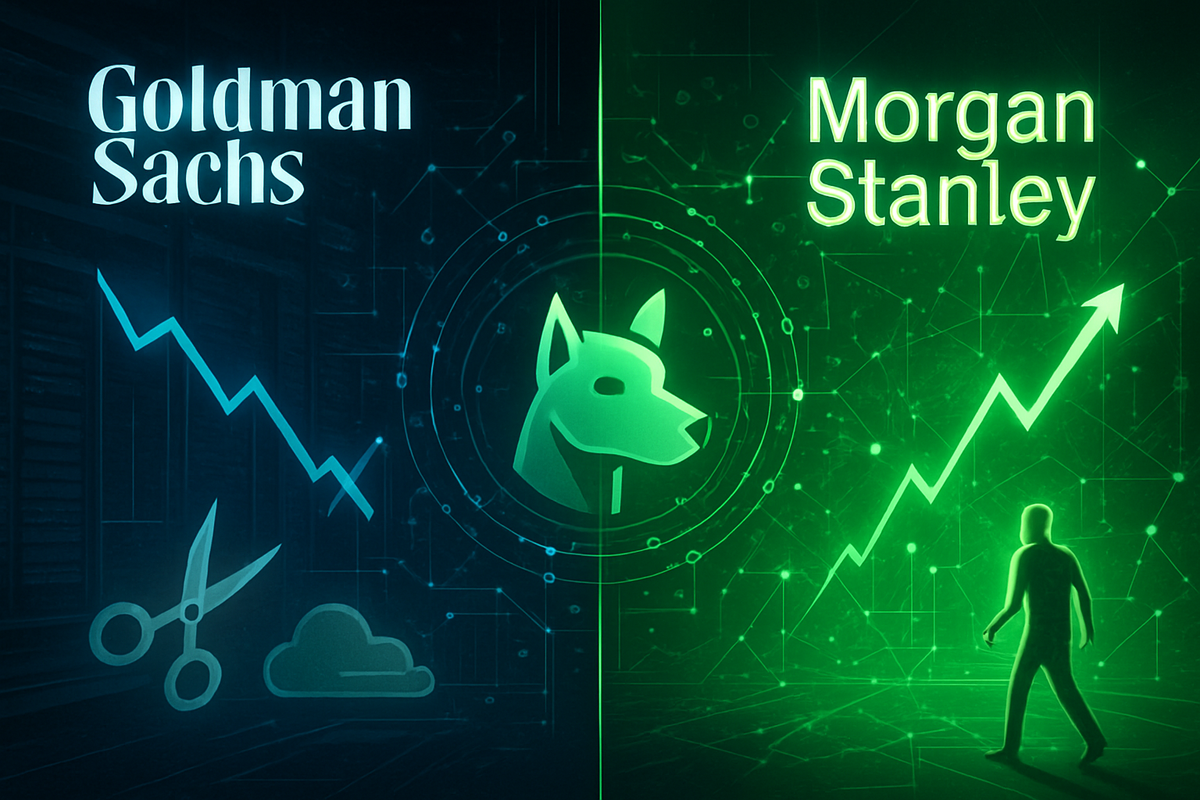
The enterprise software sector witnessed a rare and dramatic divergence in analyst sentiment today as two of Wall Street’s most influential firms took diametrically opposed stances on Datadog, Inc. (NASDAQ: DDOG). On January 12, 2026, Goldman Sachs (NYSE: GS) shocked the market by downgrading the observability giant to a "Sell" rating, citing a "pincer movement" of rising competition and customer budget fatigue. Simultaneously, Morgan Stanley (NYSE: MS) issued a major upgrade to "Overweight," arguing that the burgeoning era of autonomous AI agents will spark a massive second wave of demand for Datadog’s monitoring tools.
This high-stakes disagreement has sent shares of Datadog into a volatile tailspin, as investors weigh the risk of commoditization against the promise of a new AI-driven growth cycle. At the heart of the debate is whether Datadog’s premium pricing model can survive in a 2026 landscape where data volumes are exploding, and enterprise customers are increasingly desperate to optimize their cloud spending.
A Tale of Two Tapes: The Bearish Pivot vs. The Bullish Bet
The conflict centers on two vastly different interpretations of how the technology landscape will evolve over the next 24 months. Goldman Sachs, which had previously been a supporter of the stock, slashed its price target to $113.00, implying a significant downside from current levels. The firm’s analysts highlighted that 2026 is becoming the year of "deflationary architectures," where specialized, low-cost vendors and open-source alternatives are finally reaching the enterprise-grade maturity needed to challenge Datadog’s dominance. Goldman specifically pointed to the aggressive market entry of cloud giants like Amazon.com, Inc. (NASDAQ: AMZN) through its AWS native tools, and the consolidation of niche players like Chronosphere under the umbrella of Palo Alto Networks (NASDAQ: PANW).
In stark contrast, Morgan Stanley’s upgrade to "Overweight" came with a lofty $180.00 price target, representing a potential 43% upside. Their thesis rests on the technical complexity of 2026-era applications. Unlike the static cloud apps of the early 2020s, today’s "agentic" AI systems—autonomous software that makes independent decisions—require a level of real-time, granular monitoring that cheaper alternatives struggle to provide. Morgan Stanley argues that the market is severely underestimating this "complexity tailwind," suggesting that as companies move their most mission-critical legacy workloads to the cloud this year, Datadog’s integrated platform will become more indispensable than ever.
Identifying the Winners and Losers in the Observability War
The fallout from this analyst clash extends far beyond Datadog itself. If Goldman Sachs’ bearish view holds true, the primary beneficiaries will be the "disruptors" and incumbent cloud providers. Amazon’s AWS and Alphabet Inc. (NASDAQ: GOOGL) could see increased adoption of their native, bundled monitoring tools as customers seek to simplify their stacks. Furthermore, established competitors like Dynatrace, Inc. (NYSE: DT) and New Relic—now part of the Cisco Systems, Inc. (NASDAQ: CSCO) ecosystem via the Splunk acquisition—may find an opening to steal market share by positioning themselves as more cost-effective or specialized alternatives for specific enterprise niches.
Conversely, if Morgan Stanley’s bullish prediction of a "second wind" for observability proves accurate, Datadog will likely pull further ahead of the pack, solidifying its status as the "operating system" for the modern cloud. In this scenario, the "losers" would be the fragmented, point-solution vendors who lack the R&D budget to keep pace with the rapid evolution of AI-agent monitoring. Companies that have failed to integrate deep AI insights into their telemetry data will find themselves marginalized as enterprises prioritize holistic platforms that can handle the sheer scale of 100x data growth predicted for the late 2020s.
The Broader Shift: AI Agents and the "Cost Ceiling"
The debate over Datadog is a microcosm of a larger trend affecting the entire software-as-a-service (SaaS) industry in 2026. For years, the "land and expand" model fueled relentless growth, but we have now hit what analysts call the "Cost Ceiling." As AI adoption drives up the volume of logs, metrics, and traces, the bill for monitoring that data has, in some cases, begun to rival the cost of the compute itself. This has created a structural tension between the need for visibility and the necessity of fiscal discipline.
Historically, the observability market has undergone cycles of consolidation and fragmentation. We saw a similar dynamic in 2018-2019 when the shift to Kubernetes created a vacuum that Datadog filled. Today, the shift to "agentic" AI is creating a similar inflection point. The regulatory environment is also playing a role; as new AI governance laws take effect globally in 2026, the demand for "audit-ready" observability—showing exactly why an AI agent made a specific decision—is becoming a mandatory requirement rather than a luxury, potentially favoring high-end platforms like Datadog that offer comprehensive security and compliance features.
What Lies Ahead: Q1 Earnings and the AI Litmus Test
The next six months will be critical in determining which Wall Street giant has the correct read on the market. Investors will be watching Datadog’s Q1 2026 earnings report with intense scrutiny, specifically looking for "net retention" figures among large enterprise clients. If retention remains stable despite the rise of cheaper alternatives, it will validate Morgan Stanley’s "complexity" thesis. However, any sign of customer churn toward AWS native tools or Palo Alto Networks’ integrated offerings would provide immediate ammunition for Goldman’s bearish outlook.
Strategic pivots may also be on the horizon. To combat the "deflationary" threat, Datadog may be forced to introduce more tiered pricing or "cold storage" options for less critical data, a move that could protect its market share but potentially compress its industry-leading gross margins. Additionally, the market will be looking for signs of accelerated M&A activity; if Datadog feels the "pincer movement" described by Goldman Sachs, it may use its significant cash reserves to acquire emerging AI-native observability startups before they can grow into formidable competitors.
Final Assessment: A High-Stakes Year for Tech Investors
The conflicting views from Goldman Sachs and Morgan Stanley highlight a fundamental uncertainty in the 2026 tech market: Is AI a catalyst for higher spending, or a driver of extreme efficiency that will ultimately cannibalize legacy software budgets? For Datadog, the answer will define its trajectory for the rest of the decade. The company remains a high-quality asset with nearly 80% gross margins, but the "Sell" rating from a heavyweight like Goldman Sachs serves as a sobering reminder that no incumbent is safe from the rapid evolution of cloud economics.
Moving forward, investors should keep a close eye on the adoption rates of autonomous AI agents within the Fortune 500. If these systems become the backbone of corporate operations as Morgan Stanley predicts, Datadog’s $180 target may actually prove conservative. However, if "optimization fatigue" continues to dominate the conversation, the stock could be in for a prolonged period of multiple compression. In the volatile world of 2026 enterprise tech, the only certainty is that the "wait and see" approach is no longer an option for those holding DDOG.
This content is intended for informational purposes only and is not financial advice.