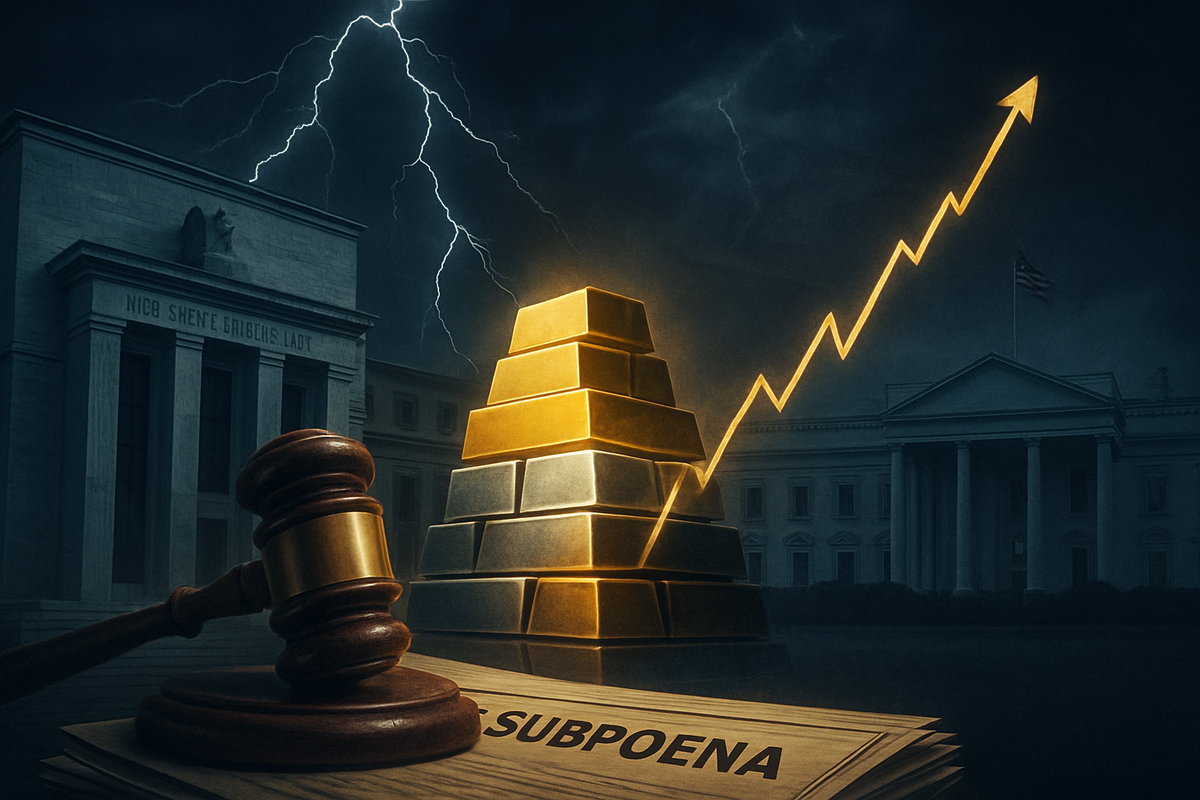
The bedrock of global financial stability was shaken to its core on Monday, January 12, 2026, as a full-blown constitutional crisis between the White House and the Federal Reserve sent shockwaves through international markets. The serving of grand jury subpoenas to Federal Reserve Chair Jerome Powell by the Department of Justice has ignited fears of a "fiscal dominance" era, where the central bank’s autonomy is subsumed by executive mandate. This unprecedented legal assault on the world’s most powerful financial institution has triggered a massive "flight to safety," catapulting gold and silver to all-time highs as investors abandon the U.S. dollar in favor of tangible assets.
The immediate implications are profound. As the Federal Reserve’s ability to act as an independent arbiter of monetary policy is called into question, the "Sell America" trade has accelerated. Markets are now pricing in a future where interest rate decisions may be influenced more by political survival than by economic data. This erosion of institutional trust has led to a sharp devaluation of the greenback, leaving commodity markets as the only perceived refuge for capital preservation in an increasingly volatile geopolitical landscape.
The Renovation Probe: A Pretext for Power?
The crisis reached a boiling point over the weekend of January 10-11, 2026, following a dramatic escalation of a long-simmering feud between the second Trump administration and the Eccles Building. On Friday, January 9, the U.S. Attorney’s Office for the District of Columbia—reportedly acting under the direction of Attorney General Pam Bondi and U.S. Attorney Jeanine Pirro—served the Federal Reserve with grand jury subpoenas. The investigation ostensibly focuses on Powell’s June 2025 Senate testimony regarding a $2.5 billion renovation project of the Fed’s historic headquarters. The administration alleges "ostentatious" spending on marble finishes and water features, accusing Powell of making false statements to Congress regarding the project’s cost overruns.
However, the timeline of events suggests a deeper motive. Throughout 2025, President Trump repeatedly and publicly demanded interest rate cuts of at least 200 basis points to stimulate the economy. Citing "sticky inflation" and a resilient labor market, Powell and the Federal Open Market Committee (FOMC) delivered only 75 basis points of easing. In a somber video statement released on Sunday, January 11, Powell characterized the DOJ probe as a "political pretext" designed to force his resignation before his term expires in May 2026. This direct confrontation has paralyzed the Fed’s leadership and left the market wondering who, if anyone, is currently steering the nation's monetary ship.
Initial market reactions on Monday morning were nothing short of chaotic. The U.S. Dollar Index (DXY) plummeted to 99.03, while 10-year Treasury yields spiked to 4.2% as foreign central banks and institutional investors began paring back their holdings of U.S. government debt. The fear is no longer just about inflation, but about the fundamental integrity of the U.S. financial system.
The Mining Renaissance vs. The Banking Retrenchment
The primary beneficiaries of this institutional chaos have been the major precious metals producers. As gold shattered the $4,600 per ounce barrier, shares of Newmont Corporation (NYSE: NEM) and Barrick Gold (NYSE: GOLD) surged by nearly 3% in early trading, continuing a multi-month rally that has seen the sector outperform almost every other asset class. Agnico Eagle Mines (NYSE: AEM) also saw gains of up to 4%, as investors sought out companies with low jurisdictional risk and high-quality reserves.
The silver market has been even more explosive. With silver prices hitting a historic $84.50 per ounce, Pan American Silver (NYSE: PAAS) and Hecla Mining (NYSE: HL) emerged as top performers, gaining 4.2% and 5.8% respectively. First Majestic Silver (NYSE: AG) and the royalty giant Wheaton Precious Metals (NYSE: WPM) also saw heavy institutional inflows, as the "silver squeeze" narrative gained renewed momentum amidst the dollar's decline.
Conversely, the traditional financial sector is reeling. The "liquidity drain" into hard assets has left major banks vulnerable. Citigroup (NYSE: C) shares dropped 4% on Monday, while JPMorgan Chase (NYSE: JPM) fell 3% as the prospect of regulatory chaos and a devalued dollar weighed on sentiment. The hardest hit, however, were consumer-facing lenders sensitive to the inflationary fallout of a weakened Fed. Capital One (NYSE: COF) and Synchrony Financial (NYSE: SYF) plummeted between 6% and 8%, while American Express (NYSE: AXP) shed nearly 5% of its market value. While investment banks like Goldman Sachs (NYSE: GS) and Morgan Stanley (NYSE: MS) may eventually profit from the extreme volatility in their trading divisions, their stock prices initially buckled under the weight of systemic uncertainty.
A Global Shift Toward Fiscal Dominance
This event fits into a broader, more alarming global trend: the erosion of central bank independence in the face of rising populism and ballooning sovereign debt. Historically, when governments face insurmountable debt levels, they often seek to "capture" the central bank to keep interest rates artificially low—a phenomenon known as fiscal dominance. The current probe into Jerome Powell is being viewed by international observers as the most significant attempt to date to implement this strategy in the United States.
The ripple effects are already being felt among U.S. allies and competitors alike. The European Central Bank and the Bank of Japan are now facing increased pressure to either distance themselves from the dollar-centric system or prepare for a world where the U.S. Treasury and the Federal Reserve are essentially the same entity. This historical precedent mirrors the 1970s era of Arthur Burns and Richard Nixon, but with the added complication of a much larger global derivatives market and a more fragile geopolitical landscape.
The regulatory implications are staggering. If the administration succeeds in ousting Powell through legal pressure, it sets a precedent that the Fed Chair serves at the pleasure of the President, effectively ending the era of technocratic monetary policy. This could lead to a permanent "inflation premium" being priced into all U.S. assets, as the market can no longer trust the Fed to prioritize price stability over political expediency.
The Road to May 2026: Scenarios and Strategic Pivots
In the short term, the market is bracing for a protracted legal battle that will likely reach the Supreme Court. The Fed’s Board of Governors may attempt to appoint an interim leader to maintain continuity, but the administration is expected to challenge any such move. Investors should prepare for a "dual interest rate" environment, where market-driven rates (like Treasury yields) diverge sharply from the Fed's target rate as the public loses faith in the latter’s relevance.
Strategic pivots are already underway. Multi-asset funds are moving toward "all-weather" portfolios with heavy weightings in commodities, inflation-protected securities (TIPS), and non-dollar denominated assets. If the crisis deepens, we may see a move toward a "shadow Fed" consensus, where major private banks and international institutions begin to set their own benchmarks for credit risk, bypassing official government data.
The long-term scenario could involve a fundamental restructuring of the global monetary order. If the U.S. dollar continues to lose its status as a neutral reserve currency due to political interference, the move toward a multi-polar currency world—or even a return to a quasi-gold standard—becomes a distinct possibility.
Summary and Investor Outlook
The "Fed Independence" crisis of January 2026 marks a turning point in modern financial history. The use of the DOJ to subpoena a sitting Federal Reserve Chair has shattered the illusion of a central bank insulated from politics. The resulting surge in gold and silver is not merely a price spike; it is a vote of no confidence in the institutional framework of the United States.
Key Takeaways for Investors:
- Hard Assets are Essential: The flight to gold and silver is likely to persist as long as the legal and political status of the Fed remains in limbo.
- Banking Volatility: Traditional financial stocks will remain under pressure as the "dollar debasement" trade continues.
- Watch the Courts: The upcoming legal filings from the Fed and the DOJ will be the primary market movers in the coming weeks.
- Term Watch: Jerome Powell’s term officially ends in May 2026. The struggle to name a successor will likely be the most contentious and market-moving political event of the decade.
As we move forward, investors must watch for any signs of a "truce" or, conversely, the appointment of a "loyalist" to the Fed board. Until the independence of the central bank is reaffirmed, the commodity super-cycle appears to have found its ultimate catalyst.
This content is intended for informational purposes only and is not financial advice.