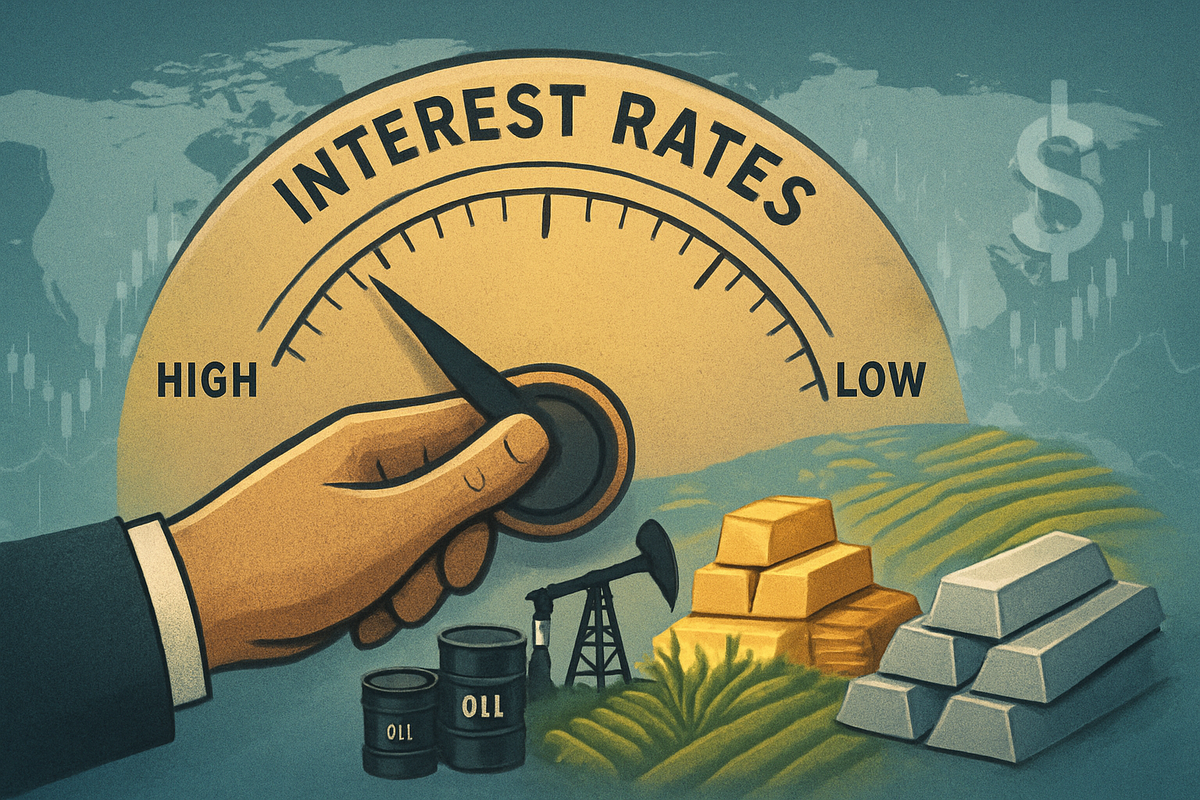
The global financial landscape is abuzz with anticipation as the Federal Reserve steers towards a period of monetary easing in late 2025 and early 2026. Following initial rate cuts in September and October 2025, markets are now pricing in further reductions, potentially bringing the federal funds rate to a target range of 3.75%-4.00% by December 2025 and further down to approximately 3% by December 2026. This pivotal shift in monetary policy is poised to send significant ripples across global commodity markets, influencing everything from the price of oil to the value of gold and the strength of the U.S. dollar.
This strategic pivot by the Fed, driven by a complex interplay of economic signals including a weakening labor market and moderating inflationary pressures, is widely expected to usher in a "risk-on" sentiment. For commodity markets, lower interest rates typically translate to a weaker U.S. dollar, making dollar-denominated raw materials more affordable for international buyers. Simultaneously, cheaper borrowing costs are anticipated to stimulate economic activity and industrial production, thereby increasing overall demand for a wide array of commodities.
Detailed Coverage of the Fed's Pivotal Shift
The Federal Reserve's journey towards monetary easing began with initial rate cuts in September and October 2025, setting the federal funds rate at a target range of 3.75%-4.00%. The market is now keenly watching for a potential additional cut in December 2025, with an 87-90% probability priced in by futures markets. Looking further ahead into 2026, the CME FedWatch Tool suggests a continued downward trajectory, with the federal funds rate potentially reaching around 3% by the end of the year, although policymakers' own projections remain more conservative, estimating rates above 3%. J.P. Morgan Global Research, for instance, anticipates one more rate cut in 2026 after the expected cuts in late 2025. This forward-looking guidance highlights a sustained commitment to fostering economic growth amidst evolving market conditions.
The impetus behind these anticipated rate reductions stems from a multifaceted economic environment. While inflation has shown signs of moderating, a weakening labor market has emerged as a key concern for the Fed. The U.S. unemployment rate edged up to 4.4% in September 2025, with GDP growth moderating to an estimated 1.8%-2.0% for 2025. These factors collectively suggest that the central bank is prioritizing economic stimulus to avert a significant slowdown. Furthermore, the incoming Federal Reserve Chair in 2026, appointed by President Trump, is widely expected to advocate for lower interest rates, which could further accelerate the easing cycle. This political dimension adds another layer of complexity to the Fed's future trajectory.
Key players in this unfolding scenario include the Federal Reserve's Open Market Committee (FOMC), which makes the actual rate decisions, as well as major global central banks that often react to the Fed's stance. Commodity producers, traders, and consumers worldwide are also deeply invested, as their profitability and operational costs are directly tied to commodity price fluctuations. Initial market reactions have already shown a tendency for the U.S. dollar to weaken in anticipation of rate cuts, while certain commodity futures, particularly in the precious metals sector, have begun to reflect upward price pressures.
The timeline leading up to this moment has been characterized by a period of aggressive rate hikes initiated in 2022 and 2023 to combat surging inflation. As inflation began to recede and economic growth showed signs of cooling, the narrative gradually shifted towards a "higher for longer" stance before eventually pivoting to the current easing expectations. This dynamic evolution underscores the Fed's data-dependent approach and its responsiveness to changing economic indicators.
Companies Navigating the Rate-Cut Currents: Winners and Losers
The Federal Reserve's anticipated interest rate cuts are poised to redraw the financial landscape for numerous companies across the energy, metals, and agriculture sectors. The mechanisms of impact—reduced borrowing costs, stimulated demand, and a weaker U.S. dollar—will create distinct advantages and disadvantages, influencing profitability, investment decisions, and market positioning.
In the energy sector, companies with substantial variable-rate debt or those planning large capital expenditures stand to gain significantly. Lower interest payments will improve cash flow and profitability, making new exploration and production projects more viable. While integrated giants like ExxonMobil (NYSE: XOM) and Chevron (NYSE: CVX) with strong balance sheets will benefit from cheaper debt for their massive undertakings, smaller, more debt-laden exploration and production (E&P) companies could experience a more pronounced positive impact. The capital-intensive renewable energy sector, encompassing developers of solar and wind farms, will also see a considerable boost as reduced financing costs make projects more attractive, potentially accelerating expansion plans for companies like Ørsted A/S. Conversely, energy companies with minimal debt or those facing persistent oversupply issues in specific markets might see less dramatic benefits from the easing cycle.
The metals sector is similarly poised for a shake-up. Precious metal miners, such as Barrick Gold (NYSE: GOLD) and Freeport-McMoRan (NYSE: FCX) (also a significant copper producer), along with silver producers like Wheaton Precious Metals (NYSE: WPM) and Fresnillo (LSE: FRES), are likely to emerge as significant winners. Lower interest rates decrease the opportunity cost of holding non-yielding assets like gold and silver, making them more attractive to investors and potentially driving up their prices. Industrial metal miners, including those producing copper, aluminum, and crucial "green metals" like lithium, will also benefit from stimulated global economic growth and increased demand from manufacturing and construction. Companies like Rio Tinto (NYSE: RIO) and BHP Group (NYSE: BHP), with diversified metal portfolios, stand to gain from this broader demand surge. Mining companies carrying substantial debt, similar to their energy counterparts, will also find considerable relief from reduced interest payments. However, miners with extensive fixed-price contracts or those operating in regions with divergent monetary policies may not fully capitalize on potential price increases.
For the agriculture sector, the impact will be felt by producers, agribusinesses, and equipment manufacturers. Farmers, who often rely on loans for operational expenses and equipment purchases, will see their borrowing costs decrease, improving cash flow. This could translate to increased demand for agricultural machinery from companies like AGCO (NYSE: AGCO). Large agribusiness and food processing companies such as Archer Daniels Midland (NYSE: ADM) and Bunge (NYSE: BG) could experience a boost in sales volumes as a weaker U.S. dollar makes U.S. agricultural exports more competitive globally. Furthermore, fertilizer and crop protection companies like Nutrien (NYSE: NTR) and Corteva (NYSE: CTVA) could benefit from improved farmer profitability and increased investment in crop production. Nevertheless, agricultural companies with high fixed-rate debt or those highly sensitive to input cost inflation might see their margins squeezed, potentially offsetting some of the benefits from the rate cuts.
Wider Significance: A Global Economic Rebalancing Act
The Federal Reserve's anticipated rate cuts in late 2025 and early 2026 are not merely a domestic monetary policy adjustment but a significant global economic rebalancing act. This pivot from a period of aggressive tightening to monetary easing is deeply intertwined with broader industry trends, particularly the ongoing battle against inflation and the pursuit of sustained economic growth. While lower borrowing costs are intended to stimulate economic activity and boost demand for raw materials, the ultimate impact on commodity markets will be nuanced, heavily dependent on whether these cuts occur during a "benign" growth period or a "recessionary" downturn. A critical concern remains the potential for rate cuts to re-accelerate inflation, especially if core inflation proves "sticky," creating a challenging feedback loop where rising commodity prices contribute to inflationary pressures.
The ripple effects of a weaker U.S. dollar, a likely consequence of lower interest rates, will resonate across the global economy. Since many key commodities are dollar-denominated, a weaker dollar makes them more affordable for international buyers, potentially increasing demand and prices. This could also influence global trade balances, making exports from other countries more expensive relative to U.S. goods and potentially benefiting European and Asian exporters whose local currencies strengthen against the dollar. Emerging Markets (EMs) are particularly sensitive to U.S. monetary policy; Fed rate cuts could trigger capital inflows into these economies as investors seek higher returns, strengthening local currencies and boosting commodity-dependent economies, while also making dollar-denominated debt cheaper to service for EM corporations.
From a regulatory and policy perspective, the shift towards easing could alleviate pressure on governments to enact fiscal stimulus measures, or conversely, it might encourage them to leverage lower borrowing costs for infrastructure projects and other growth initiatives. However, historical precedents suggest that periods of Fed easing can sometimes lead to increased risk-taking in financial markets and the formation of asset bubbles, raising concerns about potential market imbalances. The Fed's dual mandate of maximizing employment and maintaining price stability faces renewed scrutiny; if rate cuts lead to a resurgence of inflation, the central bank might be compelled to reverse course, introducing market volatility. Furthermore, the risk of political influence on monetary policy decisions could undermine the central bank's credibility.
Historical comparisons reveal a mixed bag for commodity performance during rate-cutting cycles. While JPMorgan analysis indicates an average 3% increase in commodities over nine months after a cut, performance varies significantly based on the economic environment. "Benign" cycles, like 1995, saw average returns of 15%, whereas "recessionary" cycles, such as 2001 and 2019, resulted in average declines of 16%. Energy and precious metals typically perform strongest, with average increases of 10% and 7% respectively, while industrial metals have historically lagged. Gold, in particular, consistently benefits from lower opportunity costs and a weaker dollar, with predictions for its price in late 2025 and mid-2026 showing continued strength, potentially reaching $4,000 per ounce or higher. There's also a discernible price rhythm: an initial upward trend, followed by corrections, and then a regaining of upward momentum. Ultimately, the long-term fundamentals of economic recovery or slowdown will be critical drivers for commodity prices, rather than just the initial liquidity injection.
What Comes Next: Navigating the Evolving Commodity Landscape
The Federal Reserve's anticipated interest rate cuts in late 2025 and early 2026 are set to usher in a new era for global commodity markets, demanding agility and foresight from investors and industry players. This dovish pivot, a response to moderating inflation and a cooling labor market, is expected to reshape market dynamics, presenting a complex interplay of opportunities and challenges.
In the short term, the immediate aftermath of rate cuts is likely to trigger a "risk-on" rally. Precious metals, particularly gold and silver, are projected to remain robust, potentially achieving new record highs. Gold, benefiting from lower real interest rates and its role as a hedge against geopolitical uncertainties, could average $3,675/oz by year-end 2025 and climb towards $4,000/oz by mid-2026. Silver's industrial demand, fueled by electric vehicles and solar panels, further enhances its bullish momentum. Industrial metals like copper and aluminum are also expected to find support from supply disruptions and robust demand driven by the renewable energy transition and data centers. The energy market, however, presents a mixed short-term outlook, with some anticipating oil price rises from mid-2026 due to improving demand and stalling supply, while others forecast a global oil market surplus in 2026 if OPEC+ ramps up output and demand growth remains modest. Agricultural commodities such as corn, wheat, and soybeans could see tightening markets and potential price upside, though cocoa and sugar are projected for surpluses, suggesting lower prices for these specific products.
Long-term possibilities into 2026 suggest that the sustained impact of Fed rate cuts will be deeply intertwined with broader economic trends. Goldman Sachs Research forecasts U.S. economic growth to accelerate to 2-2.5% in 2026, driven by reduced tariff impacts, tax cuts, and easier financial conditions, which would generally support commodity demand. The long-term shift towards renewable energy and rising data center consumption will continue to drive strong copper demand. Commodities, in general, are also seen as an attractive hedge against potential inflationary pressures that might amplify if the Fed's rate cuts prove expansionary. However, the World Bank anticipates a decline in overall global commodity prices for the fourth consecutive year in 2026, primarily due to weak economic activity, persistent trade tensions, and ample supplies, with precious metals being a notable exception.
Comprehensive Wrap-up: Navigating the Commodity Crossroads
The Federal Reserve's anticipated easing cycle in late 2025 and 2026 reflects a proactive stance to support economic growth and employment as inflation moderates. This dovish pivot is expected to generally weaken the U.S. dollar, creating a favorable environment for most dollar-denominated commodities. Gold stands out as a strong beneficiary, projected to continue its bullish trend. Industrial metals like copper and aluminum are also poised for support due to supply constraints and demand fueled by AI investments. The energy sector presents a more divided outlook, with some forecasts predicting oversupply while others see potential for a "run-it-hot" trade driven by economic stimulus.
Looking ahead, the market anticipates a general bullish trend for commodities, though with considerable variance across different types. The U.S. dollar is expected to continue weakening through the first half of 2026 before entering a choppier period. U.S. equity markets are projected to perform well, buoyed by rate cuts and an ongoing AI-driven investment boom. Fixed-income markets may also experience a rally in the first half of 2026, accompanied by declining Treasury yields. However, some economists caution that if economic growth accelerates beyond expectations, the Fed might consider hiking rates again in late 2026.
The Fed's policy shift signals a greater emphasis on protecting the labor market and preventing a deeper economic slowdown. The combination of rate cuts, potential tax cuts, and easier financial conditions is expected to fuel economic reacceleration, potentially leading to a "run-it-hot" scenario with robust growth and possibly rising inflation, as suggested by Bank of America. The ongoing boom in AI-driven investment is also a crucial factor contributing to this growth outlook. However, uncertainties surrounding trade policies and tariffs are likely to persist, creating asymmetric inflation pressures—potentially higher in the U.S. and softer in other regions. The potential change in Federal Reserve leadership in 2026 could also have lasting implications for future monetary policy direction.
Investors should remain vigilant and consider the following in the coming months:
- Commodity Exposure: Evaluate increasing exposure to commodities, especially gold and industrial metals such as copper and aluminum, given their favorable outlooks due to rate cuts, dollar weakness, and AI-driven demand. For energy, consider the contrarian "run-it-hot" trade perspective, but also be mindful of potential oversupply risks.
- Fixed Income Strategy: Be prepared for continued rate volatility. Active duration management will be crucial. Consider income-generating fixed income assets and selective opportunities across credit, securitized assets, global bonds, and municipals.
- Economic Indicators: Closely monitor key economic data releases, including jobs reports (unemployment rates, payrolls), inflation prints (CPI, PCE), and GDP growth figures, as the Fed's policy decisions remain data-dependent.
- Geopolitical and Trade Developments: Keep a keen eye on geopolitical events and evolving trade policies, particularly U.S. tariffs and international trade agreements, as these can significantly influence commodity prices and global economic stability.
- Central Bank Communications: Pay close attention to Federal Reserve announcements, FOMC minutes, and speeches from Fed officials, including any new chair, for insights into their policy intentions and economic outlook.
- U.S. Dollar Movement: A weakening dollar generally benefits commodities, so monitoring currency fluctuations will be important for international investors.
This content is intended for informational purposes only and is not financial advice