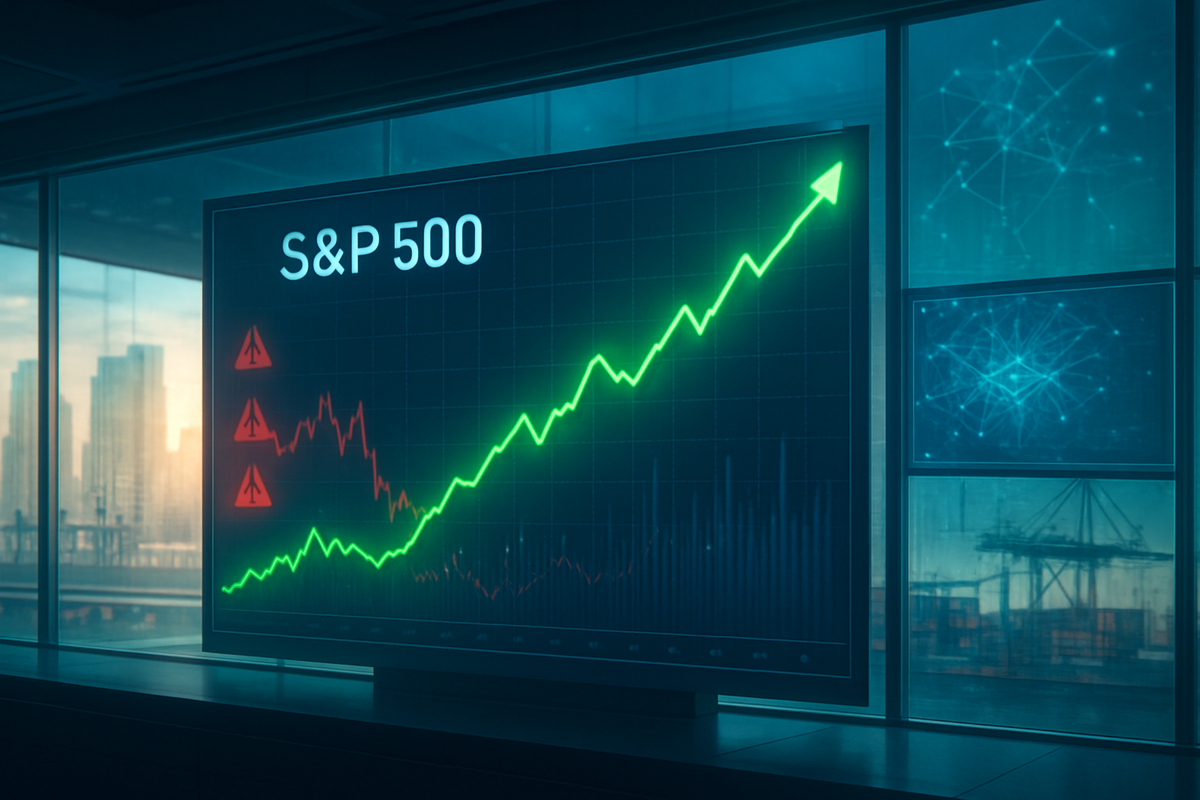
The S&P 500 (NYSEARCA:SPY) closed out 2025 on a high note, finishing the year with a robust 17% annual gain and reaching an all-time high of approximately 6,900. This performance marks the third consecutive year of double-digit returns for the benchmark index, a feat of endurance that has silenced many of the year’s loudest skeptics. Despite a calendar year punctuated by a "tariff shock" in the spring and recurring anxieties over an "AI bubble," the market proved that the American economic engine—and the tech giants fueling it—had more than enough momentum to muscle through the volatility.
As of December 31, 2025, the market’s "climb a wall of worry" narrative has been fully realized. Investors who stayed the course were rewarded as the Federal Reserve successfully navigated a "soft landing," delivering three interest rate cuts that lowered borrowing costs and sustained corporate margins. While the growth rate slowed slightly from the breakneck speeds of 2023 and 2024, the index’s ability to absorb geopolitical and trade-related shocks has solidified 2025 as a year of historic market resilience.
The Year of Volatility: From DeepSeek to Tariff Tremors
The 2025 market story began with a sharp reality check in January. The launch of a highly efficient AI model by the Chinese firm DeepSeek sent shockwaves through Silicon Valley, sparking fears that the massive capital expenditures by U.S. "Big Tech" were at risk of being disrupted by more cost-effective competitors. This "DeepSeek Shock" led to a temporary but painful correction, with industry leader Nvidia (NASDAQ: NVDA) experiencing a 17% intraday drop as investors questioned the long-term return on investment for AI infrastructure. However, as quarterly earnings reports began to roll in, it became clear that the demand for high-end semiconductors and cloud computing was not just hype, but a structural shift in the global economy.
The most significant test of the year arrived in April, an event now known on Wall Street as the "Tariff Tremors." On April 2, the administration announced sweeping new tariffs on imports from China, Mexico, and Canada. The reaction was immediate and violent; the S&P 500 plunged 5% in a single session, its largest one-day drop since the 2020 pandemic. For a week, the prospect of a full-scale global trade war loomed over the markets, threatening to derail the post-inflation recovery.
The chaos proved to be short-lived. Following a "queasy" reaction from the U.S. Treasury market and intense pressure from domestic business leaders, the administration suspended the most severe tariffs on April 9 to enter a period of high-stakes negotiations. This pivot sparked a dramatic V-shaped recovery. By the time the summer doldrums usually set in, the market had not only reclaimed its pre-tariff levels but was setting new records almost weekly, driven by the realization that trade policy was being used as a tactical negotiating tool rather than a permanent barrier to commerce.
Winners and Losers: A Tale of Two Tiers
Nvidia (NASDAQ: NVDA) once again emerged as the undisputed champion of the 2025 market. Despite the early-year volatility, the semiconductor giant became the first company in history to hit a $4 trillion market capitalization in July, eventually crossing the $5 trillion mark in October. Finishing the year up approximately 42%, Nvidia’s dominance in the AI chip space remained unchallenged, even as it faced production delays for its latest Blackwell architecture. For investors, Nvidia was the primary engine that kept the broader index afloat during the year’s darkest moments.
In contrast, other members of the "Magnificent Seven" saw more tempered success. Microsoft (NASDAQ: MSFT) delivered a respectable 15.6% gain, closely tracking the broader index, as its Azure cloud division continued to monetize AI integrations. However, Apple (NASDAQ: AAPL) found itself as a relative laggard, posting a modest gain of roughly 10%. The iPhone maker struggled with regulatory headwinds in the European Union and concerns that its "Apple Intelligence" rollout was failing to spark the massive hardware upgrade cycle analysts had predicted. Apple was forced to rely heavily on a record-breaking $185 billion stock buyback program to support its share price throughout the year.
Beyond tech, the domestic industrial sector saw a surprising resurgence. Companies like Nucor (NYSE: NUE) and other materials firms benefited from the "reshoring" momentum that followed the April tariff scare. As corporations sought to insulate their supply chains from future trade policy shifts, domestic manufacturing and packaging companies saw their best earnings growth in half a decade. This broadening of the rally was a crucial development, as it moved the market away from a pure reliance on a handful of tech stocks and toward a more balanced, multi-sector growth model.
The Broader Significance: AI Monetization and Policy Pivots
The 2025 rally is significant because it marked the transition from the "AI Hype" era to the "AI Results" era. Throughout the year, the market moved past the simple excitement of large language models and began demanding proof of profitability. This "Show Me the Money" phase forced companies like Alphabet (NASDAQ: GOOGL) and Amazon (NASDAQ: AMZN) to demonstrate how AI was streamlining operations and driving revenue in their core advertising and cloud businesses. The fact that the S&P 500 rose 17% during this transition suggests that the AI revolution is viewed by the market as a legitimate productivity booster rather than a speculative bubble.
Furthermore, the market's reaction to the "Tariff Tremors" established a new precedent for how investors view political risk. The quick recovery in April suggests that Wall Street has become increasingly adept at "pricing in" geopolitical noise, viewing aggressive trade rhetoric as a precursor to deal-making rather than a death knell for global trade. This psychological shift allowed the market to maintain high valuation multiples even in the face of uncertainty, with the forward P/E ratio for the S&P 500 hovering around 21.8—well above historical averages but supported by strong earnings growth.
The Federal Reserve’s role cannot be overstated. By shifting its focus from inflation to the labor market, the Fed provided the liquidity necessary to sustain the bull market. The three rate cuts delivered in 2025 were perfectly timed to offset the cooling effects of trade tensions and a slightly rising unemployment rate, which ticked up to 4.6% by year-end. This "Fed Put" gave investors the confidence to buy every dip, culminating in a powerful "Santa Claus Rally" in December that pushed the index to its final closing record.
Looking Ahead: The Challenges of 2026
As we enter 2026, the S&P 500 stands at a historic peak, but it is a peak that many analysts describe as "priced for perfection." The extreme concentration of the index—where the five largest companies now account for over 30% of its total value—presents a structural risk that cannot be ignored. Any significant stumble from a name like Nvidia or Microsoft could have an outsized impact on the entire market's performance in the coming year.
The short-term focus for 2026 will likely be on the durability of the U.S. consumer. While the labor market remained resilient in 2025, with final jobless claims falling to 199,000 in late December, the cumulative effect of years of high interest rates and the lingering impact of tariffs on consumer goods could begin to weigh on spending. Investors will be watching retail giants like Walmart (NYSE: WMT) and Target (NYSE: TGT) closely for signs that the American consumer is finally reaching a breaking point.
Conclusion: A Year for the Record Books
The 17% gain in 2025 will be remembered as a testament to the resilience of the U.S. equity markets. By overcoming the twin threats of an AI-induced tech correction and a major trade policy shock, the S&P 500 has proven its ability to adapt to a rapidly changing global landscape. The year ends with the "soft landing" achieved, inflation largely contained, and a technological revolution that is finally beginning to show its face in corporate bottom lines.
Moving forward, the primary takeaway for investors is the importance of diversification within the tech sector and the growing value of domestic industrials. While the AI giants led the way, the broadening of the rally in the latter half of the year suggests a healthier market than many expected. As we move into 2026, the mantra for investors remains: watch the earnings, respect the Fed, and stay prepared for the next "wall of worry" that will inevitably appear.
This content is intended for informational purposes only and is not financial advice