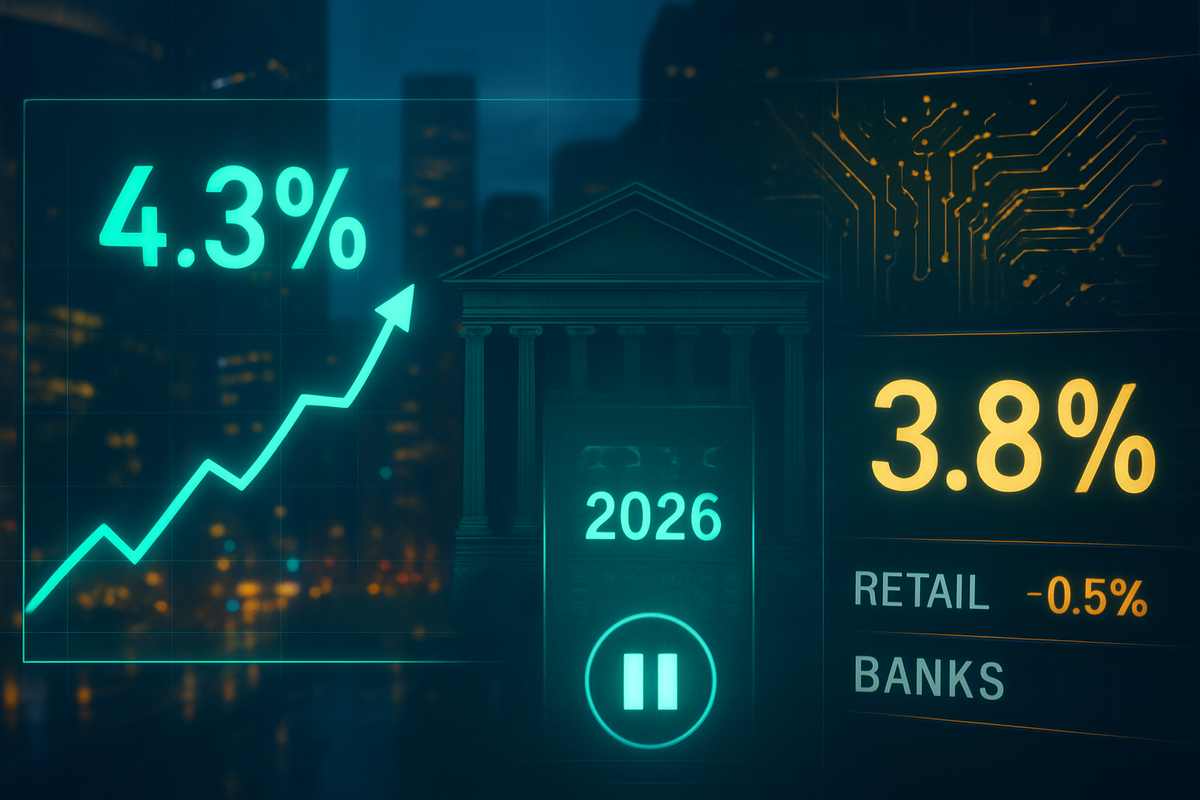
The United States economy defied gravity in the third quarter of 2025, posting a blistering 4.3% annualized growth rate that has sent shockwaves through global financial markets. This morning’s release from the Bureau of Economic Analysis (BEA) shattered the consensus forecast of 3.2%, signaling an economy that is not merely "landing softly" but potentially re-accelerating. The data, which was delayed by nearly two months due to a 43-day federal government shutdown earlier this fall, has immediately forced a dramatic repricing of expectations for the Federal Reserve’s interest rate path in 2026.
The immediate market reaction was a sharp "hawkish" pivot. The 10-year Treasury yield, a benchmark for everything from mortgages to corporate debt, surged to 4.20% as investors scrambled to price out previously anticipated rate cuts. While stock futures initially wavered, the "K-shaped" nature of the growth—driven heavily by high-income spending and artificial intelligence investment—led to a divided board. The Dow Jones Industrial Average slipped as rate-sensitive sectors braced for a "higher-for-longer" reality, while tech-heavy indices remained buoyed by the sheer momentum of corporate earnings.
The Data Fog Lifts: Resilience Amidst Chaos
The Q3 GDP print of 4.3% is the strongest reading the U.S. has seen since the post-pandemic boom, a feat made more remarkable by the backdrop of high interest rates and political volatility. According to the BEA, the primary engines of this growth were robust consumer spending, which rose 3.5%, and a significant jump in net exports. Government spending also played a larger-than-expected role, though analysts are still untangling how much of that was "catch-up" spending following the resolution of the federal shutdown in mid-November.
The timeline leading to this moment was fraught with uncertainty. For much of October and November, the Federal Reserve and private sector analysts were "flying blind" as the government shutdown halted the flow of official economic data. This "data fog" led many to believe the economy was cooling faster than it actually was. Federal Reserve Chair Jerome Powell, speaking after the December FOMC meeting where the central bank issued a cautious 25-basis-point cut, acknowledged the difficulty of the current environment. "You've got one tool. You can't do two things at once," Powell remarked, referring to the Fed's struggle to balance a loosening labor market with growth that remains stubbornly—and perhaps dangerously—above trend.
Corporate Winners and Losers: The AI and "Fortress" Divide
The 4.3% growth figure has created a stark divide between companies capable of harnessing this momentum and those crushed by the weight of sustained high interest rates. In the banking sector, JPMorgan Chase & Co. (NYSE: JPM) has emerged as a primary beneficiary. The banking giant reported a massive $14.4 billion net income for the quarter, leveraging its "fortress balance sheet" to capture market share while benefiting from higher net interest income as rates remain elevated. Similarly, Goldman Sachs Group Inc. (NYSE: GS) saw a resurgence in its investment banking division as the strong GDP print encouraged a late-year flurry of M&A activity.
In the technology sector, the narrative has shifted from AI hype to AI monetization. Nvidia Corp. (NASDAQ: NVDA) continues to be the "macro" force of the market, with its Blackwell architecture effectively sold out through mid-2026. Microsoft Corp. (NASDAQ: MSFT) and Apple Inc. (NASDAQ: AAPL) have also proven their resilience; Microsoft’s AI-driven revenue has hit record run rates, while Apple successfully leveraged its "Apple Intelligence" hardware cycle to drive a 14% jump in iPhone 17 sales.
Conversely, the "losers" are those sensitive to the cooling of middle-income discretionary spending and high borrowing costs. The Trade Desk Inc. (NASDAQ: TTD) saw its stock underperform as high rates pressured non-essential advertising budgets. In the luxury space, the divide is even more apparent. While Ralph Lauren Corp. (NYSE: RL) bucked trends with 11% revenue growth by targeting high-end consumers, European giant LVMH Moët Hennessy Louis Vuitton (OTC:LVMHF) was downgraded to "Hold" as its middle-luxury segments struggled. Retailers like Lululemon Athletica Inc. (NASDAQ: LULU) also faced headwinds as consumers became increasingly discerning with their discretionary dollars.
A "No Landing" Scenario and the Global Ripple Effect
The broader significance of the 4.3% GDP print lies in the increasing likelihood of a "no landing" scenario—where the economy continues to grow at a pace that prevents inflation from fully returning to the Fed’s 2.0% target. This puts the U.S. at odds with other major economies, such as the Eurozone and China, which are grappling with much slower growth. The divergence is strengthening the US Dollar Index (ICE:DXY), which recovered from session lows following the data release, potentially creating a "currency headwind" for American multinationals operating abroad.
Historically, such high growth late in a tightening cycle has often led to a "wage-price spiral," a scenario the Fed is desperate to avoid. The current situation draws comparisons to the late 1990s, where productivity gains from the internet boom allowed for high growth without immediate inflationary spikes. Today, the market is betting that AI-driven productivity might be providing a similar "buffer," but the 2.9% core PCE (Personal Consumption Expenditures) reading suggests that the buffer may be wearing thin.
The 2026 Outlook: A Forced Pause in Policy
Looking ahead, the Federal Reserve’s roadmap for 2026 has been effectively torn up. Prior to this GDP release, the market had priced in at least three rate cuts for the first half of 2026. Those expectations have now evaporated. The CME FedWatch Tool now shows an 85% probability that the Fed will hold rates steady at its January 2026 meeting. Analysts are increasingly calling for a "strategic pause" that could last through the entirety of 2026 if consumer spending does not cool.
The challenge for the Fed will be the "neutral rate" debate. Many economists now argue that the long-term interest rate that neither stimulates nor restrains the economy is higher than previously thought. If the neutral rate has shifted upward, the Fed's current policy of 3.50%–3.75% might not be as restrictive as officials believe, necessitating a "higher-for-longer" stance that could last well into 2027.
Investor Takeaway: Watching the "K" and the Fed
The Q3 GDP data confirms that the U.S. economy remains the primary engine of global growth, but that engine is running hot. For investors, the takeaway is clear: the era of "easy money" and rapid rate cuts is not returning anytime soon. The market will likely continue to favor "fortress" companies like Walmart Inc. (NYSE: WMT), which has used AI to mitigate tariff-related supply chain shocks and appeal to a broad consumer base, while punishing high-debt, low-margin players.
Moving forward, the focus shifts to the January FOMC meeting and the next round of inflation data. Investors should watch for any signs that the 4.3% growth is translating into renewed heat in the labor market, which would be the final signal the Fed needs to abandon its easing bias entirely. While the headline growth is a sign of strength, the "cost" of that strength may be a prolonged period of high borrowing costs that will continue to test the resilience of the American consumer and the corporate sector alike.
This content is intended for informational purposes only and is not financial advice.