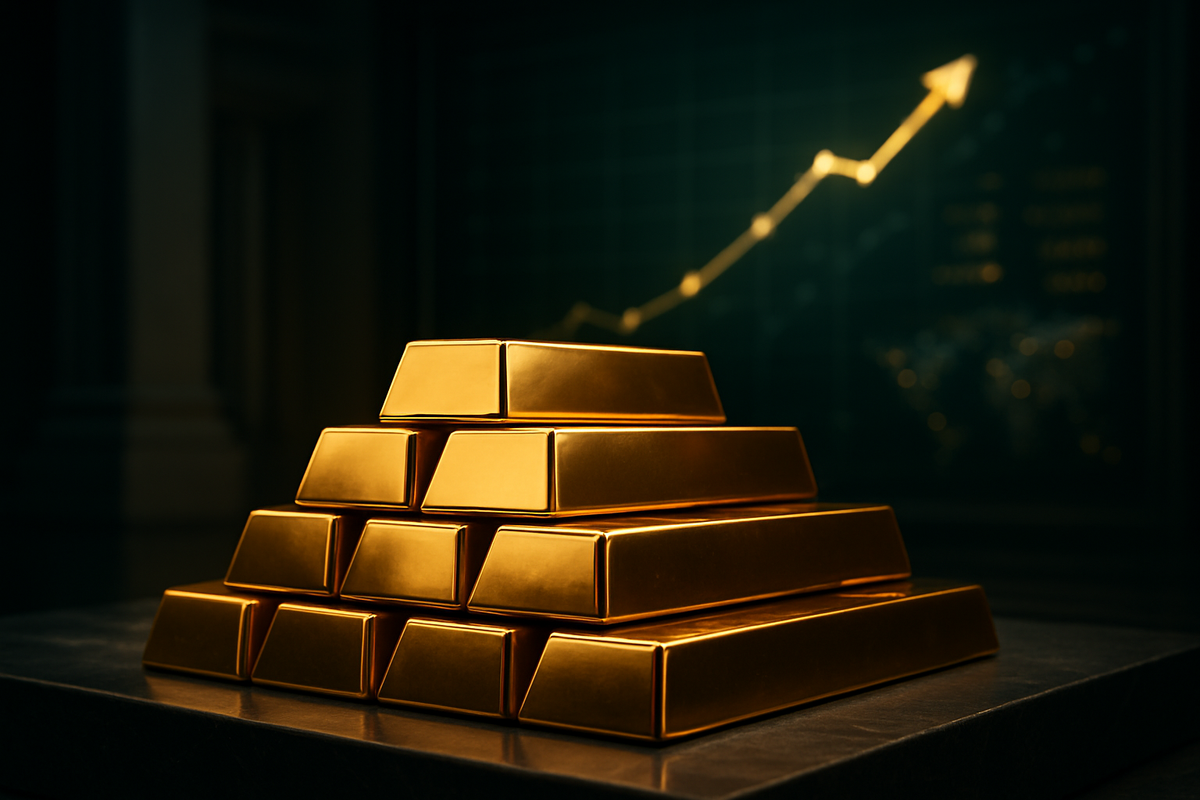
As the calendar turns to the final days of 2025, the global gold market is concluding a year that has defied traditional economic gravity. Gold prices have surged to unprecedented heights, trading at a staggering $4,435 per ounce as of December 22, 2025—a more than 60% increase since the beginning of the year. While retail investors often drive momentum in speculative rallies, the current ascent is fundamentally different, underpinned by a "structural floor" constructed by the world’s most powerful financial institutions.
This historic rally has been fueled by a dual-engine of institutional demand: relentless central bank accumulation and a massive resurgence in Western ETF inflows. For the first time in decades, gold is being treated not merely as a tactical hedge against inflation, but as a core strategic asset. Analysts at JPMorgan Chase & Co. (NYSE: JPM) suggest that the market has undergone a permanent rebasing, where previous price ceilings have become the new foundations, signaling that the gold "supercycle" may only be in its middle innings.
A Year of Shattered Records and Institutional Inelasticity
The journey to $4,400 was marked by several pivotal moments throughout 2025. The metal breached the $3,000 psychological barrier in March and accelerated through $4,000 in October, leaving many short-sellers in its wake. This price action was supported by the third consecutive year of central bank purchases exceeding the 1,000-tonne mark. According to recent data, central banks added approximately 950 tonnes to their reserves in 2025, with the National Bank of Poland, the Reserve Bank of India, and the Central Bank of the Republic of Turkey leading the charge. This persistent buying from the "official sector" has created a price-inelastic demand base that refuses to sell even as prices reach record territory.
Simultaneously, the narrative in Western markets shifted dramatically in the second half of 2025. After years of tepid interest, gold-backed ETFs saw record-breaking capital allocation, with annual inflows projected to hit $108 billion by year-end. The third quarter of 2025 alone witnessed $26 billion in global inflows, the strongest single quarter on record. This pivot was largely driven by the Federal Reserve’s transition into a more accommodative monetary policy, which lowered the opportunity cost of holding non-yielding assets and prompted institutional funds to increase their gold weighting from a historical 2-5% to a new norm of 5-10%.
The Corporate Winners and the Mining Renaissance
The primary beneficiaries of this price surge are the global gold producers, who are currently enjoying the widest profit margins in the history of the industry. Newmont Corporation (NYSE: NEM), the world's largest gold miner, has seen its stock price soar as its all-in sustaining costs (AISC) remained relatively stable while the spot price of its primary product doubled over an 18-month period. Similarly, Barrick Gold Corporation (NYSE: GOLD) has utilized the windfall to significantly de-leverage its balance sheet and increase dividends, positioning itself as a cash-flow powerhouse in the current environment.
Agnico Eagle Mines Limited (NYSE: AEM) has also emerged as a winner, benefiting from its high-grade assets in low-risk jurisdictions, which have become increasingly attractive to investors wary of geopolitical volatility. On the financial side, the SPDR Gold Shares (NYSE Arca: GLD) has seen its assets under management swell to record levels, further cementing its role as the primary vehicle for institutional gold exposure. However, the rally has not been without its losers; jewelry retailers and industrial users of gold have struggled to pass on the astronomical costs to consumers, leading to a noticeable contraction in discretionary physical demand.
Geopolitical De-Dollarization and the New Monetary Order
The wider significance of this gold rally extends far beyond simple supply and demand metrics; it reflects a fundamental shift in the global monetary order. The aggressive accumulation of gold by central banks is a clear signal of "de-dollarization" and a desire to insulate national reserves from the risks of Western financial sanctions and currency volatility. By diversifying away from U.S. Treasury-denominated assets, these nations are effectively using gold to build a "sovereign insurance policy" that is independent of any single government's fiscal policy.
This trend is mirrored in the private sector, where the "debasement hedge" has become a dominant investment theme. With Western fiscal deficits reaching eye-watering levels and national debts continuing to climb, institutional investors are using gold to protect against the potential loss of currency purchasing power. This historical precedent—reminiscent of the late 1970s but on a much larger global scale—suggests that gold is being remonetized as the ultimate arbiter of value in an increasingly fragmented and debt-laden global economy.
Looking Ahead: The Path to $5,000 and Beyond
As we look toward 2026, the momentum shows little sign of abating. JPMorgan has recently revised its price targets upward, projecting that gold will average $5,055 per ounce by the fourth quarter of 2026, with the potential to reach $6,000 by 2028. The short-term outlook remains bullish as the Federal Reserve is expected to continue its rate-cutting cycle, further enhancing gold’s appeal. However, the market may face challenges if a sudden resolution to major geopolitical conflicts occurs, which could lead to a temporary cooling of the "fear trade."
In the long term, the primary risk to the rally would be a coordinated effort by central banks to slow their purchases, though there is currently no evidence of such a shift. Instead, many analysts expect a "buy the dip" mentality to persist among institutional players, ensuring that any price corrections remain shallow. Investors should watch for the upcoming Q1 2026 reserve reports from major central banks and the continued pace of ETF inflows as the primary indicators of whether this structural support remains intact.
A New Era for the Yellow Metal
The 2025 gold rally has fundamentally changed the landscape of the precious metals market. What was once seen as a "relic" of a bygone monetary era has returned to the center of global finance, backed by the world’s most sophisticated institutional players. The combination of central bank diversification and a massive return of Western investment capital has created a structural floor that makes the "record prices" of today look like the "bargain prices" of tomorrow.
As the market moves into 2026, the key takeaway for investors is that the rules of the gold market have been rewritten. The price is no longer dictated solely by jewelry demand or small-scale speculation, but by a systemic shift in how value is stored and protected on a global scale. While volatility is inevitable, the institutional might currently supporting gold suggests that the path of least resistance remains firmly to the upside.
This content is intended for informational purposes only and is not financial advice.