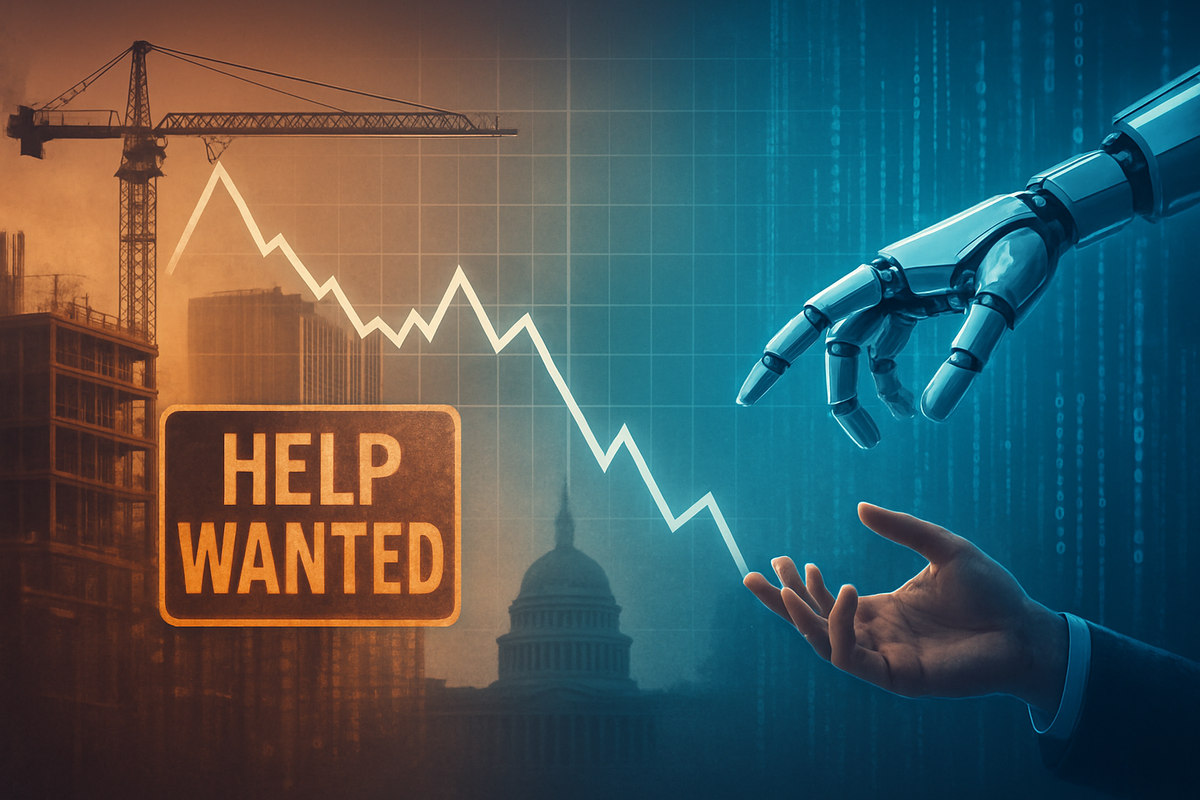
The United States labor market enters the final weeks of 2025 on shaky ground, characterized by a "low-hire, low-fire" regime that has recently begun to crack under the weight of political instability and a massive corporate pivot toward artificial intelligence. As of December 18, 2025, the national unemployment rate has climbed to 4.6%, a four-year high that has forced the Federal Reserve to accelerate its easing cycle. This "wobble" in the labor market is not merely a cyclical downturn but a fundamental restructuring, as major employers trade human headcount for automated efficiency in a bid to preserve margins.
The immediate implications are stark: for the first time since the post-pandemic recovery, the U.S. economy recorded a net loss of jobs in October, shedding 105,000 positions. While a modest rebound of 64,000 jobs followed in November, the underlying data reveals a deeply bifurcated economy. High-frequency indicators, such as weekly jobless claims which fell to 224,000 for the week ending December 13, suggest a fragile stability, yet the "affordability crisis" for workers is deepening as wage growth has cooled to 3.5% year-over-year. This cooling labor market was the primary catalyst for the Federal Reserve’s decision today to cut interest rates by another 25 basis points to a range of 3.5%–3.75%.
The Winter of Discontent: A Timeline of the 2025 Labor Shocks
The current instability can be traced back to the "Winter of Discontent," a period defined by a historic 43-day federal government shutdown that began on October 1, 2025. The shutdown did more than just halt government services; it distorted critical economic data, leading to the first non-publication of household employment figures since 1948. During this period, the federal government itself became a primary source of job losses, shedding 162,000 positions through a combination of furloughs and a new administration’s aggressive "personnel purges" and buyout programs. This sudden withdrawal of public sector support sent shockwaves through the broader economy, particularly in regions heavily dependent on federal contracts.
As the shutdown ended in mid-November, the private sector's underlying weakness became impossible to ignore. Throughout 2024, many firms had engaged in "labor hoarding," fearing the talent shortages of previous years. However, by Q4 2025, that sentiment shifted toward "right-sizing." The timeline of events shows a rapid acceleration of layoff announcements starting in late October, as companies realized that the anticipated "soft landing" was turning into a period of stagnant growth. This culminated in November’s 4.6% unemployment print, which served as a wake-up call for policymakers who had previously focused almost exclusively on inflation.
The reaction from the financial markets has been one of cautious relief mixed with structural anxiety. While the Dow Jones Industrial Average and S&P 500 initially rallied on the news of Fed rate cuts, the "quality" of the rally has been questioned. Investors are increasingly favoring companies that can demonstrate "jobless growth"—the ability to expand revenue without adding significant headcount. This has led to a widening gap between the "Automation Winners" and the "Labor-Dependent Losers," a trend that has become the defining theme of the late 2025 trading sessions.
Winners and Losers: The AI Divide and Industrial Resilience
In this wobbling market, the traditional tech and logistics giants have faced the harshest corrections. Amazon (NASDAQ: AMZN) recently announced the largest workforce reduction in its history, aiming to cut between 14,000 and 30,000 corporate roles. CEO Andy Jassy has been vocal about moving toward a "flatter structure" where AI and robotics handle tasks previously managed by middle management. Similarly, Intel (NASDAQ: INTC) has struggled with its transition, cutting 24,000 jobs as it battles to regain its footing in the semiconductor race. Even the logistics sector, once a bastion of blue-collar stability, is retreating; UPS (NYSE: UPS) announced 48,000 job cuts in late 2025 as it aggressively automates its sorting facilities.
Conversely, companies providing the "physical and digital infrastructure" for this new era are thriving. Caterpillar (NYSE: CAT) has seen its stock surge to record highs near $600, driven by a $39.9 billion order backlog. Much of this demand stems from the construction of massive data centers required to power the very AI that is replacing corporate workers. In the healthcare sector, HCA Healthcare (NYSE: HCA) has emerged as a standout winner. Despite the broader labor cooling, HCA is aggressively hiring for specialized nursing roles and tech-enabled care positions, with its stock hitting all-time highs in November on the back of massive earnings beats.
The consulting and service firms that implement these automation strategies are also reaping significant rewards. Accenture (NYSE: ACN) reported a 50% increase in new Generative AI bookings, reaching over $2 billion annually. These "automation enablers" are helping Fortune 500 companies navigate the transition, often by replacing domestic support roles with intelligent "Agentic AI" systems. While Walmart (NYSE: WMT) has kept its 2.1 million-strong headcount flat, it is a "winner" in terms of efficiency, retraining its existing workforce to operate AI-driven inventory systems rather than expanding its human footprint.
Wider Significance: The Rise of the Job-Loss Recovery
The current labor market "wobble" fits into a broader historical trend of technological displacement, but the speed of the 2025 transition is unprecedented. Unlike the manufacturing shifts of the 1980s or the 2008 financial crisis, the current displacement is hitting white-collar corporate roles and service sectors simultaneously. This has created what some economists are calling a "job-loss recovery," where corporate profits and GDP remain resilient even as the unemployment rate climbs. The 2025 experience suggests that the link between economic growth and job creation has been significantly weakened by the integration of AI.
The Federal Reserve's internal dynamics reflect this uncertainty. The December rate decision was met with three dissents—the highest level of disagreement within the FOMC since 2019. Some members argue that cutting rates will do little to help workers whose roles are being permanently eliminated by technology, while others fear that failing to act will turn a structural shift into a cyclical depression. This policy tension mirrors the regulatory environment, where debates over "AI taxes" and universal basic income (UBI) are moving from the fringes of academia into the halls of Congress as the 4.6% unemployment rate begins to feel permanent for certain demographics.
Historically, this period draws comparisons to the "jobless recovery" following the 2001 dot-com bust, but with a critical difference: the tools of displacement are now more capable and cheaper than ever. The ripple effects are already being felt by competitors and partners of the major tech firms. As Meta (NASDAQ: META) considers deep cuts to its metaverse units to focus on AI-driven efficiency, the entire ecosystem of developers and hardware partners must pivot. This creates a "survival of the most efficient" environment that prioritizes capital expenditure on technology over investment in human capital.
What Comes Next: Scenarios for 2026 and Beyond
In the short term, the market is bracing for the January 9, 2026, jobs report, which will provide the first "clean" look at the labor market following the government shutdown. If the unemployment rate ticks up toward 5.0%, the Federal Reserve may be forced into a "jumbo" 50-basis-point cut in early 2026. However, the long-term outlook depends on whether the "reallocation of demand" can create new types of jobs as quickly as AI destroys old ones. We are likely to see a continued surge in demand for "AI Infrastructure" roles and specialized healthcare professionals, while administrative and middle-management roles may never return to their 2023 peaks.
Strategic pivots will be required for both companies and investors. Companies that fail to integrate automation will likely see their margins eroded by competitors who can produce more with less. For investors, the opportunity lies in the "picks and shovels" of the automation era—companies like Caterpillar and Accenture that facilitate the transition. A potential challenge, however, is the rising social and political pressure to address the widening wealth gap. If the "wobble" turns into a sustained rise in unemployment, we may see a regulatory crackdown on automated displacement or new mandates for worker retraining.
Summary and Investor Outlook
The U.S. labor market at the end of 2025 is a study in contradiction. While the headline unemployment rate of 4.6% and the recent job losses are concerning, they are also symptoms of a massive, high-speed technological upgrade of the American economy. The Federal Reserve has signaled its readiness to support the market, but its tools are primarily designed to address cyclical demand, not structural technological shifts. The "low-hire, low-fire" regime has ended, replaced by a more volatile environment where efficiency is the only metric that matters.
Moving forward, investors should watch for a few key indicators: the stabilization of the unemployment rate, the pace of AI-related capital expenditure among the S&P 500, and any signs of "wage-push" inflation in the few sectors that remain labor-starved, such as healthcare and specialized construction. The 2025 labor wobble is not just a temporary dip; it is the first chapter of a new economic era. Those who can identify the companies successfully navigating this "Great Rebalance" will be best positioned for the years ahead.
This content is intended for informational purposes only and is not financial advice.