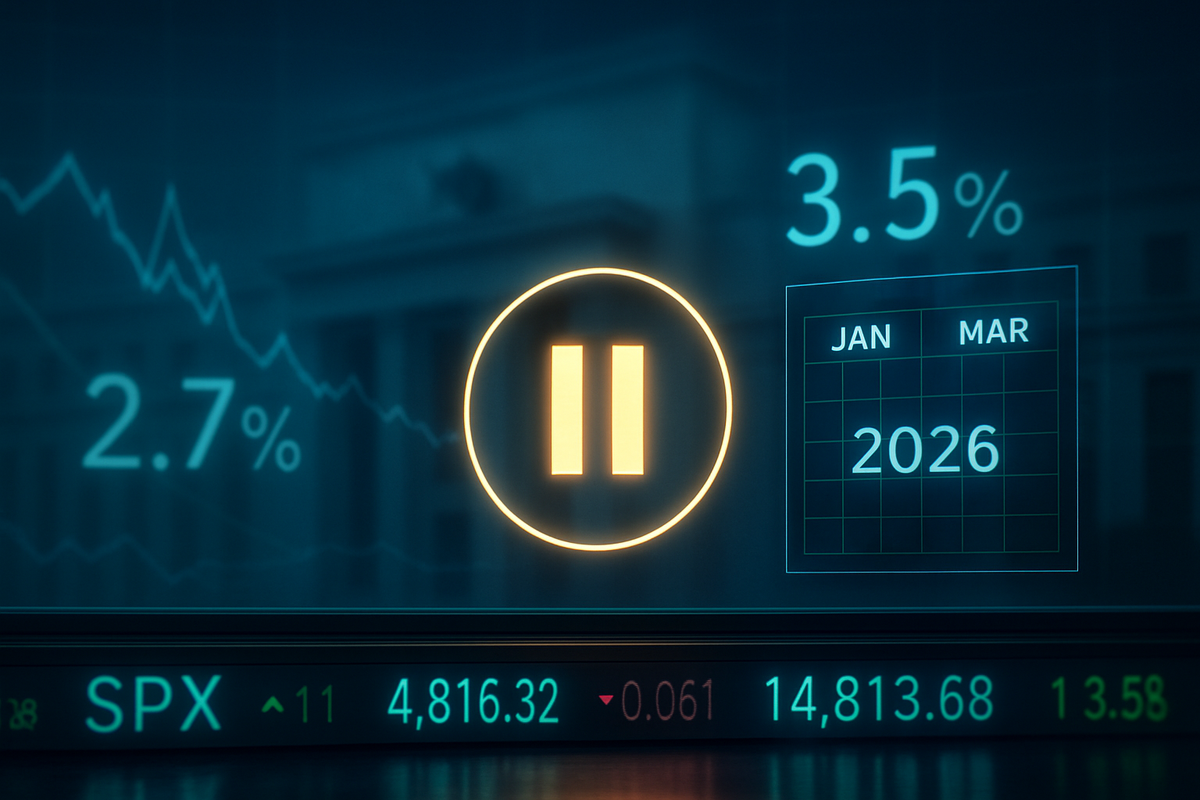
The Federal Reserve’s aggressive campaign to normalize interest rates has reached a critical juncture following the release of November’s inflation data, which showed a sharper-than-anticipated decline in consumer prices. As of December 18, 2025, the Consumer Price Index (CPI) fell to 2.7% year-over-year, a significant drop from the 3.0% recorded in September and well below the 3.1% consensus forecast. This cooling trend has immediately recalibrated market expectations, forcing investors to weigh the benefits of lower borrowing costs against the Fed’s signals that it may soon hit the "pause" button on its easing cycle.
The immediate implication of this data is a dramatic shift in the CME FedWatch Tool probabilities. While the market had previously flirted with the idea of a "January Jumpstart" to 2026 with another rate cut, the probability of a pause at the January meeting has surged to 76%. Investors are now grappling with a "good news is bad news" paradox: while inflation is nearing the Fed’s 2% target, the central bank’s desire to avoid over-stimulating the economy—compounded by a recent government shutdown that left a "data fog" over the fourth quarter—suggests a more cautious path forward in the coming months.
A Turbulent Path to the 3.5% Threshold
The road to the current 3.50%–3.75% federal funds rate has been anything but linear. On December 10, 2025, the Federal Open Market Committee (FOMC) delivered its third consecutive 25-basis-point cut, a move led by Chair Jerome Powell to provide a "cushion" for a labor market that had shown signs of cooling during a 43-day federal government shutdown. That shutdown, which paralyzed data collection agencies in October and November, created a vacuum of information that initially led to high volatility, with the Cboe Volatility Index (VIX) spiking above 25.
The timeline leading to today’s market posture began in late summer, as the Fed transitioned from a "higher-for-longer" stance to a proactive easing cycle. However, the December 10 decision was notably contentious, resulting in a 9-3 vote—the widest dissent seen in years. Hawkish members expressed concern that easing too quickly could reignite price pressures, especially with persistent fiscal deficits. The release of today's CPI report at 2.7% provides some vindication for the doves, yet the Fed’s updated Summary of Economic Projections (SEP) suggests they are in no rush to reach their 3.0% terminal rate goal.
Initial market reactions to the December 18 data were mixed. While the S&P 500 initially surged to an all-time high of 6,900, the rally quickly transformed into a sector rotation. Treasury yields plummeted, with the 10-year yield falling to 4.12%, reflecting a bond market that believes the Fed is winning the war on inflation. However, equity investors remain wary of the Fed’s "risk-management" shift, fearing that a pause in January could stall the momentum of high-growth sectors that rely on cheap capital.
Winners and Losers in the New Rate Reality
The shifting expectations for 2026 have created a stark divide between market winners and losers. Among the primary beneficiaries are small-cap stocks and cyclical industries. Companies within the Russell 2000 index, which are often more sensitive to domestic borrowing costs, have seen renewed interest as the "soft landing" narrative gains traction. Real estate investment trusts (REITs) like Prologis, Inc. (NYSE: PLD) have also benefited from the retreat in Treasury yields, as lower rates improve the attractiveness of dividend-yielding assets and reduce financing costs for new developments.
Conversely, the "Magnificent Seven" and other high-valuation technology giants have faced headwinds. As the market prices in a January pause, the Nasdaq has lagged behind the broader market. Investors are rotating out of expensive AI-driven names like Nvidia (Nasdaq: NVDA) and Apple Inc. (Nasdaq: AAPL), moving instead toward "value" plays that offer more stability in a plateauing rate environment. The logic is simple: if the Fed stops cutting, the expansion of price-to-earnings multiples for tech stocks may have reached its ceiling for the current cycle.
The banking sector presents a more nuanced picture. Large institutions such as JPMorgan Chase & Co. (NYSE: JPM) and Bank of America Corp. (NYSE: BAC) are navigating a narrowing Net Interest Margin (NIM). While the recent rate cuts reduce the interest banks pay on deposits, they also lower the yields on the loans they issue. A pause in January could provide these banks with a much-needed period of stability to recalibrate their balance sheets, but a prolonged hold into mid-2026 could squeeze profitability if the yield curve remains stubbornly flat or inverted.
The Broader Significance: Data Fog and Fiscal Friction
The current shift in Fed expectations is not occurring in a vacuum; it is deeply intertwined with broader fiscal and geopolitical trends. The 2025 government shutdown has left a permanent mark on this year’s economic narrative, creating what Goldman Sachs (NYSE: GS) analysts call "The Great Data Gap." Because the Fed is making decisions based on incomplete or delayed information, the risk of a policy error—either cutting too much or pausing too soon—is at its highest level in a decade. This uncertainty has forced the Fed to adopt a "risk-management" posture, prioritizing stability over speed.
Historically, the Fed has rarely managed a perfect "soft landing" without at least one period of market-shaking volatility. Comparisons are already being drawn to the mid-1990s easing cycle, where the Fed successfully adjusted rates to prolong an economic expansion. However, the current environment is complicated by massive fiscal spending and the potential for new trade tariffs in 2026, which UBS analysts warn could cause a temporary "inflation hump" above 3% by mid-year. This looming threat of "fiscal-led inflation" is a primary reason why the Fed is hesitant to commit to a March cut.
Furthermore, the divergence between market pricing and the Fed’s "dot plot" is widening. While the CME FedWatch Tool shows markets pricing in at least two cuts for 2026, the Fed’s own projections suggest only one. This "expectation gap" often leads to significant market corrections when one side is eventually forced to capitulate. If the Fed holds firm on its January pause and maintains a hawkish tone regarding March, the market may face a painful repricing of assets that were bought on the assumption of a more aggressive easing schedule.
What Comes Next: The Road to March 2026
In the short term, all eyes will be on the labor market data scheduled for release in early January. If unemployment remains stable despite the "data fog," the Fed will almost certainly follow through with the 76% probability of a pause in January. This would represent a strategic pivot to "observation mode," allowing the FOMC to see how the previous 75 basis points of cuts in 2025 are filtering through the economy. Investors should prepare for a period of "range-bound" trading, where the S&P 500 struggles to break significantly above the 6,900 level without a clear catalyst.
Longer term, the March 2026 meeting is the true "pivot point." Currently, the market is split nearly 50/50 on whether the Fed will resume cutting or continue to hold. A March cut would likely require Core PCE inflation to move closer to 2.5%, as projected in the Fed’s December SEP. If, however, the "tariff-driven inflation" warned of by JP Morgan analysts begins to materialize in early-year price surveys, the Fed may be forced to keep rates at 3.5% for the duration of the first half of 2026, a scenario that would likely lead to a significant pullback in equity markets.
Strategic adaptations will be required for both institutional and retail investors. The "easy money" phase of the rally, driven by the anticipation of the first cuts, is over. The next phase will be defined by "earnings quality" and "balance sheet strength." Companies that can grow earnings in a 3.5% rate environment without relying on constant refinancing will be the winners of 2026. Market participants should also keep a close watch on the 2-year Treasury yield; if it remains significantly below the federal funds rate, it will signal that the bond market is losing patience with the Fed’s cautious approach.
Final Assessment: Navigating the Plateau
The cooling of inflation to 2.7% is a milestone in the post-pandemic economic recovery, yet it has paradoxically brought more uncertainty to the Federal Reserve’s path. The "data-dependent pause" expected in January 2026 reflects a central bank that is wary of its own success, fearing that the final mile of the inflation fight could be the most difficult. For the Fed, the goal is no longer just to lower prices, but to ensure that inflation does not "bounce" back due to fiscal expansion or supply-side shocks.
Moving forward, the market is likely to transition from a macro-driven environment to one focused on micro-fundamentals. The "rotation" seen in mid-December is a precursor to a 2026 market where stock picking matters more than broad index exposure. Investors should watch for the "January Effect" to be muted this year, as the high probability of a Fed pause keeps a lid on speculative exuberance.
In summary, the Federal Reserve has successfully navigated the economy to the 3.5% threshold, but the "final descent" to a neutral rate remains clouded by data gaps and fiscal uncertainty. As we look toward the March meeting, the key takeaway for investors is clear: the era of rapid rate cuts has likely ended, and the era of the "higher-for-longer plateau" has begun. Monitoring the interplay between cooling CPI and resilient labor data will be essential for anyone looking to navigate the financial markets in the coming months.
This content is intended for informational purposes only and is not financial advice