Growing adoption of renewable adhesive inputs across packaging, labeling, and industrial binding applications accelerates market expansion.
NEWARK, DE / ACCESS Newswire / March 16, 2026 / The global Bio-Based Tackifier Resins Market is projected to grow steadily over the next decade, expanding from USD 1.9 billion in 2026 to USD 3.4 billion by 2036, registering a CAGR of 6.0%, according to the latest analysis by Future Market Insights (FMI). Demand is fueled by increasing regulatory pressure to eliminate petroleum-derived inputs, rising sustainability commitments across packaging supply chains, and the need to secure adhesive supply lines against petrochemical volatility.
As companies accelerate progress toward Scope 3 emission reduction targets, bio-based tackifier resins derived from pine, citrus, and agricultural feedstocks are becoming essential components in sustainable adhesive formulations used across packaging, tapes, labels, and industrial binding applications.
Bio-Based Tackifier Resins Market Snapshot (2026-2036)
Market size in 2026: USD 1.9 billion
Market size in 2036: USD 3.4 billion
CAGR (2026-2036): 6.0%
Leading product type: Rosin resins (~55.5% share)
Dominant application: Adhesives & Sealants (~62% share)
Key growth regions: Asia Pacific, North America, Europe
Fastest-growing countries: India (7.5% CAGR), China (6.8% CAGR)
Get Access of Report Sample: https://www.futuremarketinsights.com/reports/sample/rep-gb-32309
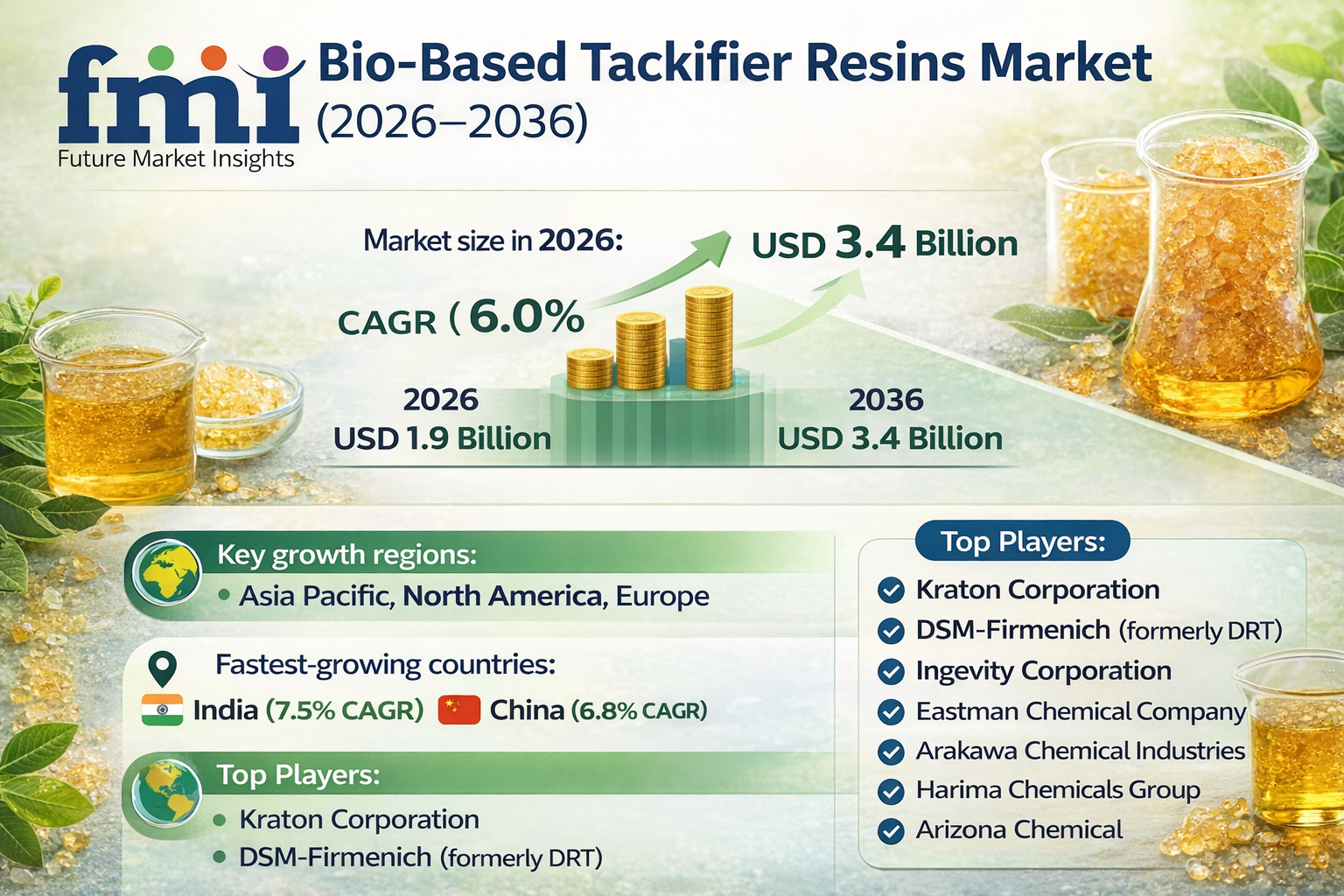
Market Momentum
The Bio-Based Tackifier Resins Market begins at USD 1.9 billion in 2026 and progresses steadily as industrial adhesive formulators transition away from petroleum-derived hydrocarbon resins. By 2030, expanding adoption in sustainable packaging adhesives and pressure-sensitive systems pushes the market to approximately USD 2.5 billion.
Between 2030 and 2036, growth strengthens as global packaging supply chains integrate renewable resin inputs to comply with evolving sustainability mandates and recycling standards. Investments in hydrogenation, advanced distillation, and resin purification technologies improve color stability, odor neutrality, and mechanical performance, enabling broader application across consumer packaging and industrial adhesives.
By 2036, the market reaches USD 3.4 billion, maintaining a 6.0% CAGR throughout the forecast period.
Why the Market Is Growing
The market is expanding as packaging manufacturers and adhesive formulators increasingly adopt renewable raw materials to comply with environmental regulations and corporate sustainability commitments.
Scope 3 emission mandates and extended producer responsibility frameworks are compelling large packaging producers to eliminate petroleum-derived adhesives. As a result, bio-based tackifiers derived from pine chemicals, citrus extracts, and agricultural byproducts are gaining traction as sustainable alternatives to conventional hydrocarbon resins.
At the same time, volatility in petrochemical supply chains is encouraging procurement teams to diversify feedstock sources. Bio-based resin systems provide greater stability in pricing and supply availability compared to traditional petroleum-based inputs.
Technological advancements in hydrogenation and resin purification processes are also improving product consistency, enabling manufacturers to overcome traditional challenges such as color variation and odor profiles in natural resins.
Segment Spotlight
Product Type: Rosin Resins Lead with ~55.5% Share
Rosin resins dominate the market due to their drop-in compatibility with existing hot-melt adhesive manufacturing systems. These materials maintain the required melt viscosity and tack performance, allowing adhesive formulators to adopt renewable inputs without major capital investment in new equipment.
Hydrogenated rosin derivatives also improve color stability and odor neutrality, expanding their use in consumer-facing packaging and labeling applications.
Application: Adhesives & Sealants Account for ~62% Share
Adhesives and sealants represent the largest application segment, driven by rising demand for bio-compatible pressure-sensitive adhesives and hot-melt systems used in packaging, tapes, and labeling.
Industrial formulators are increasingly transitioning their adhesive portfolios toward bio-based materials to meet sustainability requirements from major logistics and e-commerce operators.
Regional Growth: Asia Pacific, North America, and Europe Drive Expansion
Asia Pacific is emerging as the fastest-growing region due to rapid industrial modernization and expansion of e-commerce packaging infrastructure. Countries such as India and China are integrating bio-based adhesive systems into new manufacturing facilities.
North America continues to advance as major retail and logistics companies enforce sustainability targets across supplier networks, accelerating demand for renewable adhesive inputs.
Europe remains a key regulatory-driven market, where extended producer responsibility frameworks and recycling mandates encourage the transition toward repulpable, bio-based adhesive formulations.
Drivers, Opportunities, Trends, and Challenges
Drivers
Corporate Scope 3 emission reduction mandates
Rising demand for sustainable packaging materials
Petrochemical supply chain volatility
Opportunities
Expansion of pine chemical extraction capacity
Development of hydrogenated, low-odor resin grades
Bio-carbon verification and isotope testing technologies
Trends
Integration of renewable feedstocks in adhesive formulations
Investment in advanced hydrogenation and distillation technologies
Growth of bio-based pressure-sensitive adhesives in packaging
Challenges
Natural feedstock variability affecting resin color and consistency
Limited global capacity for tall oil fractionation
Higher purification costs required for consumer-grade applications
Country Growth Outlook (CAGR 2026-2036)
Country |
CAGR |
India |
7.5% |
China |
6.8% |
Brazil |
6.0% |
Germany |
5.5% |
United States |
5.2% |
United Kingdom |
4.8% |
Japan |
4.2% |
Competitive Landscape
The Bio-Based Tackifier Resins Market remains moderately concentrated at the extraction and refinement level, where access to pine-based feedstocks and advanced purification technology creates strong competitive advantages.
Leading producers are investing in hydrogenation capacity, distillation technologies, and vertically integrated forestry supply chains to ensure consistent resin quality and supply stability.
As sustainability standards intensify, adhesive formulators are increasingly qualifying multiple resin suppliers simultaneously to reduce supply risk and maintain procurement flexibility.
Key Players in the Bio-Based Tackifier Resins Market
Kraton Corporation
DSM-Firmenich (formerly DRT)
Ingevity Corporation
Eastman Chemical Company
Arakawa Chemical Industries
Harima Chemicals Group
Arizona Chemical
For an in-depth analysis of evolving formulation trends and to access the complete strategic outlook for the Bio Based Tackifier Resins Market through 2036, visit the official report page at: https://www.futuremarketinsights.com/reports/bio-based-tackifier-resins-market
Explore More Related Studies Published by FMI Research:
Emulsion Polymers Market: https://www.futuremarketinsights.com/reports/emulsion-polymers-market
Expandable Polystyrene Market: https://www.futuremarketinsights.com/reports/global-expandable-polystyrene-market
Bioplastics Market: https://www.futuremarketinsights.com/reports/global-bio-plastics-market
Ultrapure Water Market: https://www.futuremarketinsights.com/reports/ultrapure-water-market
Blue Carbon Market: https://www.futuremarketinsights.com/reports/blue-carbon-market
About Future Market Insights (FMI)
Future Market Insights (FMI) is a leading provider of market intelligence and consulting services, serving clients in over 150 countries. Headquartered in Delaware, USA, with a global delivery center in India and offices in the UK and UAE, FMI delivers actionable insights to businesses across industries including automotive, technology, consumer products, manufacturing, energy, and chemicals.
An ESOMAR-certified research organization, FMI provides custom and syndicated market reports and consulting services, supporting both Fortune 1,000 companies and SMEs. Its team of 300+ experienced analysts ensures credible, data-driven insights to help clients navigate global markets and identify growth opportunities.
For Press & Corporate Inquiries
Rahul Singh
AVP - Marketing and Growth Strategy
Future Market Insights, Inc.
+91 8600020075
For Sales - sales@futuremarketinsights.com
For Media - Rahul.singh@futuremarketinsights.com
For web - https://www.futuremarketinsights.com/
SOURCE: Future Market Insights, Inc.
View the original press release on ACCESS Newswire