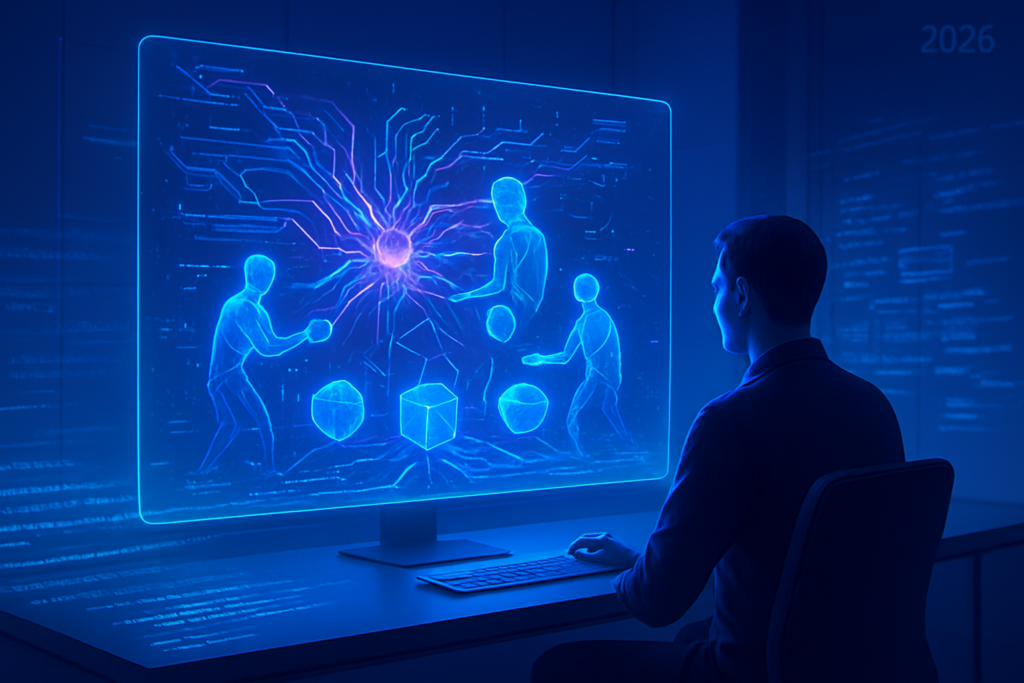
As of February 2, 2026, the image of a software engineer hunched over a keyboard, meticulously debugging a semicolon or a bracket, has largely faded into the history of technology. Over the past 18 months, the industry has undergone a seismic shift from "coding" to "orchestration," led by a new generation of AI-first development environments. At the forefront of this revolution is Cursor, an editor that has transformed from a niche experimental tool into the primary interface through which the modern digital world is built.
The significance of this transition cannot be overstated. We have entered the era of Natural Language Programming (NLPg), where the primary skill of a developer is no longer syntax memorization, but the ability to architect systems and manage the "intent" of autonomous AI agents. By leveraging advanced features like Agent Mode and structured instruction sets, developers are now building complex, full-stack applications in hours that previously would have required a team of engineers months to execute.
The Architecture of Intent: Inside the AI-First Code Editor
The technical backbone of this revolution is a sophisticated blend of large language models (LLMs) and local codebase indexing. Unlike earlier iterations of GitHub Copilot from Microsoft (NASDAQ: MSFT), which primarily offered line-by-line autocompletion, Cursor and its contemporaries utilize a "Plan-then-Execute" framework. When a developer triggers the now-ubiquitous "Agent Mode," the editor doesn't just guess the next word; it initializes a reasoning loop. It first scans the entire project using Merkle-Tree Indexing—a method that creates a semantic map of the codebase—allowing the AI to understand dependencies across thousands of files without overwhelming the model's context window.
Two features have become the "gold standard" for professional development in 2026: Agent Mode and .cursor/rules. Agent Mode allows the editor to operate with a degree of autonomy previously seen only in research labs. It can spawn "Shadow Workspaces"—isolated git worktrees where the AI can write code, run tests, and debug errors in parallel—only presenting the final, verified solution to the human developer for approval. Meanwhile, .cursor/rules (often stored as .mdc files) acts as a persistent memory for the project. These files contain specific architectural guidelines, styling preferences, and business logic that the AI must follow, ensuring that the code it generates isn't just functional, but consistent with the specific "DNA" of the enterprise.
This differs fundamentally from previous technologies because it treats the AI as a junior partner with total recall rather than a simple autocomplete tool. The introduction of the Model Context Protocol (MCP) has further expanded these capabilities, allowing Cursor to "see" beyond the editor. An AI agent can now pull real-time data from production logs in Amazon (NASDAQ: AMZN) Web Services (AWS) or query a database schema to ensure a new feature won't break existing data structures. Initial reactions from the research community have been overwhelming, with many noting that the "hallucination" rate for code has dropped by over 80% since these multi-step verification loops were implemented.
The Market Shakeup: Big Tech vs. The Agile Upstarts
The rise of AI-first editors has created a volatile competitive landscape. While Microsoft (NASDAQ: MSFT) remains a dominant force with its integration of GitHub Copilot into VS Code, it has faced an aggressive challenge from Anysphere, the startup behind Cursor. By focusing on a "native AI" experience rather than a plugin-based one, Cursor has captured a significant share of the high-end developer market. This has forced Alphabet (NASDAQ: GOOGL) to retaliate with deep integrations of Gemini into its own development suites, and spurred the growth of "flow-centric" competitors like Windsurf (developed by Codeium), which uses a proprietary graph-based reasoning engine to map code logic more deeply than standard RAG (Retrieval-Augmented Generation) techniques.
For the tech giants, the stakes are existential. The traditional "moat" of a software company—the sheer volume of its proprietary code—is being eroded by the ease with which AI can refactor, migrate, and rebuild systems. Startups are the primary beneficiaries of this shift; a three-person team in 2026 can maintain a platform that would have required thirty engineers in 2023. This has led to a "Velocity Paradox": while the speed of feature delivery has increased by over 50%, the market value is shifting away from the code itself and toward the proprietary data and the "prompts" or "specs" that define the application.
Strategic positioning has also shifted toward the "Platform-as-an-Agent" model. Companies like Replit have moved beyond the editor to handle the entire lifecycle—coding, provisioning, and self-healing deployments. In this environment, the traditional "Integrated Development Environment" (IDE) is evolving into an "Automated Development Environment" (ADE), where the human provides the strategic "vibe" and the AI handles the tactical execution.
Wider Significance: The "Seniority Gap" and the Death of the Junior Dev
The broader AI landscape is currently grappling with a profound transformation in the labor market. The most controversial impact of the Cursor-led revolution is the "vanishing junior developer." In 2026, many entry-level tasks—writing boilerplate, unit tests, and basic CRUD (Create, Read, Update, Delete) operations—are handled entirely by AI. Industry reports indicate that over 40% of all new production code is now AI-generated. This has led to a "Seniority Gap," where companies are desperate for "Philosopher-Engineers" who can architect and audit AI systems, but have fewer roles available for the next generation of coders to learn the ropes.
This shift mirrors previous technological milestones like the move from assembly language to high-level languages like C or Python. Each leap in abstraction makes the developer more powerful but further removed from the underlying hardware. However, the AI revolution is unique because the abstraction layer is "intelligent." Concerns are mounting regarding "technical debt 2.0"—the risk that systems will become so complex and AI-dependent that no single human fully understands how they work. Comparisons are frequently made to the early 2000s outsourcing boom, but with a crucial difference: the "offshore" labor is now a digital entity that works at the speed of light.
Despite these concerns, the democratization of software creation is a historic breakthrough. We are seeing a surge in "domain-expert developers"—individuals like doctors, lawyers, and biologists who can now build sophisticated tools for their own fields without needing a computer science degree. The barrier to entry has shifted from "knowing how to code" to "knowing what to build."
Looking Ahead: Toward Autonomous, Self-Healing Software
As we look toward the remainder of 2026 and into 2027, the focus is shifting from "AI-assisted coding" to "autonomous software maintenance." Experts predict the rise of "Self-Healing Repositories," where AI agents monitor production environments and automatically commit fixes to the codebase when a bug is detected—often before a human user even notices the issue. This will require even deeper integration between the editor and the cloud infrastructure, a space where Amazon (NASDAQ: AMZN) and Google are investing heavily to ensure their AI models have native "root access" to deployment pipelines.
Another emerging frontier is the "Natural Language Spec" as the final artifact of software engineering. We are approaching a point where the code itself is merely a transient, compiled byproduct of a high-level Markdown specification. In this future, "coding" will look more like writing a detailed legal brief or a technical blueprint than typing logic. The challenge for the next year will be security; as AI agents gain more autonomy to edit and deploy code, the risk of "prompt injection" or "model-induced vulnerabilities" becomes a critical infrastructure concern.
Final Assessment: The New Engineering Paradigm
The Cursor-led AI coding revolution marks the end of the "syntax era" and the beginning of the "intent era." The ability to build full-stack applications simply by describing them has fundamentally altered the economics of the software industry. Key takeaways from this transition include the massive productivity gains for senior engineers (estimated at 30-55%), the shift toward "Context Engineering" via tools like .cursorrules, and the ongoing disruption of the traditional career ladder in technology.
In the history of AI, the evolution of the code editor will likely be seen as the first successful deployment of "Agentic AI" at a global scale. While large language models changed how we write emails, agentic editors changed how we build the world. In the coming months, watch for the expansion of the Model Context Protocol and a potential "Great Refactoring," as enterprises use these tools to modernize decades of legacy code overnight. The revolution is no longer coming—it is already committed to the main branch.
This content is intended for informational purposes only and represents analysis of current AI developments.
TokenRing AI delivers enterprise-grade solutions for multi-agent AI workflow orchestration, AI-powered development tools, and seamless remote collaboration platforms.
For more information, visit https://www.tokenring.ai/.