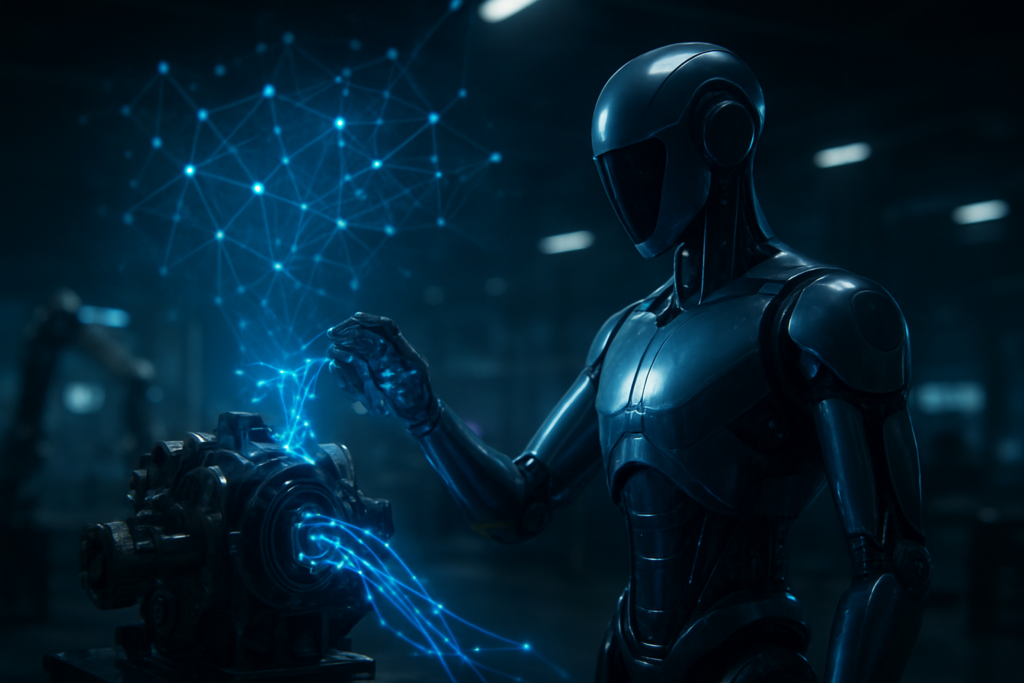
The era of the "hard-coded" robot has officially come to an end. In a series of landmark developments culminating in early 2026, the robotics industry has undergone a fundamental shift from rigid, rule-based programming to "End-to-End" (E2E) neural networks. This transition has transformed humanoid machines from clumsy laboratory experiments into capable workers that can learn complex tasks—ranging from automotive assembly to delicate domestic chores—simply by observing human movement. By moving away from the "If-Then" logic of the past, companies like Figure AI, Tesla, and Boston Dynamics have unlocked a level of physical intelligence that was considered science fiction only three years ago.
This breakthrough represents the "GPT moment" for physical labor. Just as Large Language Models learned to write by reading the internet, the current generation of humanoid robots is learning to move by watching the world. The immediate significance is profound: for the first time, robots can generalize their skills. A robot trained to sort laundry in a bright lab can now perform the same task in a dimly lit bedroom with different furniture, adapting in real-time to its environment without a single line of new code being written by a human engineer.
The Architecture of Autonomy: Pixels-to-Torque
The technical cornerstone of this revolution is the "End-to-End" neural network. Unlike the traditional "Sense-Plan-Act" paradigm—where a robot would use separate software modules for vision, path planning, and motor control—E2E systems utilize a single, massive neural network that maps visual input (pixels) directly to motor output (torque). This "Pixels-to-Torque" approach allows robots like the Figure 02 and the Tesla (NASDAQ: TSLA) Optimus Gen 2 to bypass the bottlenecks of manual coding. When Figure 02 was deployed at a BMW (ETR: BMW) manufacturing facility, it didn't require engineers to program the exact coordinates of every sheet metal part. Instead, using its "Helix" Vision-Language-Action (VLA) model, the robot observed human workers and learned the probabilistic "physics" of the task, allowing it to handle parts with 20 degrees of freedom in its hands and tactile sensors sensitive enough to detect a 3-gram weight.
Tesla’s Optimus Gen 2, and its early 2026 successor, the Gen 3, have pushed this further by integrating the Tesla AI5 inference chip. This hardware allows the robot to run massive neural networks locally, processing 2x the frame rate with significantly lower latency than previous generations. Meanwhile, the electric Atlas from Boston Dynamics—a subsidiary of Hyundai (KRX: 005380)—has abandoned the hydraulic systems of its predecessor in favor of custom high-torque electric actuators. This hardware shift, combined with Large Behavior Models (LBMs), allows Atlas to perform 360-degree swivels and maneuvers that exceed human range of motion, all while using reinforcement learning to "self-correct" when it slips or encounters an unexpected obstacle. Industry experts note that this shift has reduced the "task acquisition time" from months of engineering to mere hours of video observation and simulation.
The Industrial Power Play: Who Wins the Robotics Race?
The shift to E2E neural networks has created a new competitive landscape dominated by companies with the largest datasets and the most compute power. Tesla (NASDAQ: TSLA) remains a formidable frontrunner due to its "fleet learning" advantage; the company leverages video data not just from its robots, but from millions of vehicles running Full Self-Driving (FSD) software to teach its neural networks about spatial reasoning and object permanence. This vertical integration gives Tesla a strategic advantage in scaling Optimus Gen 2 and Gen 3 across its own Gigafactories before offering them as a service to the broader manufacturing sector.
However, the rise of Figure AI has proven that startups can compete if they have the right backers. Supported by massive investments from Microsoft (NASDAQ: MSFT) and NVIDIA (NASDAQ: NVDA), Figure has successfully moved its Figure 02 model from pilot programs into full-scale industrial deployments. By partnering with established giants like BMW, Figure is gathering high-quality "expert data" that is crucial for imitation learning. This creates a significant threat to traditional industrial robotics companies that still rely on "caged" robots and pre-defined paths. The market is now positioning itself around "Robot-as-a-Service" (RaaS) models, where the value lies not in the hardware, but in the proprietary neural weights that allow a robot to be "useful" out of the box.
A Physical Singularity: Implications for Global Labor
The broader significance of robots learning through observation cannot be overstated. We are witnessing the beginning of the "Physical Singularity," where the cost of manual labor begins to decouple from human demographics. As E2E neural networks allow robots to master domestic chores and factory assembly, the potential for economic disruption is vast. While this offers a solution to the chronic labor shortages in manufacturing and elder care, it also raises urgent concerns regarding job displacement for low-skill workers. Unlike previous waves of automation that targeted repetitive, high-volume tasks, E2E robotics can handle the "long tail" of irregular, complex tasks that were previously the sole domain of humans.
Furthermore, the transition to video-based learning introduces new challenges in safety and "hallucination." Just as a chatbot might invent a fact, a robot running an E2E network might "hallucinate" a physical movement that is unsafe if it encounters a visual scenario it hasn't seen before. However, the integration of "System 2" reasoning—high-level logic layers that oversee the low-level motor networks—is becoming the industry standard to mitigate these risks. Comparisons are already being drawn to the 2012 "AlexNet" moment in computer vision; many believe 2025-2026 will be remembered as the era when AI finally gained a physical body capable of interacting with the real world as fluidly as a human.
The Horizon: From Factories to Front Porches
In the near term, we expect to see these humanoid robots move beyond the controlled environments of factory floors and into "semi-structured" environments like logistics hubs and retail backrooms. By late 2026, experts predict the first consumer-facing pilots for domestic "helper" robots, capable of basic tidying and grocery unloading. The primary challenge remains "Sim-to-Real" transfer—ensuring that a robot that has practiced a task a billion times in a digital twin can perform it flawlessly in a messy, unpredictable kitchen.
Long-term, the focus will shift toward "General Purpose" embodiment. Rather than a robot that can only do "factory assembly," we are moving toward a single neural model that can be "prompted" to do anything. Imagine a robot that you can show a 30-second YouTube video of how to fix a leaky faucet, and it immediately attempts the repair. While we are not quite there yet, the trajectory of "one-shot imitation learning" suggests that the technical barriers are falling faster than even the most optimistic researchers predicted in 2024.
A New Chapter in Human-Robot Interaction
The breakthroughs in Figure 02, Tesla Optimus Gen 2, and the electric Atlas mark a definitive turning point in the history of technology. We have moved from a world where we had to speak the language of machines (code) to a world where machines are learning to speak the language of our movements (vision). The significance of this development lies in its scalability; once a single robot learns a task through an end-to-end network, that knowledge can be instantly uploaded to every other robot in the fleet, creating a collective intelligence that grows exponentially.
As we look toward the coming months, the industry will be watching for the results of the first "thousand-unit" deployments in the automotive and electronics sectors. These will serve as the ultimate stress test for E2E neural networks in the real world. While the transition will not be without its growing pains—including regulatory scrutiny and safety debates—the era of the truly "smart" humanoid is no longer a future prospect; it is a present reality.
This content is intended for informational purposes only and represents analysis of current AI developments.
TokenRing AI delivers enterprise-grade solutions for multi-agent AI workflow orchestration, AI-powered development tools, and seamless remote collaboration platforms.
For more information, visit https://www.tokenring.ai/.