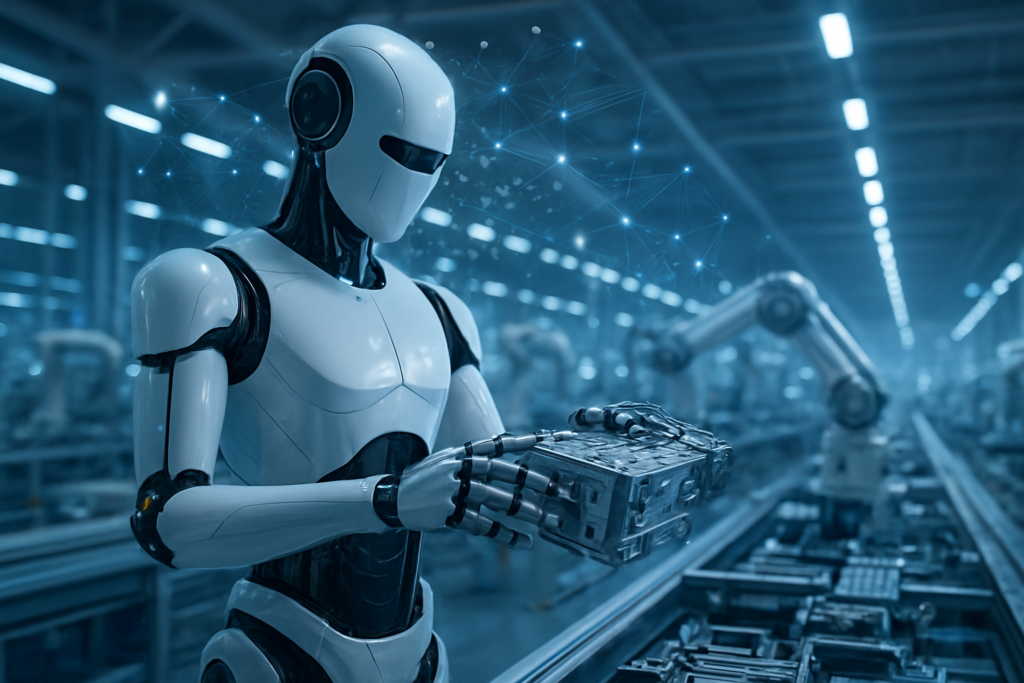
As of January 16, 2026, the transition of artificial intelligence from digital screens to physical labor has reached a historic turning point. Tesla (NASDAQ: TSLA) has officially moved its Optimus humanoid robots beyond the research-and-development phase, deploying over 1,000 units across its global manufacturing footprint to handle autonomous parts processing. This development marks the dawn of the "Physical AI" era, where neural networks no longer just predict the next word in a sentence, but the next precise physical movement required to assemble complex machinery.
The deployment, centered primarily at Gigafactory Texas and the Fremont facility, represents the first large-scale commercial application of general-purpose humanoid robotics in a high-speed manufacturing environment. While robots have existed in car factories for decades, they have historically been bolted to the floor and programmed for repetitive, singular tasks. In contrast, the Optimus units now roaming Tesla’s 4680 battery cell lines are navigating unscripted environments, identifying misplaced components, and performing intricate kitting tasks that previously required human manual dexterity.
The Rise of Optimus Gen 3: Technical Mastery of Physical AI
The shift to autonomous factory work has been driven by the introduction of the Optimus Gen 3 (V3) platform, which entered production-intent testing in late 2025. Unlike the Gen 2 models seen in previous years, the V3 features a revolutionary 22-degree-of-freedom (DoF) hand assembly. By moving the heavy actuators to the forearms and using a tendon-driven system, Tesla engineers have achieved a level of hand dexterity that rivals human capability. These hands are equipped with integrated tactile sensors that allow the robot to "feel" the pressure it applies, enabling it to handle fragile plastic clips or heavy metal brackets with equal precision.
Underpinning this hardware is the FSD-v15 neural architecture, a direct evolution of the software used in Tesla’s electric vehicles. This "Physical AI" stack treats the robot as a vehicle with legs and hands, utilizing end-to-end neural networks to translate visual data from its eight-camera system directly into motor commands. This differs fundamentally from previous robotics approaches that relied on "inverse kinematics" or rigid pre-programming. Instead, Optimus learns by observation; by watching video data of human workers, the robot can now generalize a task—such as sorting battery cells—in hours rather than weeks of coding.
Initial reactions from the AI research community have been overwhelmingly positive, though some experts remain cautious about the robot’s reliability in high-stress scenarios. Dr. James Miller, a robotics researcher at Stanford, noted that "Tesla has successfully bridged the 'sim-to-real' gap that has plagued robotics for twenty years. By using their massive fleet of cars to train a world-model for spatial awareness, they’ve given Optimus an innate understanding of the physical world that competitors are still trying to simulate in virtual environments."
A New Industrial Arms Race: Market Impact and Competitive Shifts
The move toward autonomous humanoid labor has ignited a massive competitive shift across the tech sector. While Tesla (NASDAQ: TSLA) holds a lead in vertical integration—manufacturing its own actuators, sensors, and the custom inference chips that power the robots—it is not alone in the field. This development has fortified a massive demand for AI-capable hardware, benefiting semiconductor giants like NVIDIA (NASDAQ: NVDA), which has positioned itself as the "operating system" for the rest of the robotics industry through its Project GR00T and Isaac Lab platforms.
Competitors like Figure AI, backed by Microsoft (NASDAQ: MSFT) and OpenAI, have responded by accelerating the rollout of their Figure 03 model. While Tesla uses its own internal factories as a proving ground, Figure and Agility Robotics have partnered with major third-party logistics firms and automakers like BMW and GXO Logistics. This has created a bifurcated market: Tesla is building a closed-loop ecosystem of "Robots building Robots," while the NVIDIA-Microsoft alliance is creating an open-platform model for the rest of the industrial world.
The commercialization of Optimus is also disrupting the traditional robotics market. Companies that specialized in specialized, single-task robotic arms are now facing a reality where a $20,000 to $30,000 general-purpose humanoid could replace five different specialized machines. Market analysts suggest that Tesla’s ability to scale this production could eventually make the Optimus division more valuable than its automotive business, with a target production ramp of 50,000 units by the end of 2026.
Beyond the Factory Floor: The Significance of Large Behavior Models
The deployment of Optimus represents a shift in the broader AI landscape from Large Language Models (LLMs) to what researchers are calling Large Behavior Models (LBMs). While LLMs like GPT-4 mastered the world of information, LBMs are mastering the world of physics. This is a milestone comparable to the "ChatGPT moment" of 2022, but with tangible, physical consequences. The ability for a machine to autonomously understand gravity, friction, and object permanence marks a leap toward Artificial General Intelligence (AGI) that can interact with the human world on our terms.
However, this transition is not without concerns. The primary debate in early 2026 revolves around the impact on the global labor force. As Optimus begins taking over "Dull, Dirty, and Dangerous" jobs, labor unions and policymakers are raising questions about the speed of displacement. Unlike previous waves of automation that replaced specific manual tasks, the general-purpose nature of humanoid AI means it can theoretically perform any task a human can, leading to calls for "robot taxes" and enhanced social safety nets as these machines move from factories into broader society.
Comparisons are already being drawn between the introduction of Optimus and the industrial revolution. For the first time, the cost of labor is becoming decoupled from the cost of living. If a robot can work 24 hours a day for the cost of electricity and a small amortized hardware fee, the economic output per human could skyrocket, but the distribution of that wealth remains a central geopolitical challenge.
The Horizon: From Gigafactories to Households
Looking ahead, the next 24 months will focus on refining the "General Purpose" aspect of Optimus. Tesla is currently breaking ground on a dedicated "Optimus Megafactory" at its Austin campus, designed to produce up to one million robots per year. While the current focus is strictly industrial, the long-term goal remains a household version of the robot. Early 2027 is the whispered target for a "Home Edition" capable of performing chores like laundry, dishwashing, and grocery fetching.
The immediate challenges remain hardware longevity and energy density. While the Gen 3 models can operate for roughly 8 to 10 hours on a single charge, the wear and tear on actuators during continuous 24/7 factory operation is a hurdle Tesla is still clearing. Experts predict that as the hardware stabilizes, we will see the "App Store of Robotics" emerge, where developers can create and sell specialized "behaviors" for the robot—ranging from elder care to professional painting.
A New Chapter in Human History
The sight of Optimus robots autonomously handling parts on the factory floor is more than a manufacturing upgrade; it is a preview of a future where human effort is no longer the primary bottleneck of productivity. Tesla’s success in commercializing physical AI has validated the company's "AI-first" pivot, proving that the same technology that navigates a car through a busy intersection can navigate a robot through a crowded factory.
As we move through 2026, the key metrics to watch will be the "failure-free" hours of these robot fleets and the speed at which Tesla can reduce the Bill of Materials (BoM) to reach its elusive $20,000 price point. The milestone reached today is clear: the robots are no longer coming—they are already here, and they are already at work.
This content is intended for informational purposes only and represents analysis of current AI developments.
TokenRing AI delivers enterprise-grade solutions for multi-agent AI workflow orchestration, AI-powered development tools, and seamless remote collaboration platforms.
For more information, visit https://www.tokenring.ai/.