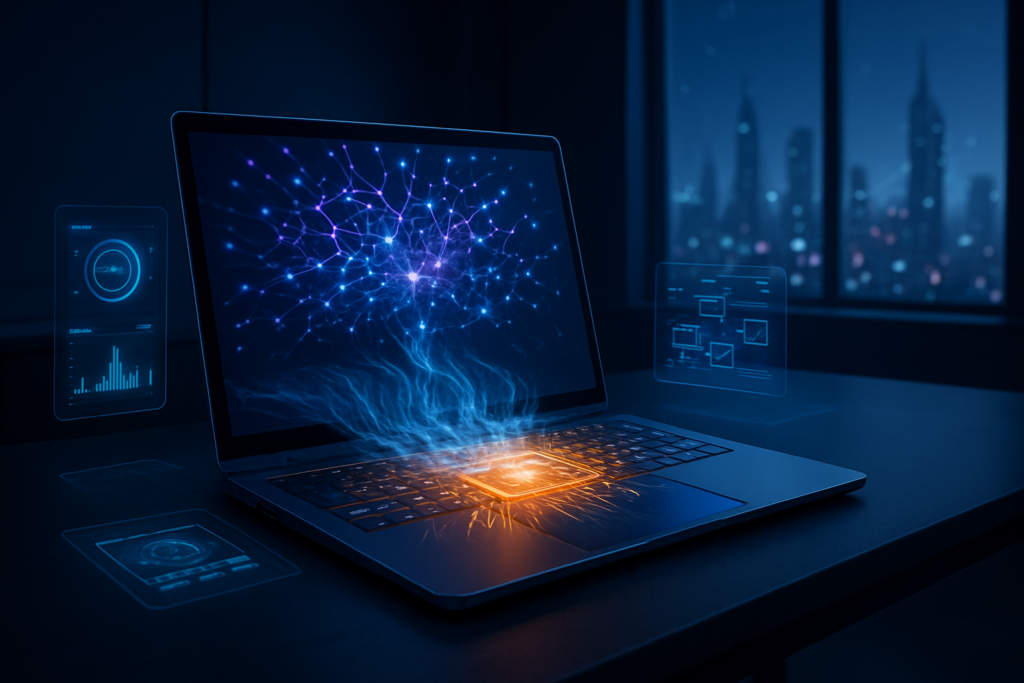
As we close out 2025 and head into 2026, the personal computer is undergoing its most radical transformation since the introduction of the graphical user interface. The "AI PC" has moved from a marketing buzzword to the definitive standard for modern computing, driven by a fierce arms race between silicon giants to pack unprecedented neural processing power into laptops and desktops. By the start of 2026, the industry has crossed a critical threshold: the ability to run sophisticated Large Language Models (LLMs) entirely on local hardware, fundamentally shifting the gravity of artificial intelligence from the cloud back to the edge.
This transition is not merely about speed; it represents a paradigm shift in digital sovereignty. With the latest generation of processors from Qualcomm (NASDAQ: QCOM), Intel (NASDAQ: INTC), and AMD (NASDAQ: AMD) now exceeding 45–50 Trillion Operations Per Second (TOPS) on the Neural Processing Unit (NPU) alone, the "loading spinner" of cloud-based AI is becoming a relic of the past. For the first time, users are experiencing "instant-on" intelligence that doesn't require an internet connection, doesn't sacrifice privacy, and doesn't incur the subscription fatigue of the early 2020s.
The 50-TOPS Threshold: Inside the Silicon Arms Race
The technical heart of the 2026 AI PC revolution lies in the NPU, a specialized accelerator designed specifically for the matrix mathematics that power AI. Leading the charge is Qualcomm (NASDAQ: QCOM) with its second-generation Snapdragon X2 Elite. Confirmed for a broad rollout in the first half of 2026, the Snapdragon X2’s Hexagon NPU has jumped to a staggering 80 TOPS. This allows the chip to run 3-billion parameter models, such as Microsoft’s Phi-3 or Meta’s Llama 3.2, at speeds exceeding 200 tokens per second—faster than a human can read.
Intel (NASDAQ: INTC) has responded with its Panther Lake architecture (Core Ultra Series 3), built on the cutting-edge Intel 18A process node. Panther Lake’s NPU 5 delivers a dedicated 50 TOPS, but Intel’s "Total Platform" approach pushes the combined AI performance of the CPU, GPU, and NPU to over 180 TOPS. Meanwhile, AMD (NASDAQ: AMD) has solidified its position with the Strix Point and Krackan platforms. AMD’s XDNA 2 architecture provides a consistent 50 TOPS across its Ryzen AI 300 series, ensuring that even mid-range laptops priced under $999 can meet the stringent requirements for "Copilot+" certification.
This hardware leap differs from previous generations because it prioritizes "Agentic AI." Unlike the basic background blur or noise cancellation of 2024, the 2026 hardware is optimized for 4-bit and 8-bit quantization. This allows the NPU to maintain "always-on" background agents that can index every document, email, and meeting on a device in real-time without draining the battery. Industry experts note that this local-first approach reduces the latency of AI interactions from seconds to milliseconds, making the AI feel like a seamless extension of the operating system rather than a remote service.
Disrupting the Cloud: The Business of Local Intelligence
The rise of the AI PC is sending shockwaves through the business models of tech giants. Microsoft (NASDAQ: MSFT) has been the primary architect of this shift, pivoting its Windows AI Foundry to allow developers to build models that "scale down" to local NPUs. This reduces Microsoft’s massive server costs for Azure while giving users a more responsive experience. However, the most significant disruption is felt by NVIDIA (NASDAQ: NVDA). While NVIDIA remains the king of the data center, the high-performance NPUs from Intel and AMD are beginning to cannibalize the market for entry-level discrete GPUs (dGPUs). Why buy a dedicated graphics card for AI when your integrated NPU can handle 4K upscaling and local LLM chat more efficiently?
The competitive landscape is further complicated by Apple (NASDAQ: AAPL), which has integrated "Apple Intelligence" across its entire M-series Mac lineup. By 2026, the battle for "Silicon Sovereignty" has forced cloud-first companies like Alphabet (NASDAQ: GOOGL) and Amazon (NASDAQ: AMZN) to adapt. Google has optimized its Gemini Nano model specifically for these new NPUs, ensuring that Chrome remains the dominant gateway to AI, whether that AI is running in the cloud or on the user's desk.
For startups, the AI PC era has birthed a new category of "AI-Native" software. Tools like Cursor and Bolt are moving beyond simple code completion to "Vibe Engineering," where local agents execute complex software architectures entirely on-device. This has created a massive strategic advantage for companies that can provide high-performance local execution, as enterprises increasingly demand "air-gapped" AI to protect their proprietary data from leaking into public training sets.
Privacy, Latency, and the Death of the Loading Spinner
Beyond the corporate maneuvering, the wider significance of the AI PC lies in its impact on privacy and user experience. For the past decade, the tech industry has moved toward a "thin client" model where the most powerful features lived on someone else's server. The AI PC reverses this trend. By processing data locally, users regain "data residency"—the assurance that their most personal thoughts, financial records, and private photos never leave their device. This is a significant milestone in the broader AI landscape, addressing the primary concern that has held back enterprise adoption of generative AI.
Latency is the other silent revolution. In the cloud-AI era, every query was subject to network congestion and server availability. In 2026, the "death of the loading spinner" has changed how humans interact with computers. When an AI can respond instantly to a voice command or a gesture, it stops being a "tool" and starts being a "collaborator." This is particularly impactful for accessibility; tools like Cephable now use local NPUs to translate facial expressions into complex computer commands with zero lag, providing a level of autonomy previously impossible for users with motor impairments.
However, this shift is not without concerns. The "Recall" features and always-on indexing that NPUs enable have raised significant surveillance questions. While the data stays local, the potential for a "local panopticon" exists if the operating system itself is compromised. Comparisons are being drawn to the early days of the internet: we are gaining incredible new capabilities, but we are also creating a more complex security perimeter that must be defended at the silicon level.
The Road to 2027: Agentic Workflows and Beyond
Looking ahead, the next 12 to 24 months will see the transition from "Chat AI" to "Agentic Workflows." In this near-term future, your PC won't just help you write an email; it will proactively manage your calendar, negotiate with other agents to book travel, and automatically generate reports based on your work habits. Intel’s upcoming Nova Lake and AMD’s Zen 6 "Medusa" architecture are already rumored to target 75–100+ TOPS, which will be necessary to run the "thinking" models that power these autonomous agents.
One of the most anticipated developments is NVIDIA’s rumored entry into the PC CPU market. Reports suggest NVIDIA is co-developing an ARM-based processor with MediaTek, designed to bring Blackwell-level AI performance to the "Thin & Light" laptop segment. This would represent a direct challenge to Qualcomm’s dominance in the ARM-on-Windows space and could spark a new era of "AI Workstations" that blur the line between a laptop and a server.
The primary challenge remains software optimization. While the hardware is ready, many legacy applications have yet to be rewritten to take advantage of the NPU. Experts predict that 2026 will be the year of the "AI Refactor," as developers race to move their most compute-intensive features off the CPU/GPU and onto the NPU to save battery life and improve performance.
A New Era of Personal Computing
The rise of the AI PC in 2026 marks the end of the "General Purpose" computing era and the beginning of the "Contextual" era. We have moved from computers that wait for instructions to computers that understand intent. The convergence of 50+ TOPS NPUs, efficient Small Language Models, and a robust local-first software ecosystem has fundamentally altered the trajectory of the tech industry.
The key takeaway for 2026 is that the cloud is no longer the only place where "magic" happens. By reclaiming the edge, the AI PC has made artificial intelligence faster, more private, and more personal. In the coming months, watch for the launch of the first truly autonomous "Agentic" OS updates and the arrival of NVIDIA’s ARM-based silicon, which could redefine the performance ceiling for the entire industry. The PC isn't just back; it's smarter than ever.
This content is intended for informational purposes only and represents analysis of current AI developments.
TokenRing AI delivers enterprise-grade solutions for multi-agent AI workflow orchestration, AI-powered development tools, and seamless remote collaboration platforms.
For more information, visit https://www.tokenring.ai/.