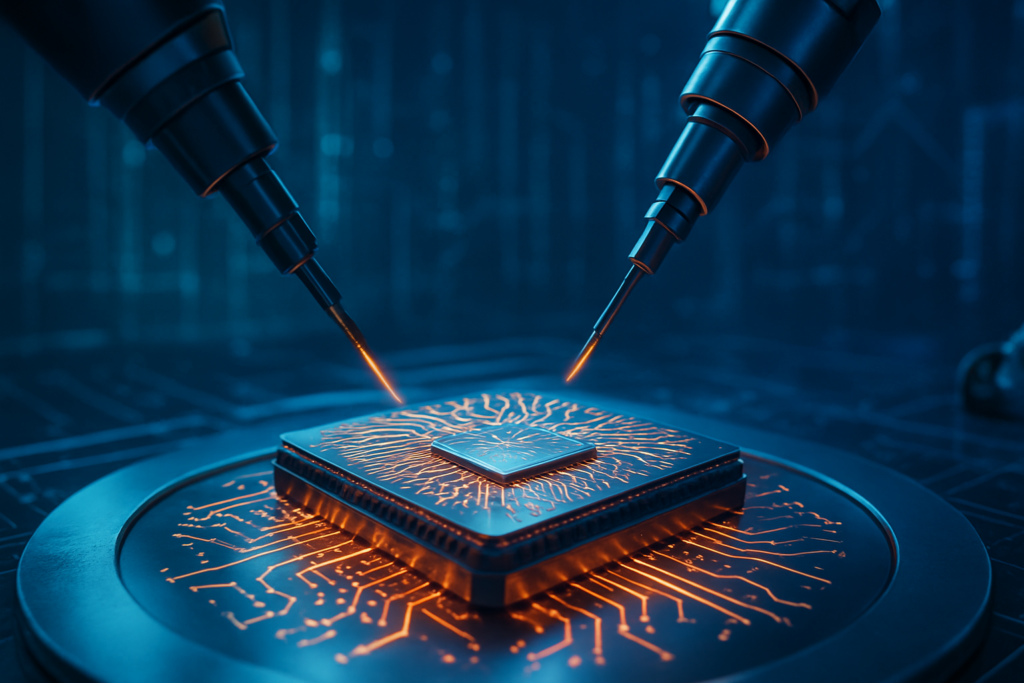
In a move that signals a seismic shift in the global semiconductor landscape, Apple (NASDAQ: AAPL) has officially qualified Intel’s (NASDAQ: INTC) 1.8nm-class process node, known as 18A, for its next generation of entry-level M-series chips. This breakthrough, confirmed by late-2025 industry surveys and supply chain analysis, marks the first time in over half a decade that Apple has looked beyond TSMC (NYSE: TSM) for its leading-edge silicon needs. Starting in 2027, the processors powering the MacBook Air and iPad Pro are expected to be manufactured domestically, bringing "Apple Silicon: Made in America" from a political aspiration to a commercial reality.
The immediate significance of this partnership cannot be overstated. For Intel, securing Apple as a foundry customer is the ultimate validation of its "IDM 2.0" strategy and its ambitious goal to reclaim process leadership. For Apple, the move provides a critical geopolitical hedge against the concentration of advanced manufacturing in Taiwan while diversifying its supply chain. As Intel’s Fab 52 in Arizona begins to ramp up for high-volume production, the tech industry is witnessing the birth of a genuine duopoly in advanced chip manufacturing, ending years of undisputed dominance by TSMC.
Technical Breakthrough: The 18A Node, RibbonFET, and PowerVia
The technical foundation of this partnership rests on Intel’s 18A node, specifically the performance-optimized 18AP variant. According to renowned supply chain analyst Ming-Chi Kuo, Apple has been working with Intel’s Process Design Kit (PDK) version 0.9.1GA, with simulations showing that the 18A architecture meets Apple’s stringent requirements for power efficiency and thermal management. The 18A process is Intel’s first to fully integrate two revolutionary technologies: RibbonFET and PowerVia. These represent the most significant architectural change in transistor design since the introduction of FinFET over a decade ago.
RibbonFET is Intel’s implementation of Gate-All-Around (GAA) transistor architecture. Unlike the previous FinFET design, where the gate sits on three sides of the channel, RibbonFET wraps the gate entirely around the silicon "ribbons." This provides superior electrostatic control, drastically reducing current leakage—a vital factor for the thin, fanless designs of the MacBook Air and iPad Pro. By minimizing leakage, Apple can drive higher performance at lower voltages, extending battery life while maintaining the "cool and quiet" user experience that has defined the M-series era.
Complementing RibbonFET is PowerVia, Intel’s industry-leading backside power delivery solution. In traditional chip design, power and signal lines are bundled together on the front of the wafer, leading to "routing congestion" and voltage drops. PowerVia moves the power delivery network to the back of the silicon wafer, separating it from the signal wires. This decoupling eliminates the "IR drop" (voltage loss), allowing the chip to operate more efficiently. Technical specifications suggest that PowerVia alone contributes to a 30% increase in transistor density, as it frees up significant space on the front side of the chip for more logic.
Initial reactions from the semiconductor research community have been overwhelmingly positive, though cautious regarding yields. While TSMC’s 2nm (N2) node remains a formidable competitor, Intel’s early lead in implementing backside power delivery has given it a temporary technical edge. Industry experts note that by qualifying the 18AP variant, Apple is targeting a 15-20% improvement in performance-per-watt over current 3nm designs, specifically optimized for the mobile System-on-Chip (SoC) workloads that define the iPad and entry-level Mac experience.
Strategic Realignment: Diversifying Beyond TSMC
The industry implications of Apple’s shift to Intel Foundry are profound, particularly for the competitive balance between the United States and East Asia. For years, TSMC has enjoyed a near-monopoly on Apple’s high-end business, a relationship that has funded TSMC’s rapid advancement. By moving the high-volume MacBook Air and iPad Pro lines to Intel, Apple is effectively "dual-sourcing" its most critical components. This provides Apple with immense negotiating leverage and ensures that a single geopolitical or natural disaster in the Taiwan Strait cannot paralyze its entire product roadmap.
Intel stands to benefit the most from this development, as Apple joins other "anchor" customers like Microsoft (NASDAQ: MSFT) and Amazon (NASDAQ: AMZN). Microsoft has already committed to using 18A for its Maia AI accelerators, and Amazon is co-developing an AI fabric chip on the same node. However, Apple’s qualification is the "gold standard" of validation. It signals to the rest of the industry that Intel’s foundry services are capable of meeting the world’s highest standards for volume, quality, and precision. This could trigger a wave of other fabless companies, such as NVIDIA (NASDAQ: NVDA) or Qualcomm (NASDAQ: QCOM), to reconsider Intel for their 2027 and 2028 product cycles.
For TSMC, the loss of a portion of Apple’s business is a strategic blow, even if it remains the primary manufacturer for the iPhone’s A-series and the high-end M-series "Pro" and "Max" chips. TSMC currently holds over 70% of the foundry market share, but Intel’s aggressive roadmap and domestic manufacturing footprint are beginning to eat into that dominance. The market is shifting from a TSMC-centric world to one where "geographic diversity" is as important as "nanometer count."
Startups and smaller AI labs may also see a trickle-down benefit. As Intel ramps up its 18A capacity at Fab 52 to meet Apple’s demand, the overall availability of advanced-node manufacturing in the U.S. will increase. This could lower the barrier to entry for domestic hardware startups that previously struggled to secure capacity at TSMC’s overbooked facilities. The presence of a world-class foundry on American soil simplifies logistics, reduces IP theft concerns, and aligns with the growing "Buy American" sentiment in the enterprise tech sector.
Geopolitical Significance: The Arizona Fab and U.S. Sovereignty
Beyond the corporate balance sheets, this breakthrough carries immense geopolitical weight. The "Apple Silicon: Made in America" initiative is a direct result of the CHIPS and Science Act, which provided the financial framework for Intel to build its $32 billion Fab 52 at the Ocotillo campus in Arizona. As of late 2025, Fab 52 is fully operational, representing the first facility in the United States capable of mass-producing 2nm-class silicon. This transition addresses a long-standing vulnerability in the U.S. tech ecosystem: the total reliance on overseas manufacturing for the "brains" of modern computing.
This development fits into a broader trend of "technological sovereignism," where major powers are racing to secure their own semiconductor supply chains. The Apple-Intel partnership is a high-profile win for U.S. industrial policy. It demonstrates that with the right combination of government incentives and private-sector execution, the "center of gravity" for advanced manufacturing can be pulled back toward the West. This move is likely to be viewed by policymakers as a major milestone in national security, ensuring that the chips powering the next generation of personal and professional computing are shielded from international trade disputes.
However, the shift is not without its concerns. Critics point out that Intel’s 18A yields, currently estimated in the 55% to 65% range, still trail TSMC’s mature processes. There is a risk that if Intel cannot stabilize these yields by the 2027 launch window, Apple could face supply shortages or higher costs. Furthermore, the bifurcation of Apple's supply chain—with some chips made in Arizona and others in Hsinchu—adds a new layer of complexity to its legendary logistics machine. Apple will have to manage two different sets of design rules and manufacturing tolerances for the same M-series family.
Comparatively, this milestone is being likened to the 2005 "Apple-Intel" transition, when Steve Jobs announced that Macs would move from PowerPC to Intel processors. While that was a change in architecture, this is a change in the very fabric of how those architectures are realized. It represents the maturation of the "IDM 2.0" vision, proving that Intel can compete as a service provider to its former rivals, and that Apple is willing to prioritize supply chain resilience over a decade-long partnership with TSMC.
The Road to 2027 and Beyond: 14A and High-NA EUV
Looking ahead, the 18A breakthrough is just the beginning of a multi-year roadmap. Intel is already looking toward its 14A (1.4nm) node, which is slated for risk production in 2027 and mass production in 2028. The 14A node will be the first to utilize "High-NA" EUV (Extreme Ultraviolet) lithography at scale, a technology that promises even greater precision and density. If Intel successfully executes the 18A ramp for Apple, it is highly likely that more of Apple’s portfolio—including the flagship iPhone chips—could migrate to Intel’s 14A or future "PowerDirect" enabled nodes.
Experts predict that the next major challenge will be the integration of advanced packaging. As chips become more complex, the way they are stacked and connected (using technologies like Intel’s Foveros) will become as important as the transistors themselves. We expect to see Apple and Intel collaborate on custom packaging solutions in Arizona, potentially creating "chiplet" designs for future M-series Ultra processors that combine Intel-made logic with memory and I/O from other domestic suppliers.
The near-term focus will remain on the release of PDK 1.0 and 1.1 in early 2026. These finalized design rules will allow Apple to "tape out" the final designs for the 2027 MacBook Air. If these milestones are met without delay, it will confirm that Intel has truly returned to the "Tick-Tock" cadence of execution that once made it the undisputed king of the silicon world. The tech industry will be watching the yield reports from Fab 52 closely over the next 18 months as the true test of this partnership begins.
Conclusion: A New Era for Global Silicon
The qualification of Intel’s 18A node by Apple marks a turning point in the history of computing. It represents the successful convergence of advanced materials science, aggressive industrial policy, and strategic corporate pivoting. For Intel, it is a hard-won victory that justifies years of massive investment and structural reorganization. For Apple, it is a masterful move that secures its future against global instability while continuing to push the boundaries of what is possible in portable silicon.
The key takeaways are clear: the era of TSMC’s total dominance is ending, and the era of domestic, advanced-node manufacturing has begun. The technical advantages of RibbonFET and PowerVia will soon be in the hands of millions of consumers, powering the next generation of AI-capable Macs and iPads. As we move toward 2027, the success of this partnership will be measured not just in gigahertz or battery life, but in the stability and sovereignty of the global tech supply chain.
In the coming months, keep a close eye on Intel’s quarterly yield updates and any further customer announcements for the 18A and 14A nodes. The "silicon race" has entered a new, more competitive chapter, and for the first time in a long time, the most advanced chips in the world will once again bear the mark: "Made in the USA."
This content is intended for informational purposes only and represents analysis of current AI and semiconductor developments.
TokenRing AI delivers enterprise-grade solutions for multi-agent AI workflow orchestration, AI-powered development tools, and seamless remote collaboration platforms.
For more information, visit https://www.tokenring.ai/.